

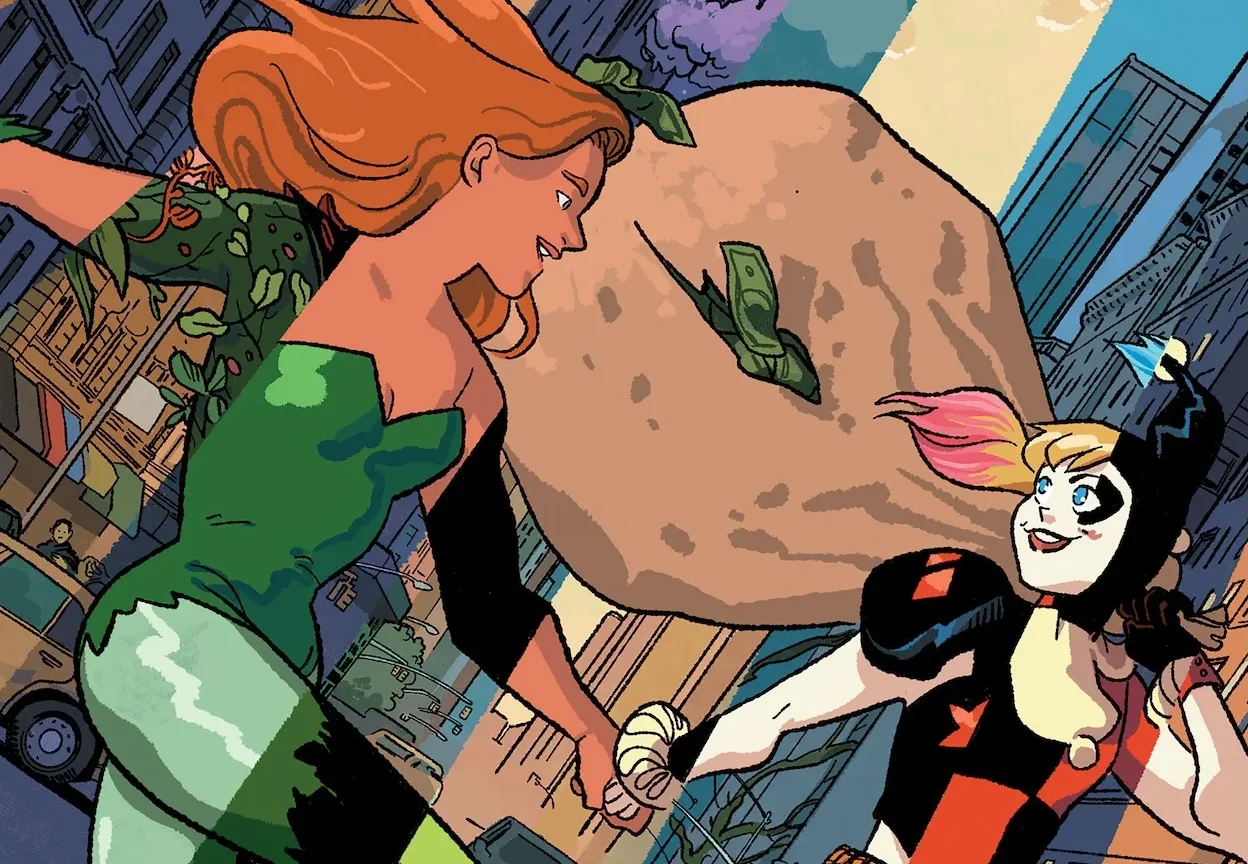

Harley & Ivy: Life & Crimes #1 begins the untold story of one of DC’s most fascinating couples — two villains who’ve each had plenty of solo spotlight (one a bit more than the other, thanks to Suicide Squad movies and a recent video game) but rarely as a pair. Writer/artist Erica Henderson (The Unbeatable Squirrel Girl, Jughead) dives into the messy, magnetic relationship between Harley Quinn and Poison Ivy. From their early clashes to their full-blown romance, this is a story longtime fans have been waiting for.
The relationship between Harley and Ivy has been teased and half-confirmed across animated shows, New 52 runs, and even a few alternate universes. Each time, fans celebrated their chemistry and potential. This book aims to do something more definitive, to crystallize decades of subtext into a solid, canonical document that expands both characters’ antihero mythologies. That seems to be the intent, at least. The result is actually a much more lighthearted affair.
The first issue of this book sets up the narrative framing for the rest of the saga. It kicks in to high gear right away, dropping the reader into a quippy back-and-forth conversation between our eponymous heroines. A mysterious someone is intently pursuing the truth behind how Harley and Ivy “got together”, and the story of how they met isn’t cutting it. They want to know how the two became one, how they became Harley & Ivy. Whoever’s asking seems to exist outside the story itself as their voice breaks past the constraint of speech bubbles, hinting that something larger is shaping this tale.

DC
The script and the art crescendo in sync with a harmony of style that only a writer/artist like this can pull off. When Harley and Ivy cross paths at Ace Chemicals, the Joker inevitably enters the picture, his cruelty contrasting sharply with Ivy’s pointed but principled villainy. In a brutal instant, Ivy sees Harley not as a rival but as someone worth saving. It’s a moment that defines both the “how” and “why” of their bond, and it culminates as the emotional highpoint of the issue.
Visually, this issue is stunning. The strength of the art is on display from the opening pages, where Henderson’s collage-style layouts blend flashbacks with present action, connected by curling vines and poisonous flora that wrap around each page. Three distinct fonts mark three voices, yet the design never feels cluttered. The balance between structural experimentation and narrative clarity is masterful. There is a thoughtful simplicity that underlies the book, a strong mix of structural tools with a pared-down script that lets the art do much of the narrative propulsion.
Color is the most potent element of Henderson’s art. Deep shadows on the Joker’s face (as well as the ones he casts on others) play against the reds of his violence. And, of course, there is a wonderful variety of greens, which is vital: Poison Ivy is one of the most closely color-associated villains in DC that doesn’t have a color in her name.
This run probably won’t reveal anything about Batman, of Gotham, or any other number of Bat-centric villains that are related to these two, though it really doesn’t need to. Still, even with the strength of its art, this book might not have the narrative weight to change how longtime readers see either of these characters or their relationship. At the same time it feels like this book is fine-tuned for those very same readers because it is highlighting a period of time that is of interest due to its previous absence from canon.

DC
All this leaves the book with high and varied expectations, yet Henderson dances deftly around them to create something that feels more intimate than explosive, more personal than performative. This makes for a fantastic reading experience, a reminder that comics are Art with a capital “A” and not just packages for plot and reader expectation.
Harley and Poison Ivy are classic Batman villains with long histories. Rather than teaming up to fight against the Dark Knight in Harley & Ivy: Life & Crimes #1 (at least not yet) they’re fighting against their loneliness, their oppressors, and the parts of society that have twisted them into villains. We’ll see what we learn.




You must be logged in to post a comment.