

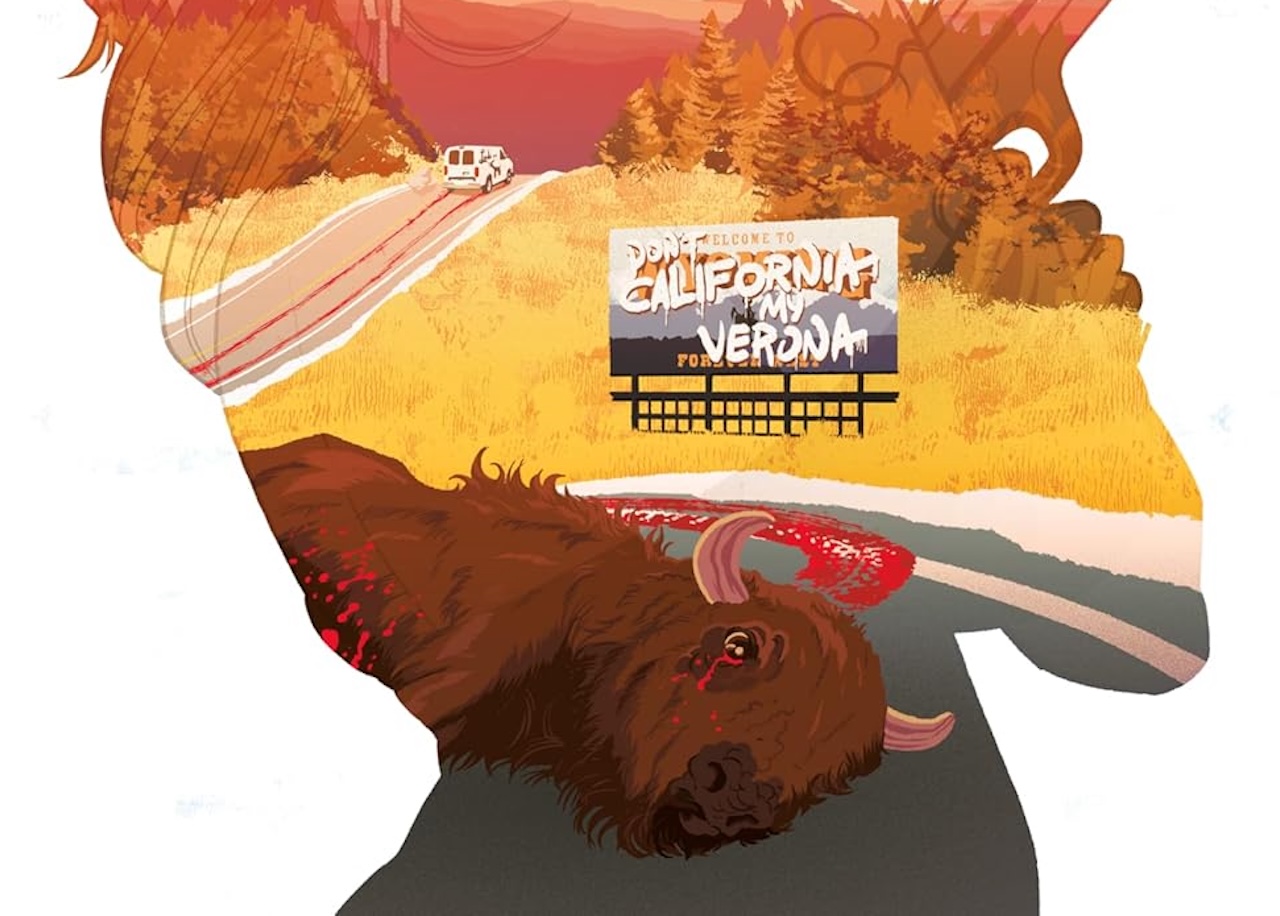

American Caper #1 has been one of those comics that hooks you from all angles. There’s the creative team, which includes Dan Houser (best known for his work on games like Grand Theft Auto and Red Dead Redemption) handling writing duties, and David Lapham (Stray Bullets) on art. There has been a rollout: first, a splashy debut at San Diego Comic-Con, followed by Houser making an appearance at LA Comic Con to discuss the series and other projects he’s working on. Now that American Caper #1 is out, the only question is: Does it live up to the hype?
Set squarely in Verona, Wyoming, American Caper #1 follows two men, William Hamilton and Orson Charmer. The two seem wildly different at first, since Orson has a picture-perfect family while William’s is deeply divided on everything. Orson also looks pretty happy in his job, while William toils away in a law firm, fighting off a gambling addiction. Their paths are set to collide because William’s law firm is engaged in less-than-legal behavior, and Orson is secretly a hitman; both their paths involve a land deal in Verona.
From the start of American Caper, Houser layers his dialogue with the same edge that permeates his video game work. William’s inner monologue reveals a deep self-loathing; he can’t connect to his wife, who’s slowly being radicalized by online chatter, or his son, who’s sinking deeper into a hole of video games and snacks. Even his daughter is separate from him, both physically, as she’s attending college in New York, and ideologically, as she has been attending protests. Houser and his co-writer Lazlow sum up William’s life in a single, cutting piece of dialogue: “We’re a typical American family. We despise each other.”

Dark Horse
I do feel that American Caper #1 could have been a bit more balanced in its exploration of the differences between William and Orson. Orson’s life is only really explored toward the end of the comic, and while the reveal of his murderous side makes for a great cliffhanger, I’d have liked to see more of his personal and “professional” life, as it would make for a better contrast.
One thing that I noticed when reading American Caper #1 is that it’s very visually distinct, courtesy of Lapham. Throughout the issue, you’ll see people in various states of distress; either they’re yelling at each other, yelling at computer screens, or, in the case of William’s wife, yelling as they pull the trigger on an expensive semi-automatic rifle. Chris Anderson’s finishes highlight the weariness in William’s face and the devout, often murderous resolution in Orson’s; to top it all off, Lee Loughridge drenches the scenery in golden sunlight that serves as a sharp contrast to the depravity and crime infesting Verona.
American Caper #1 is a solid start to an irreverent and surprisingly intriguing crime story, mixing dark humor with well-detailed art. It’s also a comic that will probably be an acquired taste; if you liked Houser’s video games, you’ll probably pick this up, but I feel it might take another issue or two for things to really get going.




You must be logged in to post a comment.