

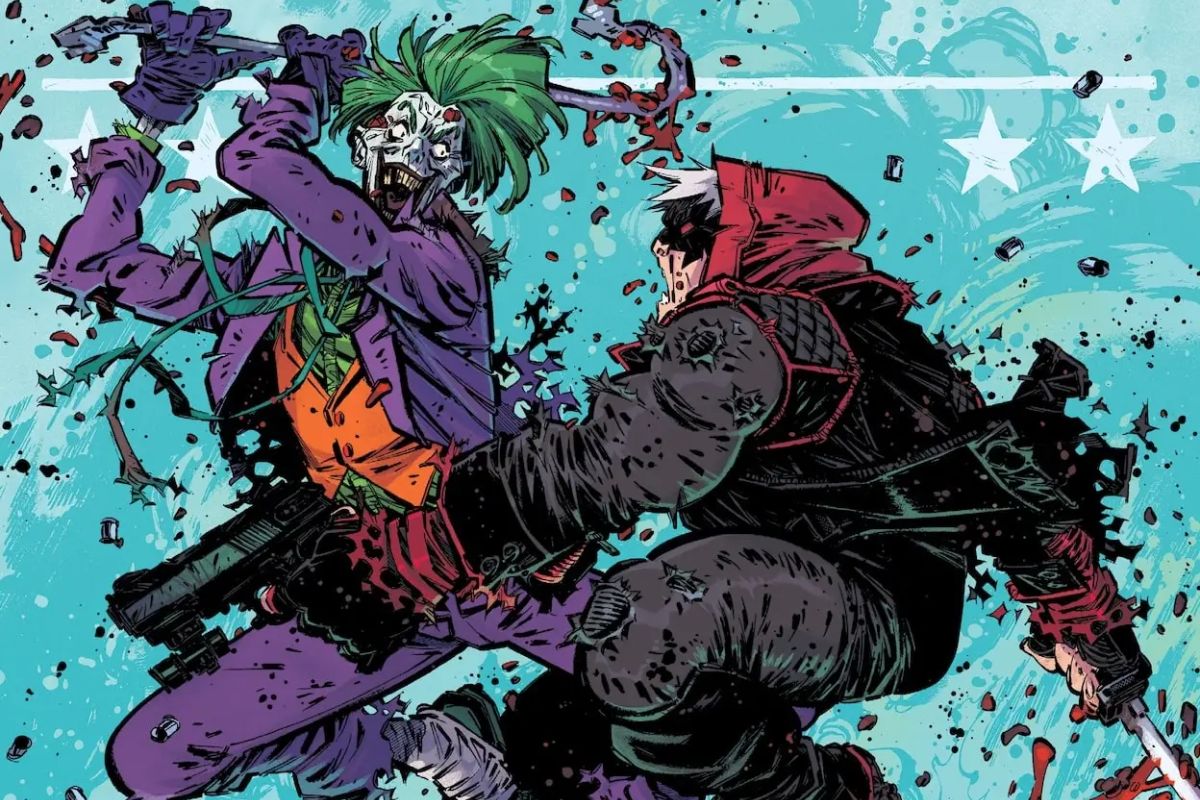

Jason Todd aka Red Hood has faced many rough patches throughout his publication history, with his only consistent thread being the Robin the Joker killed. DC K.O.: Red Hood vs. The Joker #1 acknowledges that fact and decides to tackle it head on within the Heart of Apokolips.
However, writers Scott Snyder and Joshua Williamson don’t have Red Hood relive his traumatic death over and over again until he comes to terms with it. Instead, they have him address that dark chapter of his life on his own violent terms. This is also reflected in which artists are tasked with drawing which battles.
The first battle is drawn by Dustin Nguyen, but it doesn’t recap the Joker’s origin. Instead, it addresses how Jason Todd sees the Joker, and ultimately how he sees himself: as a monster that is beyond redemption, rather than a human worth saving. Visually, this is spotlighted with Nguyen giving Jason the same monstrous appearance as the Joker when he himself falls inside the vat of acid Joker fell into years ago when he himself was the Red Hood.

DC Comics
This clever juxtaposition also organically transitions into the second layer (“round two”) of Jason’s problem with the Joker: how his own death and relationship with Batman impacted his childhood and adult life. Giuseppe Camuncoli takes over pencil duties midway through this sequence, but it’s also the battle that will likely leave readers with mixed feelings, depending on how invested they are in Jason Todd as a character.
By having Jason declare “I held back to not disappoint Batman,” DC K.O. is attempting to restore Jason’s agency so that he’s no longer “the scar” that sent Batman down a dark path to the point of needing Tim Drake as his new Robin. The problem, however, is that Jason never lacked agency in “A Death in the Family” – he was always in control of his own narrative. Additionally, by establishing that Jason “held back” on killing the Joker, DC K.O. is minimizing why his death was so tragic in the first place.
In the original storyline, Jason was a teenage boy looking for his birth mother after learning (via his birth certificate) that the woman he previously thought of as his mother, Catherine Todd, was really his stepmother. Since Bruce had already decided to relieve Jason of his Robin duties due to his impulsivity in the same storyline, Jason didn’t feel he had anything to lose by looking for his still living relative, who turned out to be Dr. Sheila Haywood.

DC Comics
What made Jason’s death emotionally impactful, however, was not Batman failing to save him, but the fact Jason’s birth mother turned out to be a criminal embezzling medical funds. The minute Sheila learned Jason was Robin, she betrayed her own son to the Joker as a way of covering up that embezzlement. More than Batman failed to protect Jason from the Joker, he unknowingly handed him over to his criminal birth mother without looking into her background the moment he learned of her existence.
Batman’s failure is really his own lapse of judgment, but none of this is acknowledged in DC K.O.: Red Hood vs. The Joker. The fact that the story is told entirely from Jason’s point of view, not acknowledging his mother’s betrayal as a significant factor in his death stands out as a really odd choice. It also comes off as a case of erasing a woman from Jason’s storyline, to keep his story centred on his fractured relationship with Batman. In this regard, the retcon is not an improvement on the original story.
The retcon also diminishes how the trauma of parental betrayal leading to his death also informed the person Jason became in the present: the lethal, less forgiving person he describes himself as in the DC K.O. one-shot. Though this battle ends with Jason “triumphing over the Joker,” it’s also a “triumph” that doesn’t truly address why he can’t move past his status as “The Robin Who Died.” It actually reinforces it by centring Jason’s story on the two men who keep defining his place in the main DC canon.
This ironically sees DC K.O.: Red Hood vs. The Joker address the other problem that’s long been plaguing Jason’s place in the DC universe: his lack of an actual identity as a character outside of Batman, the Joker and Robin. This is further spotlighted by the decision to repurpose the meaning of the “Red Hood.” Instead of being the identity the Joker used before he fell into the vat of acid that made him what he is, DC K.O.: Red Hood vs. The Joker retcons the “Red Hood” as a Gotham urban legend kids who grew up in bad neighborhoods heard about, similar to other bogeymen.

DC Comics
While the intention is once more to emancipate Jason from his status as “The Robin Who Died” and “The Joker’s Biggest Triumph” and “Batman’s Greatest Failure,” it, once more, doesn’t address the actual problem. Getting Jason to a place where he can meaningfully move on from his troubled publication history begins by embracing how that original history happened. Originally, Jason Todd was conceptually a Dick Grayson clone prior to Crisis on Infinite Earths. After Crisis, however, his reworked origin gave him a much stronger blueprint to forge a new path with: being the kid who grew up on the streets.
If DC wants to truly give Jason the fresh start he desperately needs away from his now tired status quo, creators and editors need to begin with what’s already there instead of revising canon for the billionth time as a means of artificially creating that fresh start. It’s already been long-established that canon revision doesn’t fix any of the problems with past creative decisions – it just further muddies the well, and makes DC’s characters harder to follow.
While it’s unknown what will become of Jason with his new Red Hood series cancelled and Batman: Hush 2 yet to conclude, one strong starting point for getting Jason to move forward as a character would be to further flesh out who he was before Batman. Jeff Lemire and Dustin Nguyen already did some work on this front with Robin & Batman: Jason Todd. DC just needs to keep exploring this unknown past, especially if the publisher wants to capitalize on the idea of Jason no longer wanting to be defined by his ties to Batman and the Joker.




You must be logged in to post a comment.