

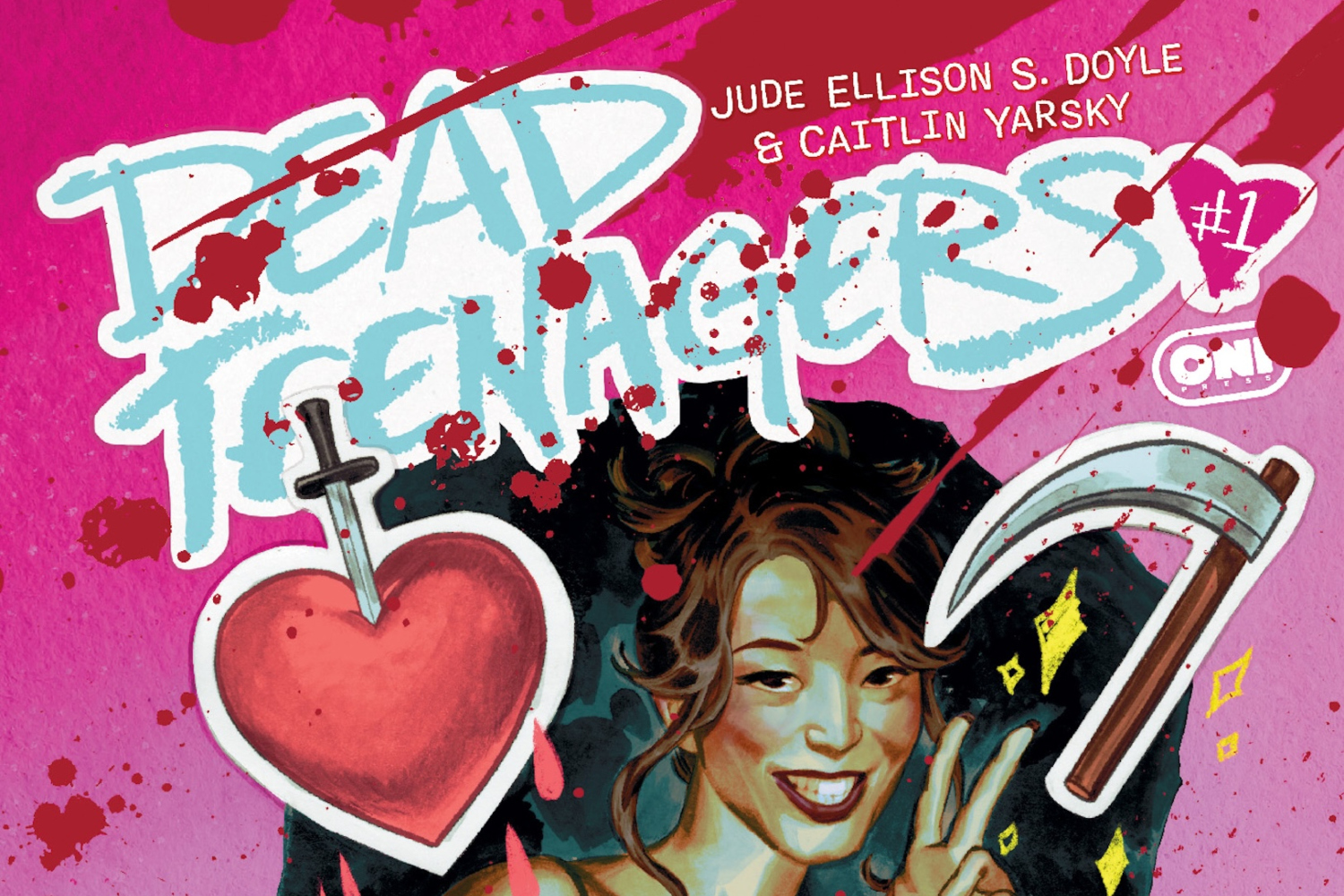

Being a teenager may suck, but eventually it’s over.
Well, it’s over for most of us, anyways.
In Dead Teenagers (from writer Jude Ellison S. Doyle and artist Caitlin Yarksy), we meet a group of friends (Alicia, J.T., Ryder, and Brandy) as they celebrate their prom in circa spring 1997. But where you and I only had to endeavor, say, bad punch and terrible, terrible dancing for one night, this group is stuck in a hellish time loop where basically everyone dies. After spending a few thousand loops dying in “new and increasingly insane ways,” the group suddenly discover that something is “about to break the cycle.” However, it’s not all good news, as “what they find on the other side will be the most disturbing revelation of all.”
Press for Dead Teenagers calls it a “brutal, genre-distorting ode to the generation that gave us Scream and Buffy the Vampire Slayer.” And while most of us have never gone full Bill Murray in a time loop, the book uses extra gory horror to explore ideas of maturity and young adulthood, growing pains, group dynamics and friendships, and perhaps the most truly terrifying lesson of all, living a life you didn’t see coming as a youngster. It’s a total horror show, for sure, but maybe you’ll also learn that adolescence wasn’t half bad. I mean, aside from all the leg pains and weird acne formations, of course.
Dead Teenagers #1 debuts on March 18. (Initial orders start next week, with the FOC set for Monday, February 23.) In the meantime, we managed to catch up with both Doyle and Yarsky via email to talk all things Dead Teenagers. That includes the story’s horror inspirations, their interest in time loops/time travel, the group’s various personalities (and how that informs the larger story), and even some of their favorite “loops,” among other topics and tidbits.

Main cover by Naomi Franquiz. Courtesy of Oni Press.
AIPT: Where did the original idea for Dead Teenagers come from?
Jude Ellison S. Doyle: “Dead Teenager Movies” is what Roger Ebert used to call slasher movies. He meant it in a derogatory way — that these movies are just endless, repetitive narratives about throwing teenagers into the wood chipper. Unlike Roger Ebert, I actually love those stories, and I tend to get strangely invested in the characters: Like, in Jason Takes Manhattan, there’s this one heavy-metal chick who goes down to the ship’s engine room to play an epic guitar solo and is killed mid-solo by Jason. Who is this woman? What does she do when Jason isn’t around? How would her life have turned out if she’d gotten to finish that guitar solo? I had this idea of a high-school reunion for slasher-victim teens, where they all hung out and reminisced about the most humiliating ways they’d been killed as teenagers. That idea gradually unfolded into the story here.
AIPT, let’s call this next one a two-parter:
- Given that the kids are stuck in a looping ’90s hellscape, I couldn’t escape the notion that this book’s a commentary on rampant nostalgia. How close am I thematically?
- Further regarding the time loop, I also kept thinking that this book could be about being stuck between childhood and adulthood, and how being a teen is as oddly boring as it is deeply scary. Does that ring true at all?
JESD: You’re dead on about the nostalgia. As a culture, we tend to fixate on youth — especially the teen years — as the most magical, special, “best” era of a person’s life, and to fear aging and growing up. People often get stuck on the pop culture they loved as kids. I definitely do. It connects us to that “better” time, when we had all our choices ahead of us, and the world seemed less complicated and threatening.
The thing is, though, being a teenager is usually awful. Cruelty and violence are part of everybody’s growing up. Young women and teens experience sexual assault at higher rates than adults do. Homophobia and transphobia are rampant and deadly forces in the American high school. Not having control, being at the mercy of adults who may or may not have your best interests in mind, is scary. The world wasn’t any less complicated back then, you just didn’t know as much, and you may not have had words for what you were experiencing.

Courtesy of Oni Press.
It’s pretty common for elder millennials like me to look back at our teen years, and even at the pop culture we loved, and realize that there was an incredible amount of violence and badness that we weren’t seeing — your favorite creator was a huge creep behind the scenes, or bigotry that was totally normalized at the time now seems inexcusable, or stuff that the world told you was “no big deal” was actually really gross and scary. Dead Teenagers at its core is about that — about looking back at your teen years, and realizing that all the “fun,” “normal” violence you took for granted was never as fun or as normal as you thought.
AIPT: Do you have a favorite/favored member of the group? And why does that person resonate for you?
JESD: I love all of them. I love Ryder because he’s a genuinely sweet dude, which is a relief for me after writing several irredeemable creeps in a row. I love Brandy because she allows me to channel my most annoying tendencies — she’s written from that place where you’ve had one drink too many and you think you’re being super fun and everyone else is just strategizing how to get rid of you. There’s a character we haven’t met yet that might be my favorite — I started writing lines for her and she gradually took over the whole book, to the point that I had to get special permission from the editor to un-kill her. She just came in with a strong point of view and decided that this was her book now, and I respect that. And I love CeCe, the girl we see crying in the bathroom at the beginning of the first issue, because she has hidden depths.
Caitlin Yarksy: I don’t have a favorite, but each one feels like a person I was at one time or another. A time when I was trying to figure myself out. Ryder is someone I totally get – wanting to help when you see injustice, but learning it can be self-serving and counterproductive if done the wrong way. Many of us have had a Brandy phase, avoiding real feelings and real pain, only to exacerbate it in the end.

Courtesy of Oni Press.
AIPT: I’ve been on a time loop movie kick as of late (Palm Springs, Timecrimes, Triangle, etc.), so this book really hit the spot. Why is that “trope” still so effective or interesting to utilize?
JESD: It’s an interesting question! I think for writers, it’s fun because you can go as weird as you want, and there are no consequences. You don’t necessarily predict, when Groundhog Day starts, that Bill Murray is going to commit suicide by letting a groundhog drive him off a cliff (I think?) but he does, and then you just jump right back to the real story. As for why they’re fun to watch or to read, again, I think it’s that they’re stories about consequences — about what happens as the result of every little decision you make throughout the day. The desire to go back and revisit your decisions and know what would have happened if you’d chosen differently is so profoundly human.
CY: 100% to that last point, Jude! We spend so much time either in the past (“what could I have done differently?”) or in the future (“what if the worst case scenario happens?”) that it’s cathartic and fun to see it play out in a campy horror setting. At the end of the day, we all want to be more present. But it’s tough getting (and staying) there.
AIPT: We start this whole story at/near a much later loop. Why opt to jump in so “far” into their journey, and not just show it all from the beginning?
JESD: I wanted them to feel deeply familiar, like a team you’re used to seeing together. I read X-Men comics, particularly Generation X, as a teenager, and by the time I dropped in, everybody always knew each other. I started watching Buffy halfway through, too. There’s something very comforting about not having to be introduced. It makes the relationships feel permanent, like features of the landscape. I wanted you to get the sense that the time loops are just their world, and everybody has their own little role and pattern, so that when that pattern is knocked off-kilter, it comes as a shock.

Courtesy of Oni Press.
AIPT: As a ’90s-based horror story, this book has a cornucopia of influences and comparisons. Was there any one book, show, film, etc. that best inspired Dead Teenagers, and why was that property so influential?
JESD: I have a Letterboxd list of about 38 movies that get referenced either directly or indirectly over the course of this series. I sent it to Caitlin [and] Sierra Hahn and Allyson Gronowitz (our editors), and it just kept growing. But Generation X and Buffy were both really formative. So was Final Destination, and the idea of death as a slapstick-comedy-loving villain who always finds a way to trip you up. I also owe a lot to many subpar ‘90s and even ‘80s slashers — stuff like Urban Legend or I Still Know What You Did Last Summer, where Jennifer Love Hewitt is almost murdered by someone putting a zip tie on her tanning bed.
All her friends are gathered around the fatal tanning bed, looking at the zip tie and screaming at the top of their lungs, and they’re trying to rescue Jennifer by hitting the tanning bed with fists and random objects, and not one of them is smart enough to think about running out and getting a pair of scissors, and I think it’s one of the two or three funniest scenes ever filmed. That scene is really what Dead Teenagers is all about.
AIPT: How much do you tap into your own teenage experiences (I hope there were no time loops) versus trying to be more “vague” and universal? Is there a sweet spot?
JESD: I actually didn’t get to go to high school — I was home-schooled for those years, which is why I developed such a fixation on teen movies. It felt like an amazing experience that I never got to have. Eventually I realized that everyone else also had a terrible time being a teenager, and that the reality was a lot less glamorous than the movies. So I did try to draw from my own experiences, or my friends’ experiences, but I filtered it through the genre lens — I tried to make them real teenagers living in a teen-movie universe.
AIPT: Is there a loop you wish you’d been able to depict? Maybe one where giant sea monkeys take over or where we’re all mentally enslaved by Kelsey Grammer?
JESD: There are a lot of universes we only see for one panel. One is just “mannequins.” Why mannequins? How did they get there? What are they doing? What makes the mannequins a threat? Couldn’t you just run, or indeed, walk away from them? These are the sorts of questions I don’t have to answer, but I encourage you to come up with more in your free time.

Courtesy of Oni Press.
AIPT: I want to see if we can dance around issue #1’s ending, because it’s super-duper interesting. What can you tell us (without revealing too much, of course) about what this does to alter and/or inform the scope of the remaining story?
JESD: I think the important thing about issue #1’s ending is that there are now consequences to what happens inside the loops. The mechanism is slightly broken somehow: People can die in one loop and not come back in the next. The order of deaths isn’t exactly the same every time. Instead of being stuck in a world where none of their choices matter — which is what adolescence can feel like a lot of the time — they now occupy a reality where every choice matters, for better or worse. That’s just growing up.
AIPT: Similarly, are there any other tidbits/wild scenarios that we can expect from the rest of the story
JESD: : Prepare for the rise of HALLBOT. Also, Brandy goes to space.
AIPT: Is there anything else you want to tell us about Dead Teenagers, time loops, adolescence, high school, etc.?
JESD: I would like to tell you that the tanning-bed scene from I Still Know What You Did Last Summer is available online, in high definition, here.
Also, here’s that guitar solo.



You must be logged in to post a comment.