


Let me read your mind:
“White Sky is basically The Road/The Last of Us/etc.”
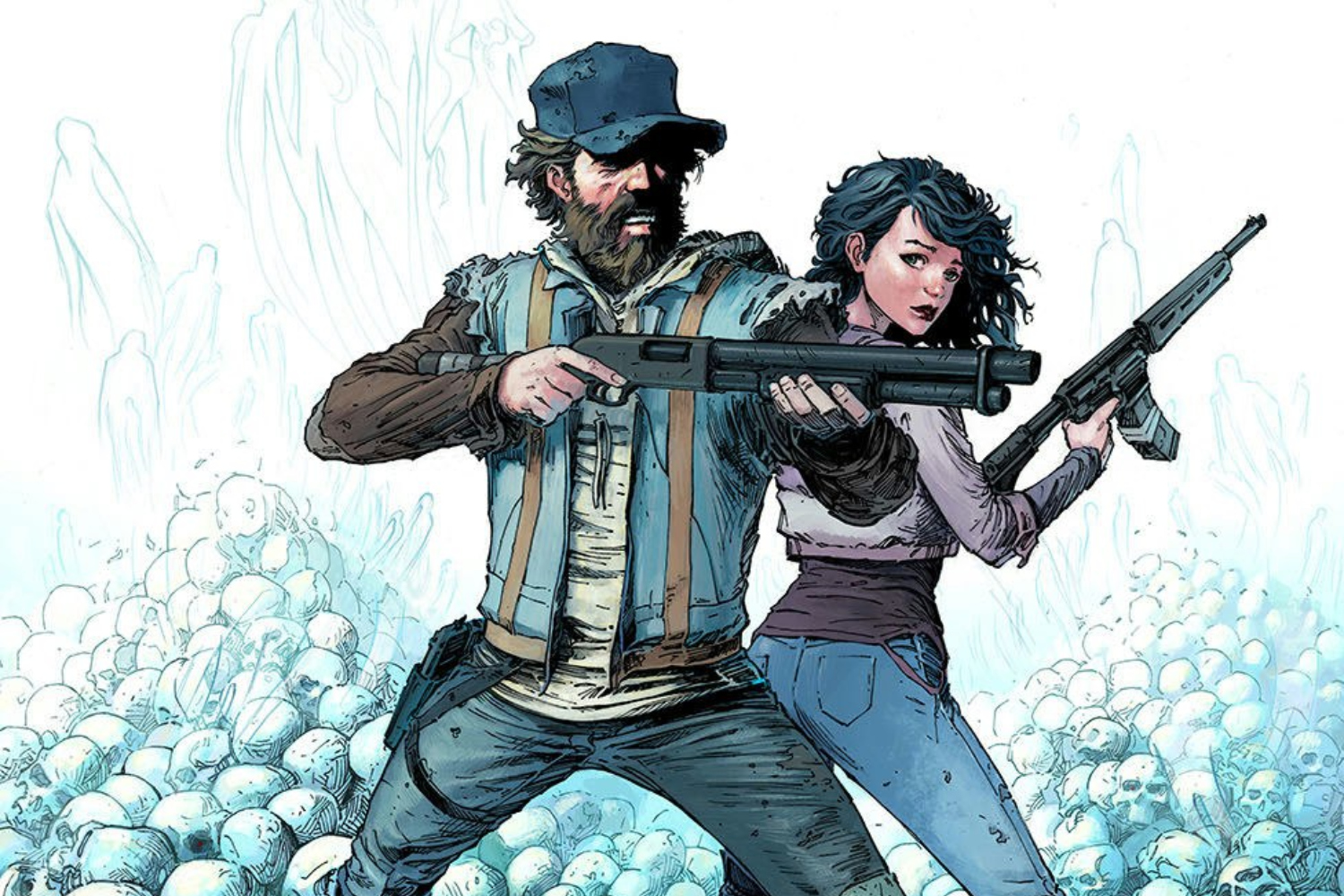
Which, hey, who am I to tell you that you’re wrong? In a world where the sky is sleet white, and ghosts pretty much run amok like infinitely more effective zombies, the tale of a father and daughter (David and Violet) trying to survive should be deeply familiar. But that also diminishes the work of the creators (writer William Harms and artist Jean-Paul Mavinga), who manage to both lean into those connections and still meaningfully innovate to make White Sky feel interesting (at least during its debut).

Variant cover by Eliza Ivanova. Courtesy of Image Comics.
Now, when I say “leaning in,” what I mean is a kind of recognition that they’re clearly working in a framework, and you have to live with that the best you can. Harms’ script does that really well: Tapping into his experiences in writing video games like Mafia III, Harms plays up certain tropes (the father-daughter bond, the unavoidable threat of “monsters,” the harrowing face of the world) to further develop a kind of language. It’s something most us already speak, and by extending that “tongue,” White Sky gets to bypass some of the world-building (that could easily return as the story develops) and get right into what matters most.
And that’s the bond between David and Violet. In past instances of stories I’m calling “family life at the world’s end,” the father figure always seemed to watch over the child. And while that’s true here, David and Violet have a chance early on in White Sky‘s debut to feel a touch different. Their conversation portrays a little more equality, or at the very least, an admission that they’re both underwater and need each other to flourish. That, in turn, makes Violet feel altogether more significant — she’s not just some dumb kid flailing across the story, but someone who has a pretty solid lay of the land. It’s a small enough choice, certainly, but it means the two share the emotional burden a little more, and we get to see a more textured family dynamic play out.

Courtesy of Image Comics.
I’d also say that the tone of White Sky feels a little different than some of its “predecessors.” Obviously stories in this “tradition” are pretty darn scary and depressive, but I’d point to issue #1’s ending as expertly typifying the sense of odds and overall feel of this book. It’s unsettling as heck so early on, and by not being somehow “earned” as to happen later in the story, and also by not being tampered with something “safe,” we’re meant to feel the weight of this like a shovel to the jaw. And that’s what we need: In a world dominated by the dead, life is truly, truly rare, and these people live with that knowledge in their perpetually itchy trigger fingers.
Still, it’s the art where I think things feel the most novel (and still “respect” the confines that White Sky is inevitably tied to). Mavinga (alongside colorist Lee Loughridge) has such a great approach to this world. The endless white and snowy effects add a kind of quiet beauty, which feels in stark contrast to the harsh, often ugly tones of similar end-of-the-world scenarios.

Courtesy of Image Comics.
From there, the character design is similarly charming; there’s a kind of handsome ruggedness to David as well as a quiet grace to Violet that almost makes you think you’re in a fairy tale. I mean, the most depressive fairy tale ever, but that offers the infusion of a different story traditions outright, and that’s only going to help White Sky‘s chances. Even the ghosts here feel different, equal parts Tolkien monstrosity and plague straight from hell. And that mixture is even more novel energy for a book that needs it, and also expertly hints at lore of this world without spoiling anything so far.
Even just the size and scope of this world feels interesting. With Violent and David seemingly the only people out in the world of White Sky, everything feels expansive (but without mitigating the proximity that comes with a good ghost story). All that room means movement and space to grapple with, and by letting the duo operate in different ways across this decidedly larger world, it feels like they’re both alone and outmatched and still have just enough space to maneuver. It’s a way for the book to play with our sensibilities and expectations, and to push and pull us in a way that feel exciting as much as it’s very much terrifying. It’s a big, wide world, and there’s hope and horror in equal measure.

Courtesy of Image Comics.
Despite all my praise, there’s still one element of White Sky #1 I was unsure of by the final page turn. Without spoiling too much, Violet is assisted at one point by an unseen voice. Is that a ghost or another supernatural presence? Does it mean she really is special/unique in the world of White Sky? Part of me likes this angle for how novel it could be, and yet a slightly larger part of me worries it’ll take away from what’s so good about this book. And that is that sense of struggle — between life and death, duh, but also this book’s battle between its own familiarity and its desire to stand out. It’s my fear that too many “gimmicks” might throw off the formula, and that the book will get pushed too far into one narrative direction.
But for now, my only real thought is the one I hope you’ll share: “White Sky is off to a solid start, and whether it’s familiar or not, it has the real potential to haunt us in a major way.”




You must be logged in to post a comment.