

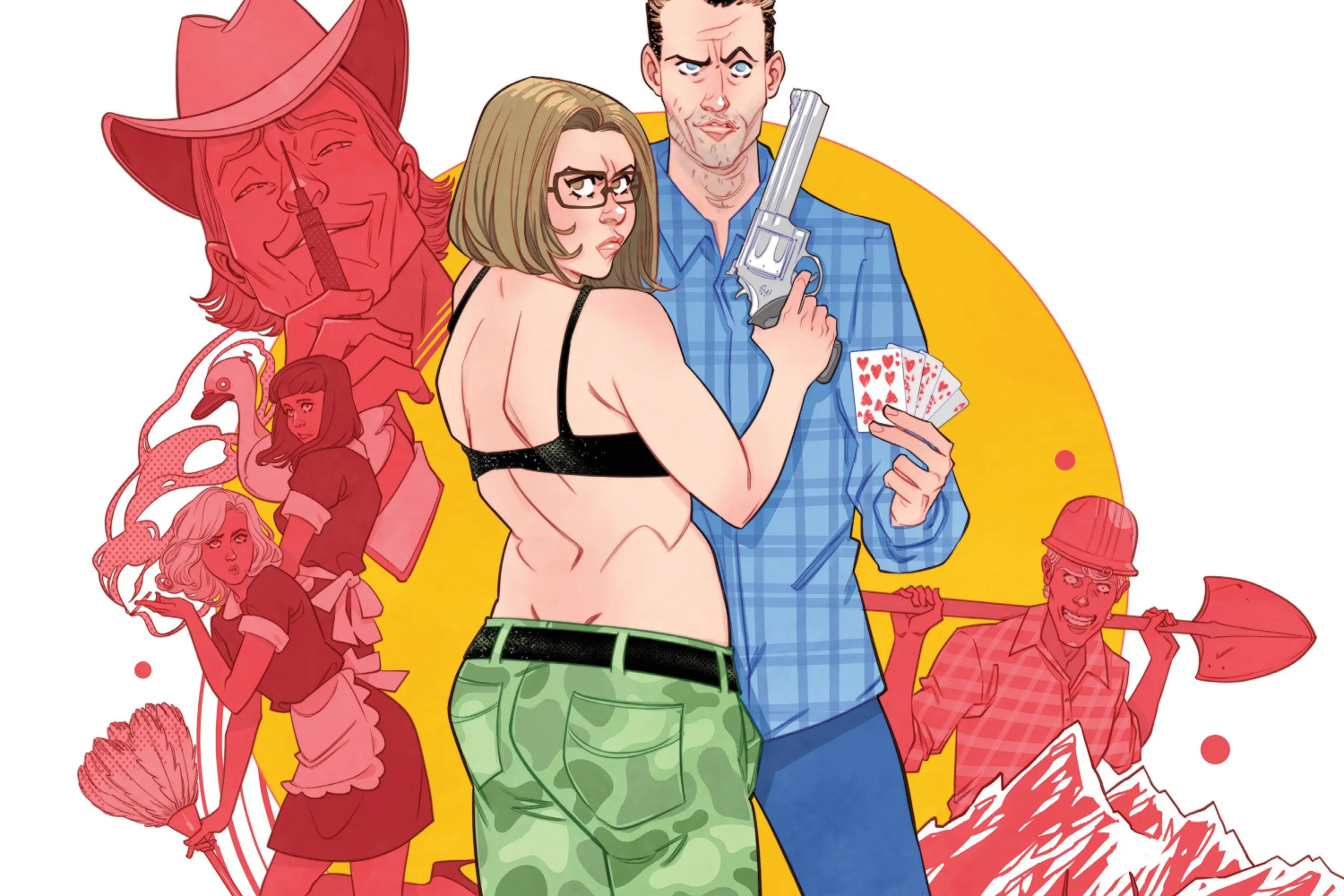

There is something gleefully poisonous about American Caper.
It is the amalgamation of a crime comic, an extra-sharp political satire, a small-town pressure cooker, and a sprawling ensemble piece where nearly everyone seems compromised, deluded, or one bad day away from disaster. The series, created by Dan Houser, has already made a strong impression thanks to its blend of warped humor, cruelty, and sharply observed social rot. Reading through the first five issues, it is hard not to feel like the book is trying to offend everyone and no one at the same time, all while turning Verona, Wyoming, into a place where every bad instinct in modern America has been given room to breathe.
When I spoke with some of the team (producer-writer Lazlow, editor Shelly Bond, and finisher Chris Anderson), what became clear very quickly was just how intentional that chaos is meant to feel. For all the book’s bloodshed, absurdity, and grotesque comedy, American Caper is the result of a team that talks constantly, shapes every page together, and seems united by a desire to make something that feels as ugly, hilarious, and unnervingly familiar as the world around us.
For Lazlow, the roots of the book go back to his long collaboration with Houser. He described the two of them as having spent decades working in satire, often tied to “a specific place and time,” especially in video games like Red Dead Redemption and Grand Theft Auto. Even when those projects were set in the 1980s or the Old West, the surrounding details always reflected the actual time period. That instinct carried naturally into American Caper, though this time the format was always meant to be comics.
“The conversation was never about making a game,” Lazlow said. “This was just purely let’s build a world and tell stories in comic book form.”

Courtesy of Dark Horse.
The seed of that world, he explained, came from one especially sharp image. Houser had “this idea about a Mormon hitman that lives in Wyoming,” and from there the cast began spilling out all around him. The result is a series that juggles two neighboring families on the verge of collapse, a cowboy-playing billionaire, escaped fugitives, cartels, real estate schemes, political paranoia, and a community where nearly every person seems to be inventing a fantasy version of themselves just to survive the day.
Bond knew quickly that the material was for her. She laughed that the team “really had me at the absurd caper,” calling it “the best crime fiction subset you can have because it’s hilarious.” Still, what hooked her was not just the book’s social ugliness or moral chaos, but its willingness to embrace black comedy as a defining mode.
“The black humor in this book is unlike anything I’ve read,” Bond said, adding that had she still been at Vertigo, American Caper would have fit perfectly alongside the kinds of books she once championed.
That same sense of difference extends to the visuals. I mentioned to the group that Anderson’s finishes give the comic a look and feel unlike almost anything currently on stands. I likened it to Robert Crumb, and Anderson admitted he often hears comparisons to wildly different legends depending on who is talking. Still, he clearly understands the role he is playing here. David Lapham, who pencils the series, brings what Anderson called “great storytelling” and has “perfected it.” Anderson sees his own role less as directly inking those pages and more as adding “this skin over the top of his storytelling.”

Courtesy of Dark Horse.
That distinction matters, truly. Anderson said much of his prior work has leaned into horror and sci-fi, genres that demand atmosphere, unease, and sometimes a bizarre sense of fun. That experience helped him find the tone of American Caper, where silliness and disgust often occupy the same panel.
“I try to, in certain spots where it’s called for, bring a little bit of silliness to the line work,” Anderson said. “And where it needs to be, like, really hyper-violent and gross, I add the extra detail and textures to that.”
That tension between cartooning and carnage is a big part of why the comic simply works. It also helps that the series has no shortage of characters who threaten to steal the spotlight. Marty Blowman, the HGH-swigging millionaire turned cowboy, is one such example.
Lazlow admitted he could “write dialogue for Marty Blowman all day long” because he is “completely ridiculous.” But the trick, he said, is resisting the temptation to overplay the loudest characters simply because they are fun. That is where Bond comes in.
“Shelley has been fantastic in sort of guiding Dan and I,” Lazlow said, with Bond dutifully making sure that the larger ensemble stays balanced at all times.

Courtesy of Dark Horse.
That balance also matters because American Caper is built like a web. Characters introduced in one context reappear later in another. Background figures turn out to be quite central to the story. One bad choice spirals into consequences for people who do not even know each other yet.
I mentioned during the interview that the book’s morally gray cast and interconnected crimes reminded me at times of 100 Bullets, and Bond was quick to take that as a major compliment, calling it “good company to be in.” But she was also candid about what that kind of storytelling requires behind the scenes.
“You really need to define the rules of the game before you break them,” Bond said. Communication, she stressed, is absolutely everything.
Lazlow echoed that same point, giving a lot of credit to Bond and assistant editor Jesse Cortez for building a “bible” and detailed timelines to keep the entire structure intact.
“There’s so many things that cross over and people that cross over,” Lazlow said.
The team spent a lot of time in early discussions figuring out the continuity of specific events, bodies found, flashbacks, and discoveries so that the book would not later trap itself. The only way a comic this expertly tangled works, he suggested, is if everyone is constantly talking and everyone is willing to contribute.
“It’s not just something’s made and it’s handed off like an assembly line,” Lazlow said. “Everybody’s pitching in.”

Courtesy of Dark Horse.
Bond clearly thrives in that collaborative mode. She described herself as the sort of editor who is always “in the weeds with the team,” keeping an eye not only on deadlines but also on rhythm, repetition, and variation. As Bonded added, “You don’t want anything to be arbitrary, and you want to watch the repetition.”
For her, the editor’s role is not simply to supervise, but to help ensure everyone is doing their best work and that the comic stays visually and structurally dynamic from issue to issue. She pointed to Lapham in particular as “the master of pacing,” suggesting the whole team has learned from watching how he controls a page.
One of the best examples of that collaborative spirit comes through in the fake ads scattered through the series, full-page joke pieces that feel like they have been ripped from the book’s world. They deepen the setting, mock consumer culture, and often work as little side stories of their own. Lazlow said the impulse behind them was second nature. He and Houser have long enjoyed making “fake radio commercials” and other satirical ads in Grand Theft Auto, and he sees them as part of world-building.
“There’s nothing that cements a place like the advertising,” Lazlow said.

Courtesy of Dark Horse.
Anderson agreed, arguing that all ads are a form of storytelling. In American Caper, the fake ads serve that purpose twice over. They sell a ridiculous product or location while also filling out the world of Verona and its surroundings. Because Anderson got to lay some of them out himself, they also gave him room to stretch into a slightly different visual register.
“It’s not extra work,” Anderson said. “It’s still part of telling the story.”
That extra space for tone and texture shows up throughout the comic, especially in issue #5, which Bond and the team repeatedly returned to during the conversation. She described it as a sort of “female issue,” one that strips back several of the book’s women and reveals what is under the surface. Eva, in particular, comes into focus there in a much bigger way, with Bond promising that readers would understand why she considers the character such a force.
“I think Eva will give Furiosa a run for her money,” Bond said.
Issue #5 also contains one of Anderson’s favorite pages in the run, though the reason is as filthy as it is funny. He lit up describing the very first page, where Lapham stages a lawnmower approaching a huge pile of dog feces.
“You just know what’s going to happen,” Anderson said, adding that he was delighted by the inevitability of it. He also admitted that he got to spend “some quality time texturing some dog feces,” which says as much about American Caper as any elevator pitch ever could.

Courtesy of Dark Horse.
That willingness to go disgusting rather than glamorous came up more than once.
Late in the conversation, Lazlow recalled a long team email thread devoted to deciding exactly how low a flamboyant cowboy billionaire’s aging scrotum should hang on the page. Bond jokingly dubbed “geriatric scrotum” the phrase of the month, while also making a more serious point: one of the reasons she wanted to be involved was how willing the creators were to focus on male nudity and male absurdity in a medium that has historically had plenty of female T&A presented. She said she was impressed by how Houser and Lazlow handled female characters, and that the book’s women ultimately helped seal the deal for her as editor.
As funny as the conversation often became, the team was equally thoughtful when discussing what American Caper is really satirizing at its core. Lazlow pushed back on the idea that it is merely a political comic, even though it regularly jabs at both left and right. To him, the bigger subject is social misery.
“It’s more of a commentary on how miserable we’ve become,” Lazlow said, pointing to the internet, social media, the endless churn of information, and the inability to know what is real anymore.
That is why Arabella, the daughter at an ultra-liberal college in Brooklyn, is meant to be “just as extreme and ridiculous” as Marnie, her conspiracy-soaked mother back in Wyoming. Nobody gets out clean.
“Make fun of everybody with equal enthusiasm,” as Lazlow explained it, is effectively the book’s operating principle.

Courtesy of Dark Horse.
That theme of delusion also runs through one of the book’s more surprising characters, Brian, the son buried in games and fantasy. When Bond asked what I made of him, I pointed to the novelty of seeing a character who enacts his hero fantasies through gaming rather than through real-life acts. Lazlow tied Brian back into the larger pattern immediately.
“There’s a lot of people wanting to be a hero and feel like they’re doing the right thing,” he said. Brian has games. William has gambling and lust. Marnie has militia fantasies and online conspiracies. Marty has cowboy cosplay. Orson, the Mormon hitman, has religion and righteousness. Everybody is lost in some version of a self-serving fantasy.
The physical world of Verona is what makes those fantasies collide altogether more effectively. Lazlow spoke from experience about the mountain towns of Wyoming, Montana, and Idaho, where gorgeous landscapes coexist with outsider wealth, local resentment, and all manner of extreme personalities. He wanted the town to feel like “one of the most beautiful places on earth with some of the worst people.”
That contradiction, the beauty of the landscape and the ugliness of the people trying to exploit it, sits at the heart of the series.

Courtesy of Dark Horse.
And yet, for all the grotesqueness, the strongest impression left by the interview might have been just how much everyone involved enjoys making this thing together.
Lazlow described pages being touched over and over by the team, with ideas, tweaks, comments, and even redraws continuing far into production. Bond framed the entire experience as a rare pleasure, saying it had been “a tremendous experience” and “an absolute blast” to freelance edit a monthly like this. Anderson, for his part, seemed energized by how often the project asks him to move outside his comfort zone.
When I asked near the end who they would trust most if they were forced to survive a week in Verona, the answers only reinforced how warped this book’s sensibility really is to its very core.
Lazlow, drawing on his Oklahoma roots, chose Marnie, believing he could probably get into her good graces by parroting militia nonsense. Bond went with Carter Evans, the FBI agent, trusting him as a fish-out-of-water lawman type while wanting nothing to do with his constantly eating partner. Meanwhile, Anderson was less optimistic: “I don’t trust anybody,” he said, noting that he had effectively drawn himself getting steamrolled in one of the montage scenes.

Courtesy of Dark Horse.
That might be the best summary of American Caper available. Nobody is safe, nobody is entirely right, and everyone is dragging some private absurdity into public view. The comic is vicious, funny, ugly, and meticulously made. As I told the team at the very end of our conversation, for someone reading dozens and dozens of comics every week, “there isn’t anything else like it on the stands.” Bond quickly called that “the best compliment you can give a comics team in the 21st century.”
She is right. In a marketplace full of polished sameness, American Caper feels like a real live wire.
For more from each creator, check out their websites!
- Chris: https://powerpulpcomics.com/
- Shelly: offregisterpress.com & filfthandgrammer.com
- Lazlow at Absurdaverse: absurdventures.com
American Caper #6 is out this week (April 22) via Dark Horse.



You must be logged in to post a comment.