

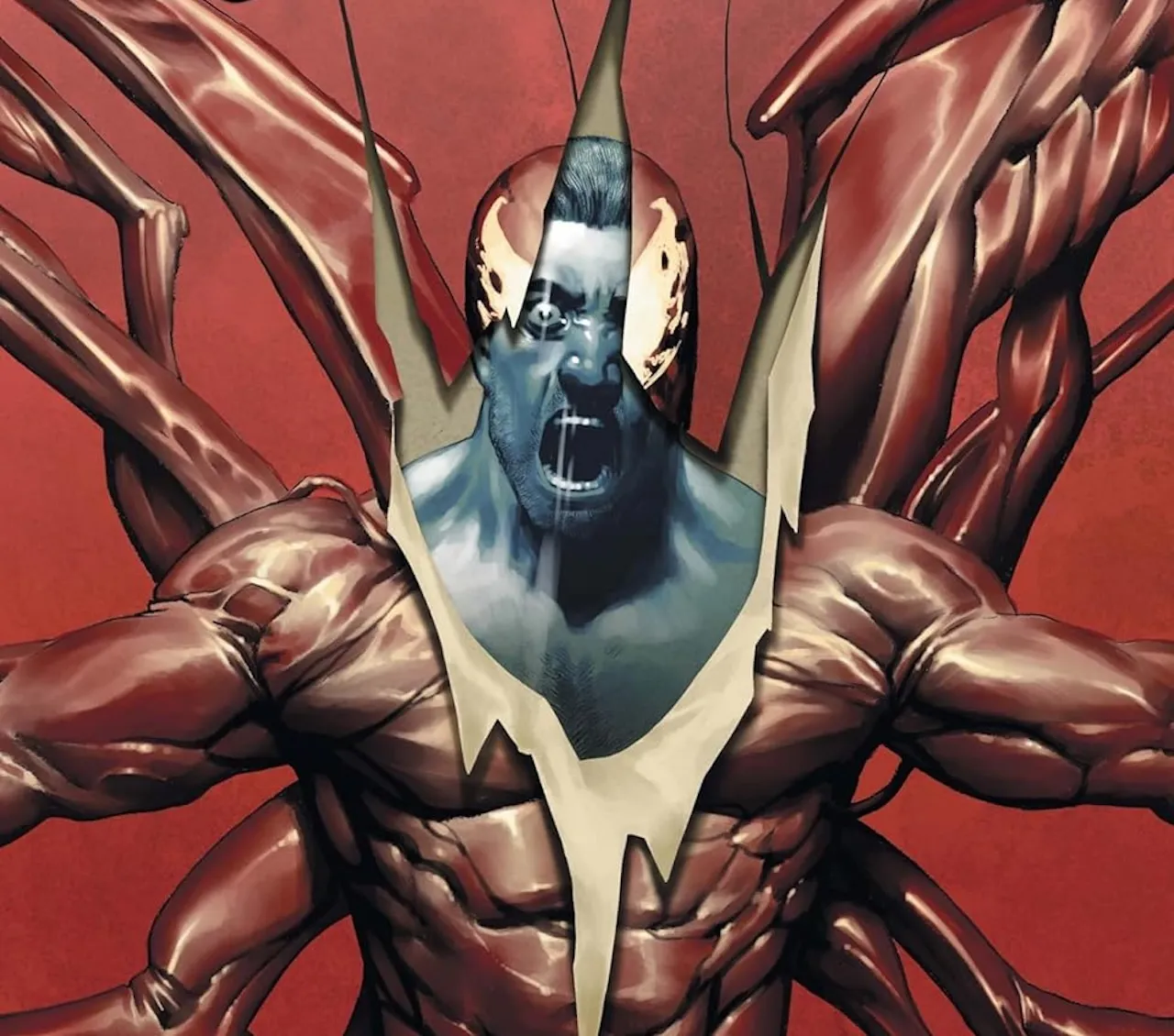

The first volume of Eddie Brock: Carnage was a huge surprise to me. As someone who can get a little eye-rolly at Marvel’s constant Symbiote merry-go-round, I wasn’t expecting much from putting Eddie into his symbiote spawn, but the Charles Soule and Jesus Saiz series was a surprisingly mature look at the ramifications of Eddie’s long life as an unwilling symbiote expert, and the constant back and forth between Eddie and the Carnage symbiote made for a surprisingly fun and dark buddy cop vibe. As the two travelled the world taking on the worst of the worst, they eventually ran afoul of Muse, the deranged super-powered serial killer. While the first volume left Eddie and Carnage’s relationship at a stalemate, the focus on the interior conflict between the two made the series extremely engaging for me, and that thread line is only strengthened in The Killing Muse, the second and final volume from Charles Soule and artists Jesus Saiz and Juanan Ramirez.
As Eddie Brock and the Carnage symbiote continue their odd couple routine, the serial killer Muse is on the hunt for revenge over the two destroying his studio. Troubled by mysterious visions, Eddie and Carnage travel to Spokane, Washington to confront a mysterious woman who may have the key to Eddie stopping the Carnage symbiote once and for all. Naturally, the crimson colored pile of goo doesn’t want that to happen, and the two continue their strange dance of the mind on their way to Washington, unaware that Muse has been more than successful tracking them to their destination. It all leads to confrontation that will determine the future of Eddie and Carnage’s relationship.

Marvel
One of the key features of Eddie Brock: Carnage isn’t the gruesome killings or serial killer fights (though it’s a plus). The internal struggle between Eddie Brock and Carnage is the true star in this series, and Charles Soule finds a lot of really interesting and surprising emotional depth to this relationship. While Spider-Man has always felt a responsibility for bringing Venom and Carnage into this world, Soule makes it a point to showcase that Eddie feels just as responsible, if not more so than Spidey. There’s a weight to Eddie’s character in this series that feels really relatable and apt when you consider the character’s long history. He’s been a villain, an antihero, a literal king, and now is the host of the murderous child he helped bring into the world. Donny Cates made Eddie the action hero. Al Ewing went full cosmic weird with Eddie. But Charles goes introspective, and it works in a way that makes the character the most sympathetic and relatable he’s ever been. There’s a weariness to him that makes you want to root for him in getting rid of the carnage symbiote, yet you also understand why he hesitates to lose any connection with the things that have defined his adult life.
While that inner conflict is the main thrust of the series, Soule also makes a point to really amp up the menace with Muse in this collection as well. As one of the most recent villains in the Marvel universe to make the jump to live action in Marvel’s Daredevil: Born Again series, seeing Muse here is a real treat, and Soule really enjoys being able to showcase his creation and delve a litter deeper into his mania and drive as a villain. There’s still not a lot of depth to his character, but as a foil to Carnage’s wanton chaos, he makes for a great character to put against him. Less effective is Eddie’s drive to get to Spokane, as Soule relies on a mysterious and unseen new character named Melina to deliver the plot thread of a symbiote removal potion. It’s an interesting angle and adds a lot to the Carnage/Eddie struggle, but it arrives too late in the series to have the impact it’s intended to.
Those slightly rushed narrative issues come to a forefront in the final issue of the run and volume, which unsurprisingly was the tenth issue of Eddie Brock: Carnage. I know I sound like a broken record at this point, but Marvel’s insistence at cutting off issues as soon as they hit double digits is truly doing a disservice to readers and creatives alike. Even writers as skilled as Soule have noticeably sped up story beats, and the epilogue of the story that ties into the current Death Spiral event in the Spider-Man books feels tacked on when it should feel like the huge reveal it deserves to be.
Marvel
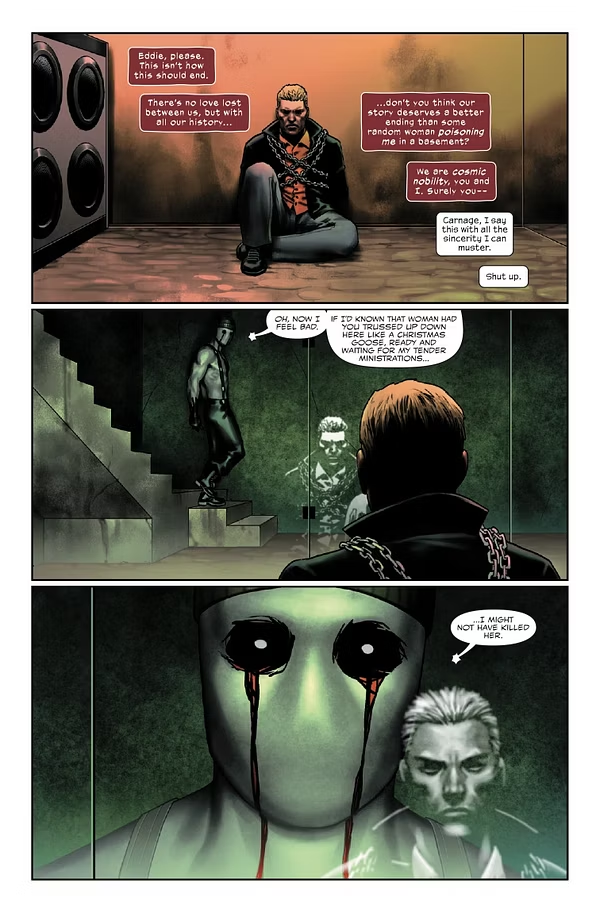
On the art side of things, Jesus Saiz and Juanan Ramirez trade off on art duties. Saiz handles the brunt of the art here, and his style is truly perfect for the story Soule is crafting. The dark, moody atmosphere of Saiz’ art and his truly unique and at times hilarious depictions of the Carnage symbiote are really well crafted, giving the series a weird David Fincher vibe. Juanan Ramirez’ fill-in issues are still good, but they are missing that wickedness that Saiz has in his issues, and are slightly more cartoony than what is established early on in the volume. That being said, neither artist skimps on the violence in this series, which is one of the most surprisingly dark and graphic Marvel books to not have a MAX or Red Band label. There’s some stuff in here, especially with Muse’s methods of getting “art supplies”, that really made my jaw drop.
While it has a bit of a rushed finale, Eddie Brock: Carnage‘s final volume really shines where it matters most: the focus on Eddie and his unwanted symbiosis. Soule, Saiz, and Ramirez really had a great time delving into this darker character, and the result is one of the most unexpectedly solid Spider-Man spin-off books in some time. In a better publishing time, this wouldn’t be the final collection but the second in a series of more, but it’s good to appreciate what we have, even if what we have is a murderous inner voice wanting us to kill.




You must be logged in to post a comment.