

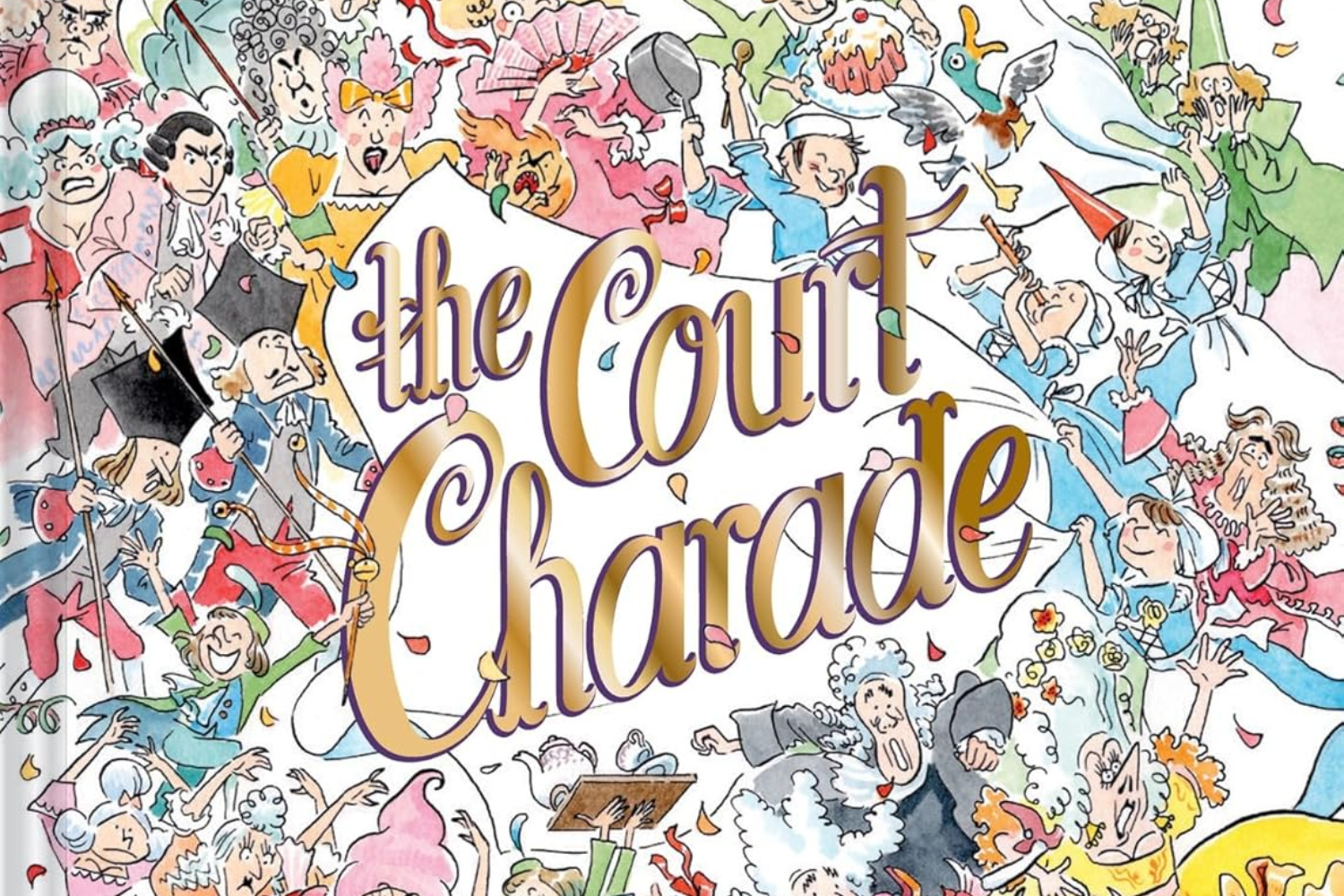

Fairy tales have routinely been about survival (from your wicked stepmother, mythical beasts, etc.), but rarely have they felt this sharp, chaotic, and uncomfortably familiar. In The Court Charade, author Flore Vesco and artists Kerascoët (Marie Pommepuy and Sébastien Cosset) deliver a witty, subversive spin on the genre as we follow a clever young woman (Serine) navigating a royal court that feels less like a dream and more like a cutthroat workplace.
Armed with little more than her sharp instincts, quick thinking, and a refusal to ever give up, Serine must dodge gossip, schemes, and sudden bursts of royal fury, all while trying to secure her future. The result is a story that blends playful fairy tale energy with pointed observations about power, survival, and what it takes to carve out a place for yourself in a world that was never built for you. It’s basically Cinderella for a wholly modern audience.
Recently, I spoke with Kerascoët about crafting Serine’s voice, designing a fluid and whimsical visual storytelling style, and why kindness, humor, and a bit of absurdity might be the most powerful tools of all.

Courtesy of Abrams.
AIPT: Serine is such a charming protagonist. She’s bright and so positive. What interested you about telling a story through a character who survives mostly through wit and improvisation?
Kerascoët: Serine’s weapon is her mind; she attacks and defends herself using her intelligence and her words. Discovering this character — so touching, free-spirited, enthusiastic, empathetic, and radiant — immediately made us want to bring her to life. She’s exactly the kind of heroine we’ve always dreamed of. We want to provide role models for our young readers, and Serine embodies everything we love and want to champion in a fictional character.
AIPT: One of the most striking things about the book is how the gutters feel less rigid than in many American comics. The panels often flow together or drift across the page. What was the thinking behind that approach, and were you hoping it would create a more whimsical or storybook-like feeling?
Kerascoët: We like to experiment with different treatments and styles in each of our albums; what matters to us is ensuring that the content resonates with the form. In The Court Charade, our primary goal was to tell the story of a free woman. To achieve this, we didn’t want to confine her to rigid panels. We adapted our approach to staging and storytelling by focusing specifically on the characters, even if that meant sometimes omitting backgrounds entirely to prioritize a fluid reading experience centered on our protagonists. This is what makes our layout feel lighter, despite the large amount of information on the pages — information that is necessary for understanding the whole story.

Courtesy of Abrams.
AIPT: The visual storytelling in The Court Charade is incredibly playful. The bustling kitchen full of cooks and servants, the jester dancing across the page (and the text going this way and that), or a painterly castle or building all feel very different from each other. How do you decide when a moment needs a tight panel, a wide scene, or a full-page composition?
Kerascoët: Here again, our main goal is to be as clear and understandable as possible. Reading should be a pleasure, not a struggle. We try to provide the information that’s essential for readers to understand. A large image is often better than a long, descriptive passage. To be immersed in the story, you shouldn’t have to wonder where you are or how things are set up. Once you keep these elements in mind, there’s no need to complicate things further with intricate backgrounds in every panel — the reader has got the message. And then it’s also a matter of pacing and composition; we try to make the pages varied and not monotonous — changing perspectives and scales helps keep readers engaged.
AIPT: Court settings in fairy tales often feel glamorous, but in The Court Charade, the palace is also chaotic, gossipy, and dangerous. How did you approach building that world visually and narratively?
Kerascoët: The whole premise of the book revolves around the fact that the king and queen’s court is a whimsical place populated by people who each have their own secrets and hidden agendas. We drew inspiration from real castles and authentic historical decor elements to give the setting a sense of believability, and within that setting, we added a touch of madness and excess. This creates a sense of stylized, cute realism that contrasts with the darkness of certain elements of the plot.

Courtesy of Abrams.
AIPT: Humor plays a huge role in the book, especially in the dialogue and Serine’s observations about court life. How do you balance the comedic tone with the underlying stakes for the characters? Also with the humor, there’s a small touch of nudity, what made it important to throw that in too?
Kerascoët: Serine’s humor and wit are her only weapons against powerful conspirators and political manipulation, so it was essential that Flore work with us on her dialogue to ensure it had the greatest possible impact.
Nudity is just one aspect of her offbeat style, which often relies on wordplay (sometimes difficult to translate).
AIPT: Fairy tales often revolve around transformation. Without spoiling anything, how does The Court Charade play with or challenge the traditional fairy tale idea of who gets to “win” in the end?
Kerascoët: Sometimes you have to change your approach and jump in headfirst without thinking about the consequences to really make a difference. At one point in the story, Serine is faced with a choice: give up or fight back by any means necessary. What this story tells us is that if you do good around you, the people you’ve helped will help you when they have the chance. Kindness begets kindness, empathy begets compassion, and goodness is a strength — not a weakness. In the end, the winners and losers of the story are the same from start to finish, from our perspective ^_^.

Courtesy of Abrams.
AIPT: Readers might notice influences from classic fairy tales as well as a kind of theatrical energy in the staging of scenes. Were there particular stories, visual traditions, or artists that inspired the look and tone of the book?
Kerascoët: Not really — we drew inspiration from many sources, just like always. We tried to create a joyful world, like a box of candies or Ladurée macarons; a soft, pastel-colored world, like Sofia Coppola’s film Marie Antoinette; and a world that’s a little bit crazy, like Disney’s Alice in Wonderland…with our own twist.
AIPT: If Serine suddenly found herself working in a modern office instead of a royal court, what role do you think she would end up in… and would she still manage to outwit everyone around her?
Kerascoët: Serine would always find a way to come out on top, no matter what challenges she had to overcome, because she has the superpower of caring for others with kindness and compassion. In today’s world, she could be an activist, a lawyer, a doctor, a reporter, an artist, an author — any profession related to helping people. And she would always come away a winner in the end, because winning doesn’t always mean defeating your opponent, but doing what’s right.
The Court Charade in arrives in comic shops and bookstores starting today (March 31).



You must be logged in to post a comment.