

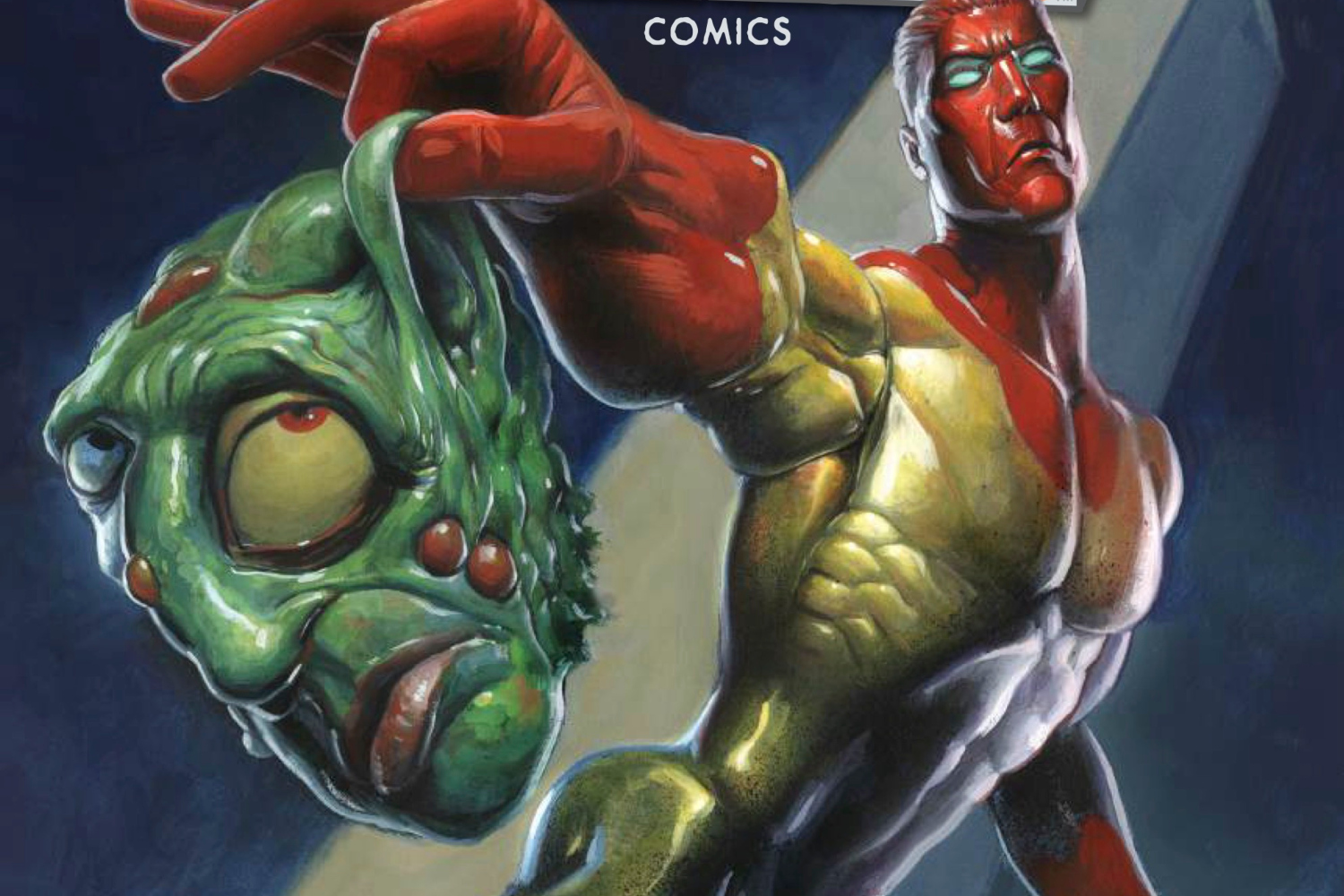

If there’s one thing that the Matt Bors-led Toxic Avenger “resurgence” has done well, it’s satire.
(If there’s two things it’s done well, it’s freaky hybrid beings. Yeesh!)
In The Toxic Avenger, that was man’s feckless approach to environmentalism. In Toxic Crusaders, it’s human ineptitude and bureaucracy (and said environmental bungling). But in the latest arc of Toxic Avenger Comics — the aptly titled “Toxie Goes to Washington” — our mutant paladin is tackling the current perpetual quagmire that is American politics.
And while the satire is sharper than ever in Toxic Avenger Comics #8, it’s also even more poignant and gut-punching in its total power.

Courtesy of AHOY Comics.
Here’s what you need to know coming into issue #8. President Young has been assassinated, and Toxie is taking the fall as the patsy. Meanwhile, the former VP Karns — actually the brain of a robot scientist residing in a cyborg body — has assumed the presidency. (And his wife is now VP, and if they weren’t bloodthirsty fascists, I’d almost find that endearing.) Now, as a fugitive from the law, Toxie finds himself battling not only the Planet Teens but Doctor Planet, who made quite the splash in Toxic Avenger Comics #7.
Originally, the most obvious promise of Toxic Avenger Comics #8 was meant to be the smackdown between Toxie and the not-so-good Doctor. And, absolutely, the art team (artist Fred Harper, colorist Lee Loughridge, and letterer Rob Steen) give us plenty of that — a bruised and beaten Toxie is capable of great feats of sympathy as well further churning our stomachs. (It’s a dynamic that powers so much of this book, and what makes it such a textured experience as we delve into difficulty, heady subject matter.) But I instead found myself drawn to more quiet, complicated moments where Toxie’s head wasn’t being palmed directly into a D.C. monument.

Courtesy of AHOY Comics.
Namely, some of the stuff with the Karns. For all the power that Harper’s art brings to this book — depicting a bizarre form of humanity that illustrates the increasingly tenuous line between man and monster — perhaps the biggest challenge was depicting backroom dealings between the Karns and Senator Greene (who may or may not be so noble as we’d first assumed). There’s a kind of All the President’s Men-esque air of mystery and intensity to their conversations about (effectively) further scapegoating Toxie to push across their nefarious political agenda. That, and voting!
It’s all mysterious figures (even if it’s just a janitor) and ample shadows imbuing a mood of cutting seriousness, and without ever mitigating the art’s singular capability in dissecting and displaying a humanity that’s just slightly off. It’s a meeting of a very “theatrical” aesthetic paired with some very real wheeling and dealing, and said dynamic is interesting for playing with the story’s specific interest in politics.
In our world, where the actual president does dumb/illegal stuff in the open and in real-time, you feel the weight of what we’re “missing.” Does that somehow make this Nixon-esque “political intrigue theater” somehow better? IDK, maybe it made folks sleep better? But what it really does is show us that we’ve never had a role to play, and even if we can now see the production play out over social media, nothing’s really changed.
On the flipside, what we assume to be decorum is also just a disregard of our collective intellect, but being out in the open while they screw our collective future is at least “honest.” Either way, you not only see the true scope of our systems, but the thread connecting it all, and how perception, secrecy, and a general disregard for humanity are always at the seat of power, no matter who’s actually in charge.

Courtesy of AHOY Comics.
Now, is this my favorite “form” of satire from Bors? If I’m honest, I love the sillier, neon-tinged madness of Toxic Crusaders. But Toxic Avenger Comics is perhaps the smartest and most effective arm of Bors’ writing. It’s the one where he’s engaged in the least amount of finger wagging (even if it remains utterly clear who is in the wrong). Instead, it reminds me of some of the better stuff from The Nib, where the relationship between truth and fantasy blur just enough, and we’re invited into consume some rather potent political analysis.
And that’s what those politicking scenes are: a history lesson in comic form, and where the satire becomes grounded in ample context so we see the whole big, ugly picture. Again, they lack the shiny oomph of mutant fight scenes, but they do contextualize the socio-political heft of this story in a way where it cuts even deeper and gets us engaged in a whole new way.
And speaking of ways to ground some of this thematic gold, the humanization across Toxic Avenger Comics #8 continues with Doctor Planet. This version of the Toxie-verse has been ripe with great origins (the one for Junkyard in Toxic Crusaders #3 was just killer), and that continues as we get some meaningful personal time with the Doctor.
Without spoiling too much (just read the previews here!), the creative team expertly compare and contrast the Doctor and Toxie both visually (there’s a neat “secret” to his appearance that once again disgusts as it also fosters understanding) as well as in their general backgrounds/emotional output. I don’t want to say they’re two sides of the same coin — maybe it’s better to say their connection is more complicated than you’d hope. And that 1) feels thematically significant with the rest of this issue’s work to dissect our political practices/structures and also 2) offset some of the headier discussions here for a nugget of “messier” humanity. (Messy like reality TV and not Nixon’s mortal soul.)

Courtesy of AHOY Comics.
In an issue with ample talk about filibusters, not to mention the body of an actual (made-up) executive order, it’s a nice break to let ideas of choice, duality, and the illusions of power resonate in a more “human” way. For one, Doctor Planet is set up as someone who just might surprise us down the road (or, more likely, break our hearts instead), and that ideas of good versus evil are presented more viscerally (while respecting some of the more “demanding” messaging here). Plus, it feels like with the pair’s Superman-Lex Luthor-esque interactions, and the Doctor’s own monologues (like an angsty Doctor Manhattan), we’re getting a genuinely great comic story as the through-line, and that feels exciting as this book further retains its accessible core.
Perhaps the best moment of this robust humanity across Toxic Avenger Comics #8 comes at the very end. Here, a broken, bloodied Toxie learns of his “options” while imprisoned by the government. From a visual standpoint, it’s a rather gross, slightly unnerving visual metaphor (and another testament to the way “horror” is used in this book to cut to the core of these huge ideas/questions). However, from a narrative standpoint, the moment not only feels somewhat familiar in its thematic heft, but expertly crystalizes why Toxic Avenger Comics is so dang potent right now.

Courtesy of AHOY Comics.
It’s that it all feels tonally spot-on amid a sea of otherwise middling satire elsewhere. That, and you get to think about radioactive mutants in the same moment as senatorial voting habits. Plus, it all feels so heavy and real but lends just enough distance for us to laugh and relish this genuine release. Ultimately, Toxic Avenger Comics is important because it simultaneously smacks you in the head and the heart, and it’s thoughtful, creative, and unwavering in its efforts. It tears apart the world, but leaves us feeling whole (if not deeply shaken) because damn good satire must always empower if said dismantling will mean a damn.
Whatever work Toxie has left in D.C., expect it to tickle the soul as it tries to pull out your bottom ribs.




You must be logged in to post a comment.