


It’s official: Narco may be the least violent and/or bonkers story from Doug Wagner and Daniel Hillyard.
That was apparent enough across issue #1, where the pair made good on their various promises to tell a grounded thriller that focused more on the emotional beats rather than the stabby kind. And the change made sense: In a murder mystery where your lead (Marcus) is sensitive, isolated man with narcolepsy (that causes him to pass out if he over-exerts), we don’t need to go full bore with the gallons of blood and cannibalistic furries.
But Narco #2 really pumps the insanity breaks, and makes clear that a slower, more deliberate focus could garner even more gold from Wagner and Hillyard.

Courtesy of Image Comics.
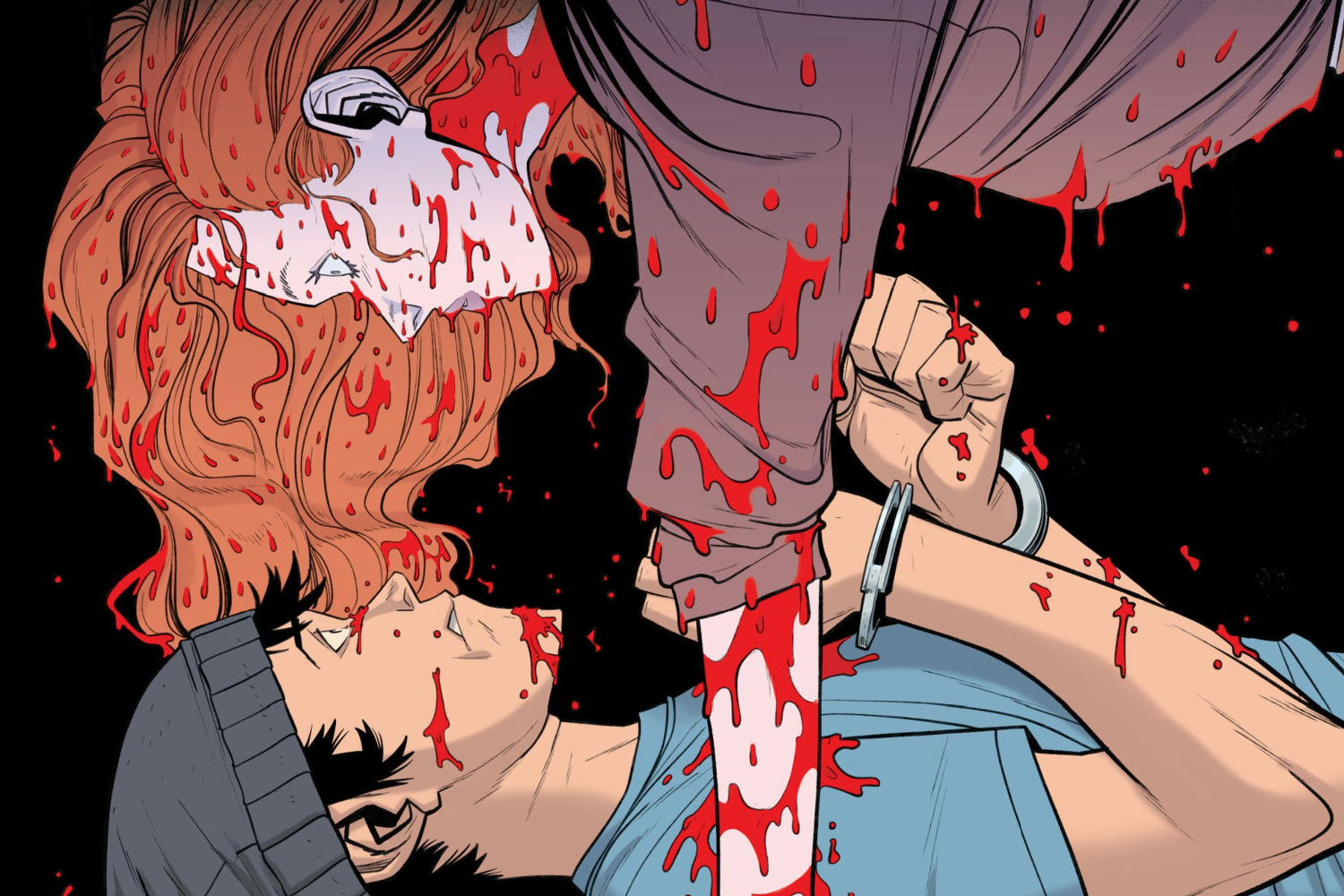
That’s not to say that there’s not blood in Narco. Heck, the intro sees Marcus wake up in a pool of it, staring at the newly-dead body of his crush/neighbor, Jess. But where other books in the pair’s canon might have used that as a way to shock readers, this moment in Narco is massively disarming. The art team (Hillyard joined by colorist Dave Stewart and letterer Ed Dukeshire) foster this deep, pervasive sense of longing, making us feel both the love and terror that Marcus enters as he wakes up on the floor. (Surrounded by cops, mind you, meaning the humor is always just on the periphery serving its supporting role.) Even Marcus’ blackout in this moment feels less drastic or quieter, reflecting a certain tenderness-meets-dread that defines this moment.
From there, a huge chunk of this issue is dedicated to both Marcus’ interrogation and a post-arrest hang sesh with his friends, moves that are light years away from a story like Vinyl. In the former scenario, things are a tad dry — not in a bad way, mind you. Wagner’s script just wants to slow us down another way with a proper procedural, and to see Marcus feel the weight of this moment in a newer, equally visceral sense. (And the slower pace also adds to how grounded this book is, and how dalliances of blood and/or whimsy truly feel extra special.) We also get some time with Detective Violet, and she’s this smart, no-BS cop who has the skills that could make her the perfect counter/balance for Marcus.

Courtesy of Image Comics.
Meanwhile, the hang sesh is one of those moments that does feel a smidgen out of place. I mean, if I were arrested for murder, maybe I wouldn’t necessarily want to eat ice cream and wings with my bros. But, as we touched on in Narco #1, Marcus isn’t your average Wagner-Hillyard “hero”; his friendships and connection give him something to lose and also lean into, and this strength is a reminder of why he must build (and protect) a life despite his condition.
The evening is also a moment for Marcus to gather evidence for the detectives, a demonstration of his savvy and computer skills that once more sets him apart from someone like Plush’s Edwyn, who tends to flail, or even Klik Klik Boom’s Sprout, who is mad skilled but grapples with human connections. Marcus is very much alive, and if he’s going to prove it, it means using everything to his advantage. And not, mind you, trying to play action movie badass.
Still, there are other key moments here, and they help push Narco forward without mitigating its “slow core.” The evidence-gathering scene points us toward Ben, Jess’ violent, misogynistic ex. Ben’s introduction serves a few key purposes: Not only is there some satisfaction when he and Violet “interact,” but he also feels like red herring of sorts. I mean, he’s so obviously the killer, and yet knowing Wagner and Hillyard stories the way I do, it can’t be that simple. (Right?)
And there’s also a little undercurrent of that red herring-ness detected in Marcus’ interrogation; maybe it’s just me, but it felt like they were expertly hinting at how the “great fainting kid” may not be as innocent as we suspected. (There’s even threads of that in the issue’s end where Marcus and the cops confront Ben — why would he work with the cops exactly, and should we put more thought into it?) It’s small, yeah, but it’s another way Narco is really engaging with the essence of these crime stories.

Courtesy of Image Comics.
The other quite important happening in #2 is yet another moment that Marcus shares with his local opossum. (Yes, I said important.) For one, it allows one of his friends to come in and share some great, understated humor that really is the heart of all Wagner-Hillyard stories. Similarly, it reminds us that quirky is always the duo’s baseline, and even if things are more “grounded,” you always know that the creators are ready to get weird at any moment. (Sort like with the aforementioned cops in Marcus’ apartment.)
But mostly, the interaction is another moment to really slow things down (and thus inject other textures) while reminding Marcus of his place in the world (i.e., a human opossum). That for the way this issue plays out — making him look quite sturdy as he faces a new challenge unlike any before — he can only go so far. There’s still a Jess-shaped hole in his world, and nothing will fix that no matter what he says or feels. His own limitations will always be there, and in that way they continue to feel significant and not like some chintzy gimmick.
And while that may not involve any actual decapitations or a swimming pool of human viscera, it’s clearly a different kind of violence — the violence of being alive. The “opossum connection” is ultimately this stark reminder that you can and will lose it all, and while you should never give up and always try to improve, the world will always secure its pound of flesh (and then some).
It’s a violence that spares the body but ravages the heart and mind, reminding us that these two are masterful storytellers who, in fact, are done sparing us the final shred of dignity and space that their trademark absurdity routinely offers.
Turns out, Narco is coming for all of our heads, and you’d be wise to let it in pronto.




You must be logged in to post a comment.