


You’ve heard the acronym KISS: “Keep It Simple, Stupid.”
With Head Lopper, writer-artist Andrew MacLean seemingly prefers KISSBNBOD.
As in, “Keep It Simple, Stupid, But Never Boring Or Derivative.”
That very notion was at the heart of our recent deep dive as Head Lopper returns from a multi-year hiatus with its fifth volume. The premise remains deliberate as ever: Norgal, the titular “Head Lopper,” continues his unwilling team-up with the severed head of Agatha the Blue Witch to fight monsters and prevent the outright destruction of Narschlahn. And in that “simplicity,” MacLean has the power to do pretty much whatever he wants, spinning in new ideas as he desires, going overboard with the gore and violence, and generally making this story a reflection of himself and his worldview. There’s a real power to KISSBNBOD.

Variant cover by Alex Horley. Courtesy of Image Comics.
When we begin issue #1 of Head Lopper volume five, Death (an ardent admirer of Norgal) gives us everything we need to know: Norgal and Agatha have teamed with Goat and Brishka (basically another version of our duo, but with their own respective layers/levels) and Tarf, a former prince who was nearly assassinated. Is there stuff I’m missing or leaving out (purposefully or otherwise)? God yes! Like, who are those people, where did they come from, what do the offer to the group dynamic, etc. Do you need to know those answers? Yes, they’re anything a reasonable person might expect outright.
And, sure, all of that might help, but ultimately the one piece of info you do need is this: “They’re working on killing demigods on Norgal’s list.” Now that suggest heaps upon heaps of history and subtext involved, but nothing changes the fact that heads a plenty will roll, and that giddy swell of interest and excitement should be enough to push forward most readers. Anything else is up to you to add context or flavor the story as you see fit, and MacLean is a genuine master at giving us enough of the “basics” so we can enjoy Head Lopper for what it really is and what it does better than most other books.

Variant cover by Jeffrey Alan Love. Courtesy of Image Comics.
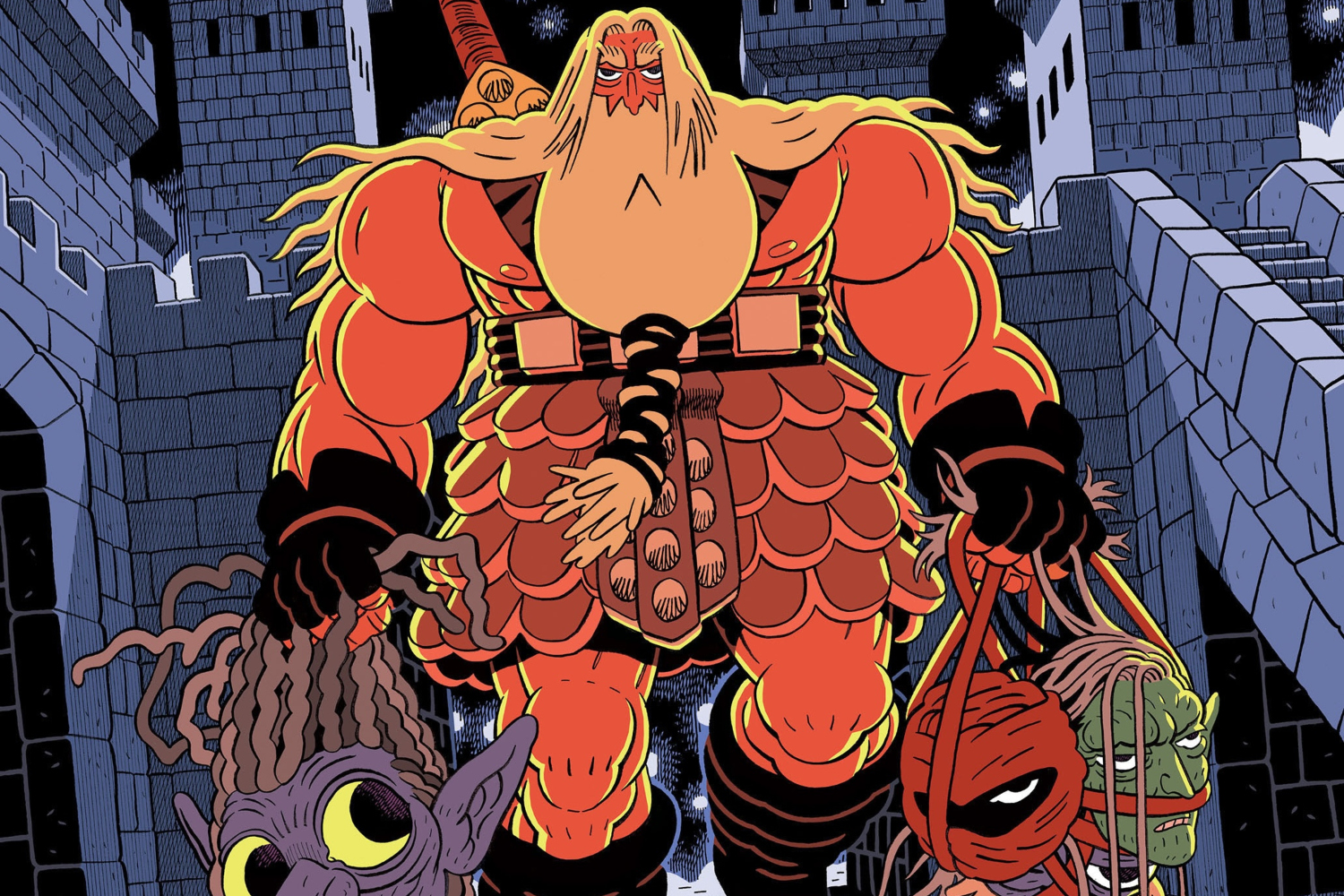
And that, dear friends, is wanton violence. In our interview, MacLean mentioned having genuine and unwavering fun in drawing decapitated monsters and blood by the metric tonnes. And that continues here across 80 jam-packed pages. There’s Norgal severing the head of goblins like he’s dancing in a Madonna video; Norgal bashing around two large man-lizard hybrids with a kinetic heft you can practically feel; Norgal poised with a severed hand in highly detailed, pulp-ian wonder; and even a little blood lust from Agatha that’s small and weird but equally satisfying.
Those are just a rather small sliver of the mayhem across Head Lopper #1. Does the unwavering depiction of blood and chaos have some larger contextual value? Sure, if you were inclined to think this way, you might assume MacLean is making a comment on the nature of these stories as well as their role as wish fulfillment in an actual society where that’s increasingly important. But mostly you see and feel the fun MacLean must have had, and the joy he experiences every time he shares these stories with people as quirky and obsessive as himself. You feel not the pain or violence’s desperation, but this deep, abiding humanity.

Courtesy of Image Comics.
It’s why you can have weird little side jokes about “Head Lopper, not Head Looper” or stylized high-fives mid-battle — it’s never about mitigating our core humanity. Instead, it’s using these (mostly) harmless displays of aggression to let off steam, connect to certain storytelling traditions, and generally use comics as a springboard into seeing how we’d really like the world to play out. (Maybe less head lopping and more earnest folks getting over on the evil jerks of the world? OK, keep the executions.) I truly, truly feel MacLean in these moments, and it’s a genuine joy to connect with someone and converse (without speaking) about what we love most in the world: dumb jokes, goblin blood, and having fun in our stories.
At the same time as MacLean doubles (nay, triples) down across this latest volume, he also talked about his time away as a means of doing new things through a fresh set of eyes. And perhaps the biggest part of that is that Head Lopper V5 takes the form of a murder mystery aboard a casino barge. But before we get to that bonanza, there’s a couple other moments in issue #1 worth revisiting.

Courtesy of Image Comics.
The first is Death’s intro: While this narration device is familiar enough, there’s a certain infusion of whimsy in the art, paired with a newfound confidence in the actual monologue. Together, you see that MacLean isn’t just having fun, but he’s also found a new level of understanding for this story world, and a desire to plan ahead with gusto, and that together feels as palpable as his sense of joy.
You also see it an early scene where Brishka climbs a building: For a man who has painted himself (happily) into a perpetual corner of violence/gore, MacLean can lay out and approach different kinds of action with a liveliness and inventiveness that reminds of who is really telling this tale. He may prefer the bloody stuff, but MacLean can surprise you with his thoughtfulness and general skill.
And those are very much at the heart of and/or informing this volume’s turn to the aforementioned murder mystery. It’s still a little too early in the story to gauge how well this “formula” works, but there’s a few key points also worth addressing that speak toward this being a generally good idea. Or, at the very least, it’s new enough to feel really interesting in this context.

Courtesy of Image Comics.
At the center of all heists (aside from a dashing lead, generally) is the set-up/explanation. You’ve got to info-dump a bit about jewels and schedules and whatnot to give people a chance to understand the plan and its stakes. There’s such info-dumping across #1, about a demigod who controls floods and why the have to be on this boat to find the beast and its handler. Luckily, it never feels like information overload, and instead we feel like 1) we’re getting a slightly needed break from the violence and 2) we’re learning about this world in a new way (and its lore/mythos is a lot deeper than I’d expected even with the previous four volumes).
Similarly, even the look of the boat is elegant and interesting, and you get the sense it’s from a different part of the world and that things are opening up for us like never before. But it’s also just a dope lil’ boat that exudes a certain fantasy charm. And I really prefer that rather specific aspect of Head Lopper: The depth is always there, but if you don’t find it, you’re still going to get your money’s worth. And if you do decide to experience the world in a deeper way, you feel an even heftier connection to MacLean. The book is alive in this way, and there beats its undeniable heart.

Courtesy of Image Comics.
And that, folks, is why I have always and will continue to gleefully adore Head Lopper. Not only am in charge of actually fostering my own specific enough reading experience, but it rewards me not only with info and texture, but what I really want from this book. And that’s not just human connection, but the kind that seemingly connects right back to us. A swirling wind storm of ideas and energies that positions stories as these life-changing things, and that if we share the experience, we can all find a sense of undeniable joy and community (when such things are in short supply).
Here’s another important acronym for Head Lopper going forward: HLIBCATWIBFISC. Or, “Head Lopper Is Bonkers Comics, And The World Is Better For Its Savage Charms.”




You must be logged in to post a comment.