

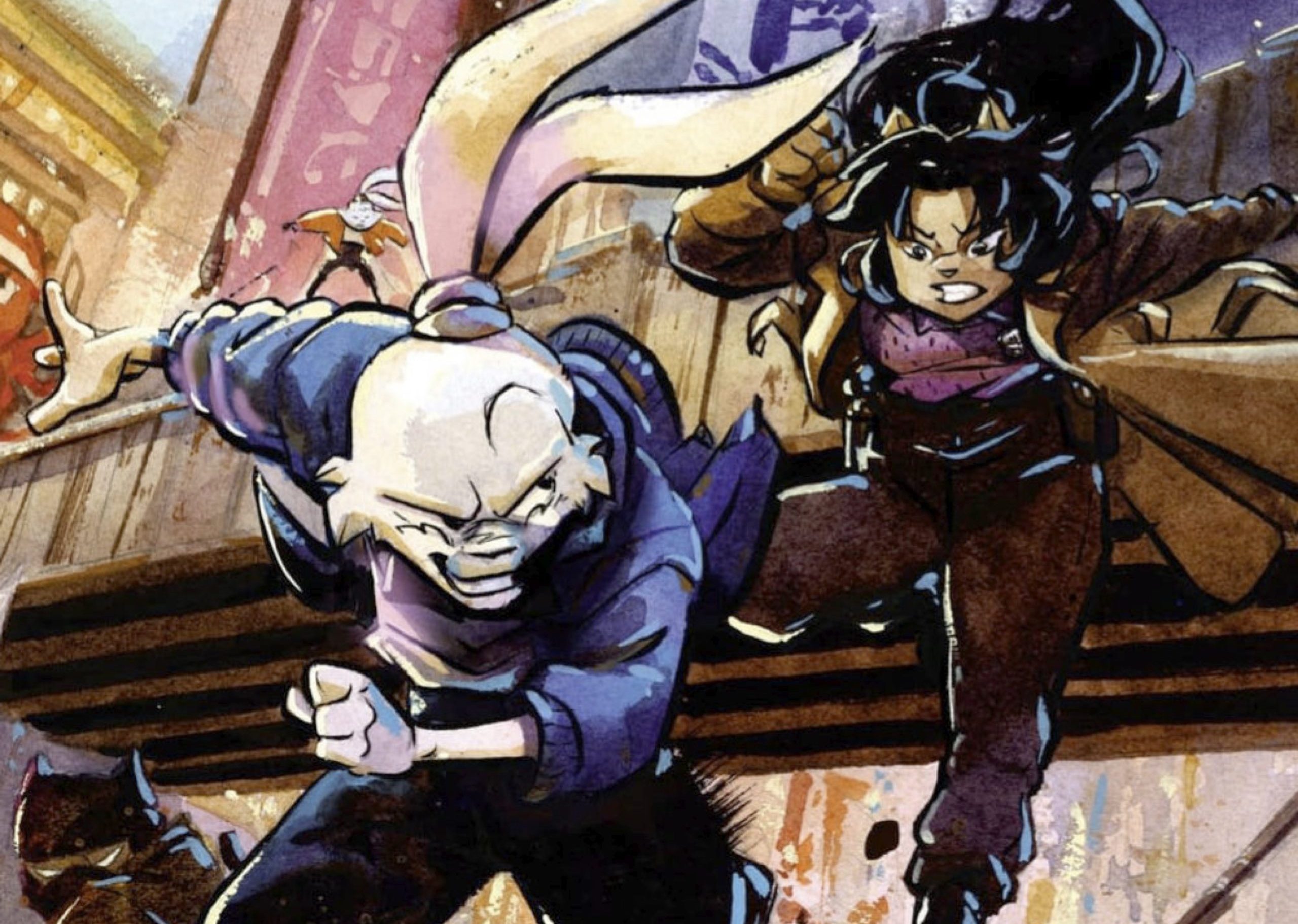

Jared Cullum and Zack Rosenberg’s Kaitō ’84, their 1980s-set riff on Stan Sakai‘s legendary rabbit samurai comic Usagi Yojimbo, does a lot right. Cullum’s artwork riffs on Sakai’s style while building its own visual language. His character designs lean into the cast’s animal natures, and his action scenes emphasize physicality and force. His colors are sumptuous, whether he’s capturing a deep red twilight, the grimier corners of Osaka or a surreal, nightmarish vision of the distant past. Rosenberg’s script has a strong handle on Kaitō, the Robin Hood-like descendant of the legendary samurai Miyamoto Usagi. Kaitō shares his ancestor’s compassion, drive to do good, and all around integrity, but he’s a sneakier, wearier figure, and he struggles to keep close to the people he loves. He’s a terrific protagonist, and Rosenberg is now two for two in scripting comics that keep Kaitō on his toes and continually give him a chance to showcase the many facets of his character.

Dark Horse
Indeed, there’s quite a bit to dig in Kaitō ’84‘s second issue. The ensemble make themselves better known, including a very fun take on Usagi Yojimbo‘s lady samurai Tomoe Ame as a detective determined to bring Kaitō to justice. Likewise, the book’s big picture story is coming into focus, and it’s a solid idea, pitting the decidedly down-to-earth Kaitō against a supernatural threat from Usagi’s time, a threat the likes of which Kaitō’s never had to deal with. The introduction of that threat brings with it a lengthy vision sequence that skillfully ups the comic’s stakes. It emphasizes the sheer force of the villain’s wicked powers, not only through his abilities and Cullum’s emphasizing his physical ferocity, but by the desperate measures a pushed-to-his-limits Usagi must resort to in order to stand a chance against him. By itself, the vision is thrilling. In the context of Kaitō ’84 as a whole, it flips the book on its head. Kaitō and his crew are brave, talented thieves. They’re ready to go up against advanced security, scheming shadow players, and even ninja. They are NOT ready to go up against unspeakable supernatural evil.
The vision is Kaitō ’84 #2’s highlight. It’s also an albatross. The series’ first issue was promising, but tossed a lot of balls in the air: Kaitō, his past, and his relationships with his friends and loved ones; the metatextual relationship between Kaitō, his pals and their counterparts in Usagi Yojimbo; and the big heist that Kaitō has been blackmailed into pulling off, the theft of the legendary Blood Kintsugi Spear from Osaka Castle. One of my primary concerns with the first issue was that, as a five-issue miniseries, it only has so much space to tell its tell compared to Usagi Yojimbo, which has run for over 40 years. Usagi‘s longevity and consistent quality give Kaitō a deep reserve of quality material to draw on. In a pinch, Usagi‘s characters and their histories can serve as shorthand for their Kaitō counterparts’, but that comes with the risk of Kaitō‘s cast becoming Usagi‘s cast with cool jackets, rather than interlinked-but-distinct characters like Kaitō himself.

Dark Horse
On that front, Kaitō ’84 #2 acquits itself well. Kaitō’s crew echoes Usagi’s, but their history and relationships are distinct, and the semi-estrangement and tension between the crew and Kaitō is intriguing. That’s a comic in and of itself, but it isn’t Kaitō ’84. Kaitō ’84 pits its title hero and friends against a foe of Miyamoto Usagi’s, and while he’s a marvelous villain, he’s also Usagi‘s villain. Cullum and Rosenberg execute his menace and threat really well, but the time they give him is time they do not give to Kaitō’s crew. The villain has decades worth of stories. This miniseries is the first time Kaitō and company are appearing. Given how the comic is playing out and where it leaves off, the villain will continue to command significant page time. With the clear care Cullum and Rosenberg have put into crafting Kaitō and his crew, it would be a shame for their debut to shortchange them in favor of a long-established Usagi Yojimbo character.
There is a lot that works in Kaitō ’84. It’s a solid comic, one I’d recommend to folks who love Usagi Yojimbo, urban fantasy, and tarnished heroes striving to do good. With that said, the book’s first issue left me cautiously optimistic. Kaitō ’84 #2 leaves me both more optimistic and more cautious.




You must be logged in to post a comment.