


Some of my favorite books already this year have deftly and earnestly explored the rich-but-complicated history of Latins from across the globe. There’s not only Death to Pachuco — which explores the Zoot Suit Riots of L.A. in the 1940s — but also the forthcoming The Beast of Borikén about Puerto Rico and that people’s clashes with colonialism. (More on Beast next week, FYI.) Now you can add another title to that list: We Are Pan.
Written by Andre Frattino, and with art by Yasmin Flores Montanez, We Are Pan explores the history of Operation Pedro Pan, a “joint effort between the U.S. government and the Catholic Welfare Bureau to evacuate 14,000 children from Cuba to the U.S. between 1960 and 1962.” We follow the lives of five such “Pedro Pans” during and after their evacuation from the newly-installed government of Fidel Castro. In their own unique way, each child grapples with leaving behind their families and adapting to a strange new country amid a time of even grander social change/upheaval.
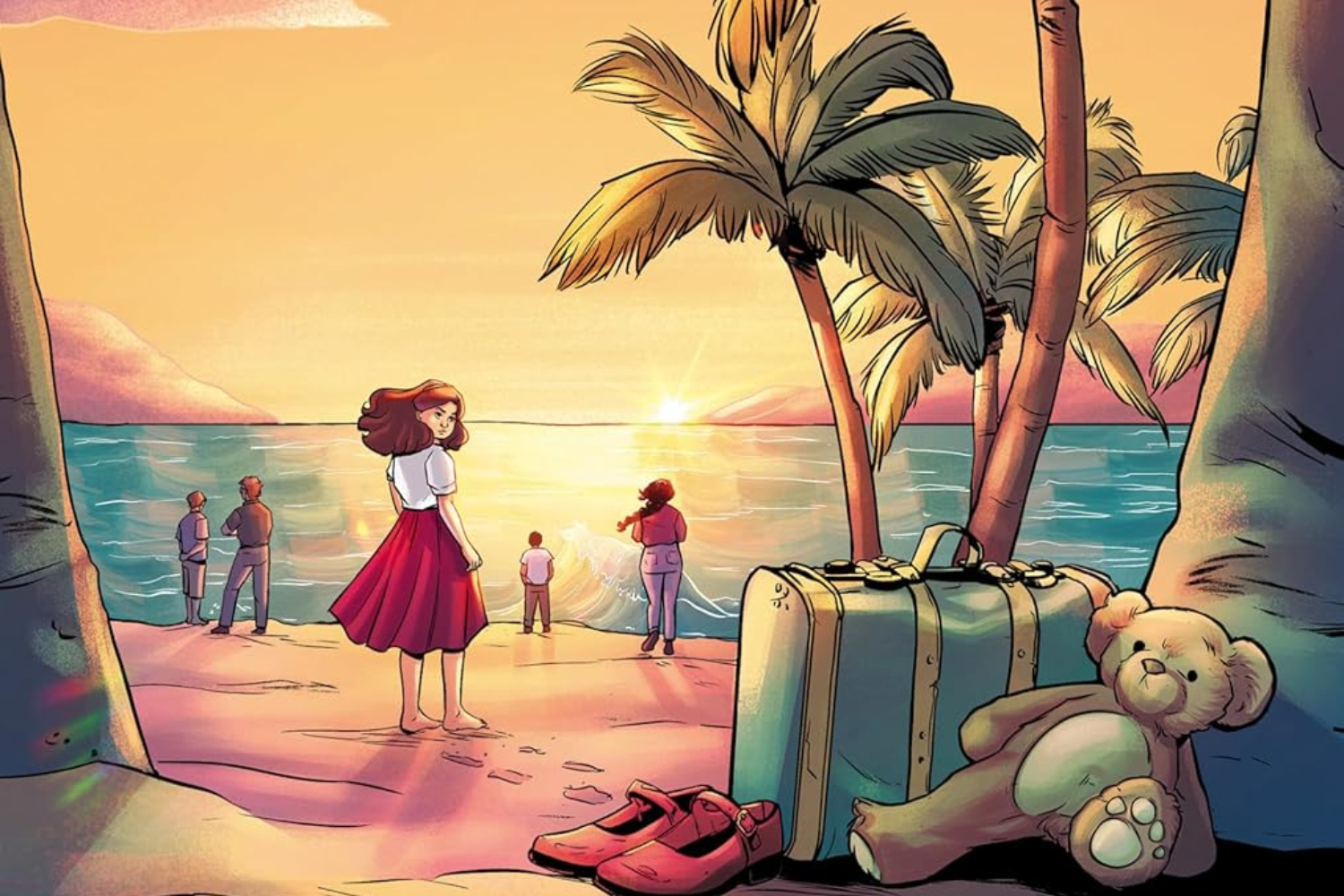
What welcomes you into We Are Pan is initially Flores Montanez’s art, which captures both the idyllic beauty of Cuba alongside a dream-like quality that’s perhaps typical of childhood. From there, Frattino’s writing is gentle but unrelenting, offering both a nuanced look at the many big ideas and themes of this moment in time while also allowing room for these fictional characters to feel truly alive. The end result is both a history lesson and a deep meditation on life amid revolution. Whether you know the surrounding history or not, We Are Pan will move you in ways both small and mighty.
We Are Pan is out this week (June 2) from Top Shelf Productions. Ahead of that debut, we caught up with Frattino via email to tackle some important questions regarding this dynamic OGN. That includes more history regarding Operation Pedro Pan, his own connections to this larger story, working with Flores Montanez, We Are Pan‘s relationship with his other releases, and the use of the Spanish language. And, in the coming days, stay tuned for our review of We Are Pan.

Courtesy of Top Shelf Productions.
AIPT: How familiar with Operation Pedro Pan were you before starting on this book? What drew you to this unique event/moment?
Andre Frattino: Not at all! My wife is Cuban-American, and a few years back was showing me some pictures of her grandparents living in Cuba. I told her that I felt like there was a story here somewhere; her grandparents were young and in love in the pictures, and I originally imagined a love story taking place during the revolution. Kathleen (my wife) then told me about Operation Pedro Pan, and instantly my imagination became fixed on that. It just so happened that her Spanish teacher from grade school was a Pedro Pan and she was still in touch with her. An introduction was made, and her teacher in turn introduced me to her network of fellow Pedro Pans. We Are Pan was born.
AIPT: In that same vein, what kind of connections does OPP have with right now in 2026? Obviously refugees are on most of our minds right now (and have been for some time).
AF: While I’m thankful that my wife’s family was able to find their way to America and build a life here, it’s impossible for me not to see the hypocrisy in America’s immigration stance across the 60-year gap. Whether it was out of a sense of humanitarian obligation, or a strategic Cold War maneuver, the fact remains that we opened our borders to Cubans in a time of crisis, in a time of their need. I would be very shocked if that would happen today. “It was a different time. A different circumstance” is the common defense, but people are people, families are families, and children are children.

Courtesy of Top Shelf Productions.
AIPT: What are the challenges of telling a very real story like this? How do you balance being factual and accurate with any kind of dramatic flourishes or whatnot?
AF: I don’t sacrifice history for drama. I want to give readers a clear starting point for their own historical deep dives. I cringe at the idea of fudging facts to pigeon hole in something that might make it more exciting or dramatic, and that goes for all of my historical works. Fortunately, I pick topics for my graphic novels where the facts are stranger than fiction, so the balancing act isn’t nearly as difficult as it may seem.
AIPT: The book focuses on 5 rather different/diverse teens. What about this crew made sense for best understanding the happenings in this book?
AF: These characters were built from interviews I conducted with surviving Pedro Pans. I took inspiration from their stories and weaved together characters across social classes, family dynamics, and future aspirations. What I discovered from my research and my interviews was that there were children from so many various walks of life, all sent 90 miles across an ocean on one mission: to survive. I wanted these characters to symbolize the different walks of life, not only within Cuba, but within our own society today. These teens are meant to reflect children today, as much as they are meant to reflect them from the past.

Courtesy of Top Shelf Productions.
AIPT: Talk to me about working with Yasmin. What does her rich, joyous style offer in helping to tell this story and craft the tone and approach of your script?
AF: I worked with my fearless leader of an editor, Heather Antos, to find the right artist for this project; it was a joint effort. It was a lot of fun to sit down and peruse galleries and portfolios, looking for the right style to visualize this story. In the end though, the only real answer was Yasmin Flores Montanez. Not only because she brought the characters and the world of Cuba to life in her detailed art, but because she understood the gravity of the story itself, the importance of the message. It was a true partnership working with her, and she owned We Are Pan through her dedication and collaborative nature. Yasmin and I were also fortunate to work with colorist Fabi Marques. Yasmin and Fabi worked together previously on another project, so I had an idea of what we were getting with this dynamic duo! Seeing the color and warmth Fabi brought to Yasmin’s detailed illustrations in We Are Pan was a dream come true!
AIPT: You previously wrote Tokyo Rose – Zero Hour, about a young woman hosting a radio show in Japan ahead of Pearl Harbor. What’s your interest in not only historical fiction, but maybe that span of history specifically?
AF: There’s a personal connection there as well. My grandfather was a First Division Marine in the Pacific Theater. He was at Pearl Harbor when it was attacked, and went on to fight at Guadalcanal, Okinawa, Midway, and Iwo Jima. He too was an artist, and I think I get a lot of my creativity from him. He told me stories about WWII, and while he never mentioned Tokyo Rose, I imagined he was familiar with her voice over radio broadcasts. In truth, though, my drive to create that graphic novel was to share a “lesser-told” story of the war. A Japanese-American woman trapped between two worlds and fighting her own war, it’s an aspect we don’t associate with WWII, but it deserves to be known.

Courtesy of Top Shelf Productions.
AIPT: Building on that last question: Do you see any connections (spiritually, tonally, etc.) between Tokyo Rose and We Are Pan?
AF: That passion for “lesser-told” storytelling is the theme that connected Tokyo Rose to We Are Pan, and even onwards to my next project…but we can’t talk about that yet. ;-)
AIPT: I love the way the Spanish language is used across the book. Obviously it has to be there for several reasons, but how did you decide to balance it for authenticity but still connect with non-Spanish language folks?
AF: It’s funny because I don’t speak a lick of Spanish myself. Not for a lack of trying, even my wife has tried to help me, but nothing sticks. However, I had a Cuban friend in high school and I would watch with fascination how she and her family would dance back and forth between Spanish and English when they would talk with each other. I witnessed it again at my wife’s family gatherings. I didn’t want to neglect the importance of language, both as a cultural and familial tie. I think had I just settled on straight up English the book would have lacked some depth of character.

Courtesy of Top Shelf Productions.
AIPT: I feel like this isn’t your standard fare for more YA-leaning audiences. How do you balance the “dark” subject matter with a more approachable feel and tone?
AF: I have a philosophy when it comes to writing my books, and it’s to find the balance between “family-friendly” and “adult” narratives. I want it to be approachable and digestible for all, and that requires knowing when and how much “darkness” to apply without alienating any particular demographic. A little goes a long way. Unfortunately, that often finds me having to shrug when asked by parents “what’s the age range for your book?” I want to create books that are both informative and entertaining for all, so I write with that squarely in mind.
AIPT: Do you have a favorite moment or scene across the book? Maybe something that speaks to the heart of what the team is trying to accomplish?
AF: The nightmare sequence that Wilfredo’s father experiences midway through the book. I have no clue where that came from when I dreamed it up, but Yasmin’s illustration of it made it even more disturbing than I expected. I think it symbolizes the driving force behind Operation: Pedro Pan, at least as far as parents were concerned.

Courtesy of Top Shelf Productions.
AIPT: What’s the one thing you hope readers will take away from We Are Pan?
AF: How easy it is to lose everything, not only family but your sense of self. When I was 20, I lost my father suddenly and unexpectedly, and my world was shattered. Suddenly it wasn’t perfect, I wasn’t complete, I felt a little lonelier. When my daughter came into this world (a world full of uncertainty and fear-mongering), the thought about what it would mean for her to be in it alone…without me or my wife…it became too much to bear. I try to imagine being in the place of those Cuban parents who had to say “goodbye” to their children, and I don’t think I could do it. But that doesn’t mean I shouldn’t stop trying to imagine it, because in a blink of an eye, it could be a very real thing that any of us could experience.
AIPT: Is there anything else we should know about We Are Pan, Cuban history, comics, etc.?
AF: Operation: Pedro Pan has been made the subject across other works of fiction and nonfiction alike. I would encourage readers to look further into the experience, as well as visit the Cuban Diaspora Museum next time they’re down in Miami. Cuba might be in the news today, but the story of the Revolution has been ongoing since even before Castro. What led to it and what happened afterwards because of it is extremely topical and important for us all to be aware and informed of…thoroughly.



You must be logged in to post a comment.