


Remakes are a tricky endeavor, creatively. At their best, they’ll see a dedicated creative team finding a new angle on a beloved piece of work, or introducing a beloved project to a new audience. Think of the crew at CAPCOM who built Resident Evil’s mostly beloved remakes, or Type-Moon’s stupendous Tsukihime -A piece of blue glass moon-. At their worst, they’ll fail to translate the success of the original work, or worse, end up as misconceived boondoggles.
Metafiction is a tricky endeavor, creatively. At its best, it takes narrative forms, their tools, and the reader’s awareness of both and uses them to push storytelling in fun, challenging ways. Think of Caspar Wijngaard and Kieron Gillen’s Peter Cannon: Thunderbolt. Wijngaard and Gillen’s comic explored both the impact of Dave Gibbons and Alan Moore’s Watchmen on comics and how readers reacted to it. In the process, Peter Cannon: Thunderbolt was a consistently enjoyable book.
At its worst, metafiction wraps in on itself, all sound and fury signifying nothing. See the recent musical dramedy Power Ballad, which takes time away from its characters and story to ruminate on the director’s previous work. The sequence in question is long enough to be distracting, but too short to make any point. The result is a great big ball of nothing.

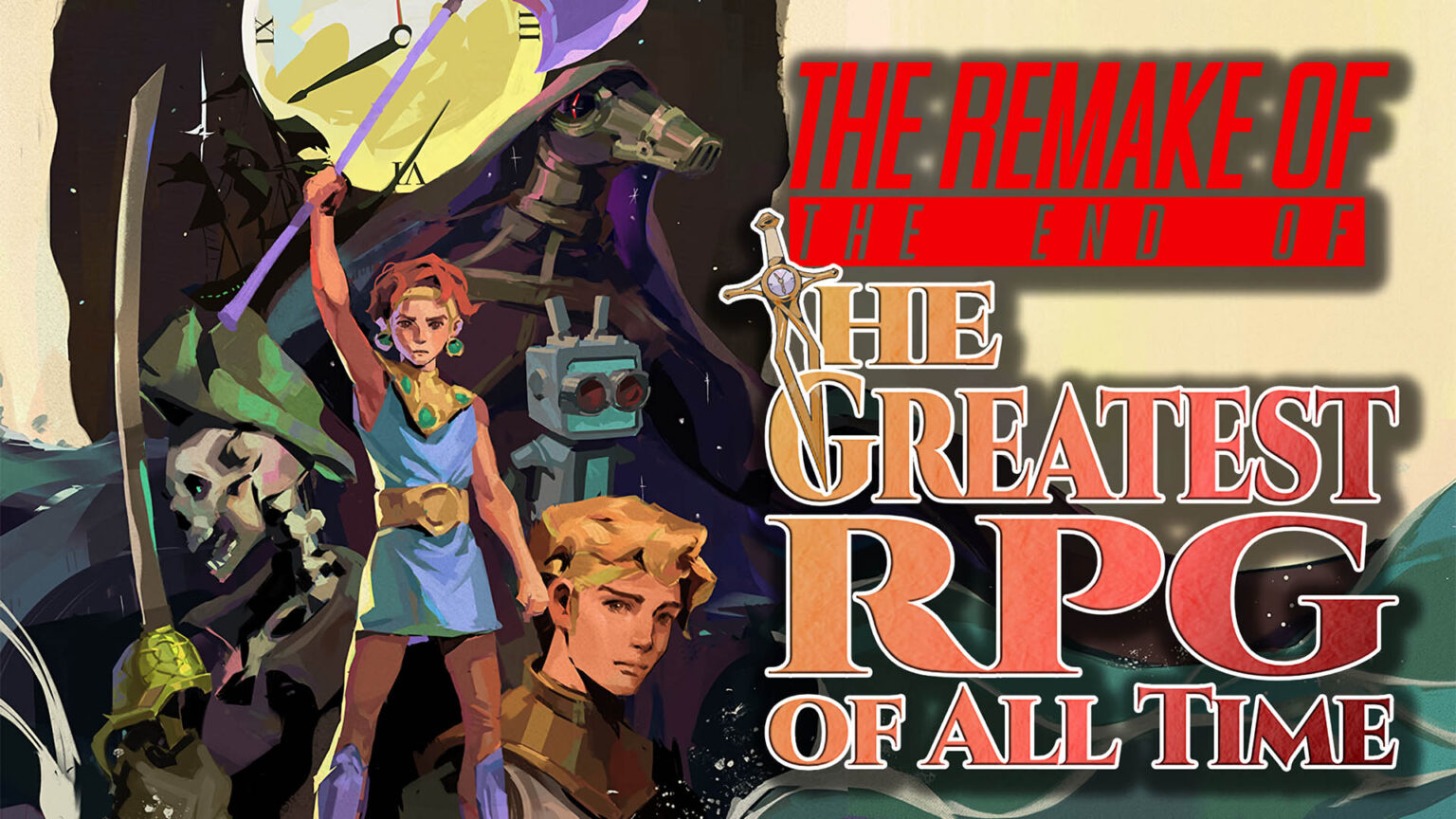
With The Remake of the End of the Greatest RPG of All Time, the team at Coin Drop Games has delivered a metafictional game that’s striking, thought-provoking, and interesting even amidst major pitfalls. On the surface, TRotEotGRPGoAT (hereafter the short name for the overall game) is exactly what it says on the tin. It’s a remake of the last act of a turn-based RPG from the 1990s (hereafter The End for short), à la Square Enix’s 2022 remake of Live A Live. After a long, transformative journey, a small band of time travelers arrives in an ominous castle to confront a nefarious Chronomancer.
Aside from The End, TRotEotGRPGoAT contains additional layers. As a game, it focuses on puzzles and detection. As a narrative, it is about the small, fictionalized team making The End more than it is the battle with the Chronomancer. Aesthetically, it combines its skillful pastiche of Super Nintendo-era turn-based RPGs and their recent remakes with a stark, surreal 3D space and elaborate multimedia elements.
Within The End, players collect pages from the original game’s manual and clips from a documentary made about its development. The documentary clips reveal the development team’s trials and tribulations. The manual, full of notes and doodles from the developers’ youths, reveals why they were drawn to the game as much as it does the game’s mechanics. At times, the player must explore a museum-esque first-person environment. The goal is to discover the truth behind The End and its making.

TRotEotGRPGoAT’s most satisfying moments interlink its multiple modes of exploration. A party member in The End does not match a character described in the manual, which has gameplay consequences. The manual and the documentary point to why the development team made that creative choice. Exploring the museum reveals that this choice had serious consequences for The End’s reception among its audience.
Putting together the pieces of TRotEotGRPGoAT’s big-picture puzzle is rewarding. That puzzle challenges players to see the game’s disparate pieces as a whole. The End is not TRotEotGRPGoAT’s be-all and end-all. The documentary is only part of the truth. TRotEotGRPGoAT repeatedly challenges players to look at how their experience is being framed and to push at why it’s being framed that way. It’s a tricky, thought-provoking piece of writing. The Coin Drop crew works it into TRotEotGRPGoAT’s medium-juggling detection gameplay with skill and style. But while TRotEotGRPGoAT’s mystery narrative and detection are exciting and well-built, the pieces that comprise them are less successful.
The End is a very pretty game, and the hooks it offers ring true; it feels like a game that could worm its way into someone’s head when they’re 10 and stay there forever. Its gameplay, though, is so simplistic that it becomes a chore. There are specific ways to defeat each enemy, and only those ways will work. Granted, The End’s battles are puzzles more than they are turn-based combat. They still hit a point where their repetitiveness and lack of options grate, especially since their presentation as turn-based combat creates the illusion of options that are not there.

The process of discovering what happened during The End’s development is exciting, but the answers themselves are disappointing. The fictionalized development team has a fun, thorny chemistry. Their shared history and the highs and lows of their knowing each other are intriguing, particularly when looking at The End and seeing how those factors shaped its creation. When TRotEotGRPGoAT focuses on The End’s development team and their relationship, it shines, and the questions about creativity their story raises it shines. The trick is that TRotEotGRPGoAT prioritizes its insufferable, shallow antagonist.
Insufferable, shallow villains can work in mysteries. See the work that Daryl McCormack did as the hateful influencer Cy in 2025’s Wake Up Dead Man, for instance. TRotEotGRPGoAT’s villain, though, is not well drawn. His obnoxiousness is clear, but lacks context. His shallow conception of what games should be and who should be allowed to make them is thematically interesting, but its execution blends back into his obnoxiousness. He’s well-performed, and hats off to his actor, but he’s such a grating character and such a constant presence that time away from him becomes welcome.

TRotEotGRPGoAT’s villain is a huge part of the game, and he is not written well enough to support the importance the narrative places on him. The rare moments that feature the villain when he isn’t spewing smarmy bile don’t get enough context to give him depth. Moreover, the time TRotEotGRPGoAT spends on its villain weakens its thematic content.
Its explorations of how games can move their players and the creative challenges facing folks tackling a remake are incredibly interesting. They run into a wall with a character whose engagement with games is framed predominantly by his visceral hatred of The End and his total lack of interest in why he finds the creative decisions in the remake so wounding.
The Remake of the End of the Greatest RPG of All Time has ambition to spare and oodles of style. Its use of multiple gameplay styles to build an overarching detective game is creative. Unravelling its mysteries feels good. Its moment-to-moment puzzles grow repetitive due to a lack of options, and the best parts of its story do not receive the focus its unsuccessful villain does.
Folks interested in the art of game-making and the creative challenges of remakes will find a good amount to chew on. Fans of classic turn-based RPGs will find an affectionate homage to the genre and era. There’s quite a lot to like here, but its failures are significant. Bear that in mind.
The Remake of the End of the Greatest RPG of All Time is available on Steam. This review was completed using a code provided by the publisher.




You must be logged in to post a comment.