

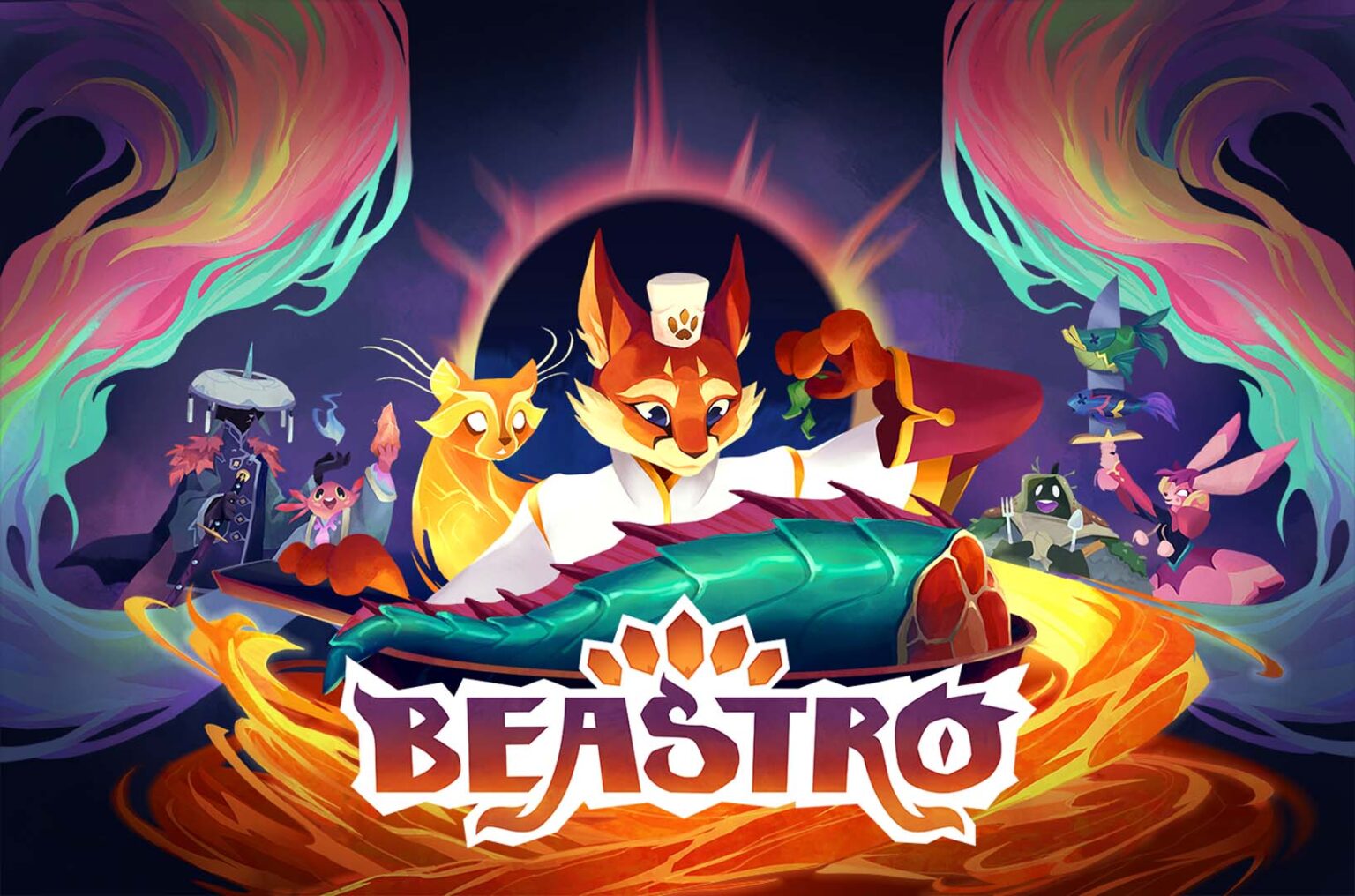

Beastro is the newest game from Timberline Studio. You play as Panko, a sous chef who has been thrust into the responsibility of head chef since the previous head chef’s disappearance. With the help of Flambe, a magical fire spirit, Panko can add flavor magic to his dishes and give caretakers, the champions of this world, more abilities and strength while fighting monsters.
The story is strong and slowly unveils itself. I was caught up in the mystery of the previous head chef’s disappearance and the closing of the portals. There was much more focus on story beats than I expected coming into this game. Not that it is a negative, but a surprise, since I expected more of a focus on gameplay, with hints of lore more akin to Stardew Valley and other cozy games.
The art direction is a visual feast, where so much personality is interwoven into the characters. The caretakers have a flavor-based speciality, and you can see its influence in how they act, dress, and fight. The characters moved stiffly, and poses were rigid, but that isn’t a complaint of the overall presentation. Two standouts were Flambe and Oyshi. Oyshi was so wonderfully constructed, and one of my favorite characters I have seen this year in gaming. Little touches made the world feel lived in, such as Flambe lying inside of the oven when restaurant service started.
Beastro consists of three distinct phases: the ingredient-gathering morning, the restaurant and recipe development afternoon, and the deck builder rogue-lite nighttime. Each phase has a balance of positives and negatives, but the main star of this game’s dish is the nighttime deck builder phase.

The nighttime phase has the most polish and is clearly the primary driver of the overall game. Graphically, the puppet story structure is gorgeous with beautiful monster design interwoven in a distinct visual style (within an already distinct visual style). The characters and monsters are on sticks, simulating a story being told for entertainment. The best comparison I can come up with is Paper Mario: The Thousand Year Door and how they would be on stage for combat sequences. The nighttime phases were always interesting visually, and it was honestly a bit sad when they ended (sometimes abruptly due to the story beats taking priority over extended gameplay).
The gameplay itself is good, bordering on great. The ‘flavor wheel’ brings in the paper, rock, scissors of advantage and weaknesses like every other card game, but feels more special because of how it is so well integrated into the larger culinary themes. The ‘flavor enhancements’ were fun, and the cards had interesting abilities that I started to really dive into as Beastro became more complex. The harshness of having the wrong card played at the wrong time held back the phase from being great.
If you have a deck that pulls the wrong hand (which happens often in a rogue-lite), then the consequences are harsh. There’s really no chip away or mitigation on an unlucky roll; you are screwed. On the first main boss, I had it down to 2 HP and hit a run where there was nothing I could do but take the heavy damage.
The other two phases are interesting in their structure. I don’t know if it was scope creep or an expectation that they needed more beef, but both had perplexing additions. The morning phase is the coziest, where you collect ingredients, visit vendors, and speak to various citizens in town. A straightforward phase, and I found my routine pretty quickly. The lack of a jump option made navigating the village frustrating. I don’t know if I missed it, but I couldn’t adjust the camera, and the standard camera made the world feel claustrophobic.

The afternoon phase was the least baked of the three. You run the restaurant in a light sim and engage in different Cooking Mama-style mini-games. However, by day ten, I was past the mini-games. It’s not that they are bad; they just offer nothing of value to the experience. The boiling mini-game was a basketball free-throw-style carnival game, but stuck out like a sore thumb because the free-throw animation did not fit the game at all and looked like it was added here because ‘they just needed something.’
The recipe building part, which is the essential mini-game that goes directly into the battle phase, has the player laying out ingredients onto a grid to create a balanced flavor profile. It is very successful and fleshed out, which makes the previous mini-games even more egregious and out of place.
Beastro is being labeled as a cozy game, and I have umbrage with the classification. The game is aesthetically cozy, but the gameplay is far from it.
Every phase bleeds right into the next, and a misstep in one creates a downstream issue for the entire day. I actually found myself becoming risk-averse during my nighttime runs, especially when building conservative dishes because I didn’t want to ‘waste’ a run, as I wouldn’t get to do another for 5-10 minutes. Which is a shame, because thematically recipe experimentation is one of the joys of cooking, and the rogue-lite genre sings when you find that unexpected deck or power combination.
For the majority of Beastro, I felt like I was at the whim of the developer’s intended way to play and hit many artificial ceilings and background machinations to ensure progress stopped at the right time. One of the highs of a rogue-like game is when you accidentally (or purposely) hit a great deck and ‘punch above your weight’ and go a little bit farther than you probably should. There are so many starts and stops for story beats, or when you see that there is no possible way you can beat an enemy with the decks being given, it can be deflating that they have put a barrier in front of you unless you ‘did their grind.’

On the second caretaker, as I was starting to get comfortable with the fighting/card system, I can tell immediately that the ceiling on my deck had no chance to beat the boss. Many ingredients and recipes are locked behind story beats, and the caretakers level up and receive stronger cards as a result of giving them successful dishes. For the majority of the first five hours, I accepted that Timberline Studio had a grand plan for me, and I was simply going through the motions.
Beastro desperately needs time-saving mechanics. If I make a perfect recipe, shouldn’t I be able to save it for future use like the custom card decks in Hades 2? Like a real restaurateur during closing time, shouldn’t I be able to submit an order form that auto-buys the ingredients I want for the next morning?
An odd, but fitting from my perspective, game comparison is the ‘be a pro/road to the show’ gameplay modes found in many modern sports games. They usually also have multiple, distinct phases like the real game and practices, but the main difference from them to Beastro is that you can simulate the phases you don’t enjoy in those games. If you want to max out each phase, you can, but if you want ‘ok’ improvement, then you can do that. In Beastro, you need to fully engage with each phase to move forward.
Beastro has a Michelin star restaurant exterior but problems in the kitchen when service starts. There is a specific type of player base to whom this genre will appeal, but other gamers will wish they had more agency over how to play and which aspects to focus on.




You must be logged in to post a comment.