

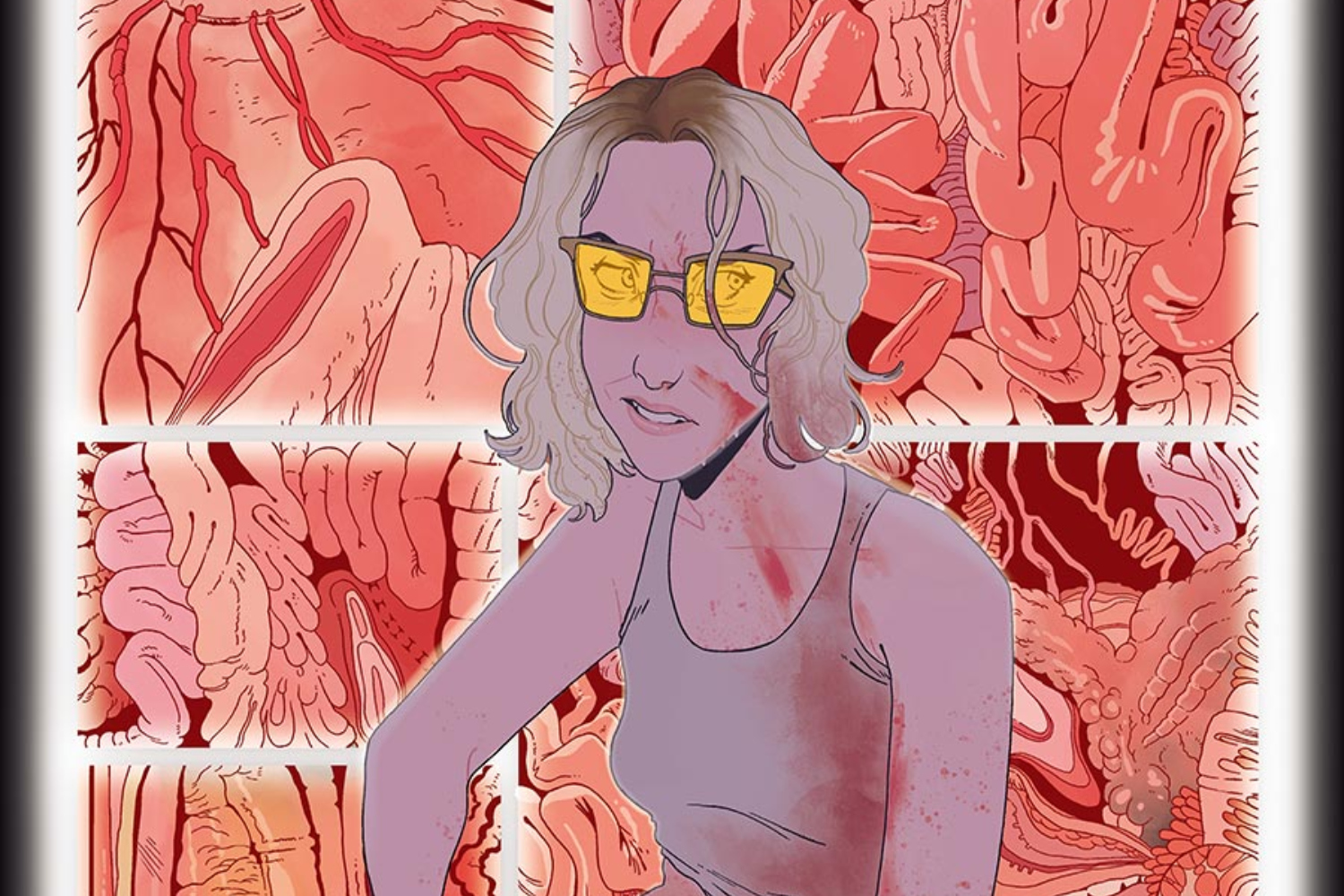

Sure, distance makes the heart grow fonder, but it also tempers expectations. That last bit just doesn’t sound very romantic.
Because as is my norm (#humblebrag), I was up close and personal with Did You Hear About Mimi Green? for quite some time. And that proximity with the book (and even creators Connor Goldsmith and Josh Cornillon) isn’t just exciting, but the more this “approach” happens, the easier it is to engage with the book on a deeper, wider, more impactful level.
I felt myself truly caught up in this tale of a writer who’d been “cancelled” heading to rehab — only to find themselves sucked into some strange body horror dream dimension. (Sharing a profession and also maneuvering an increasingly tenuous digital minefield furthered that connection.) Yes, the book was good — a timely, heartfelt dissection of parasocial relationships, social media, and accountability — but there was no denying that at least some of that connection was the buzzy rush that comes when you live in/with a book for so long.
Flash forward several weeks, and we come to Mimi Green #2. With the initial “surge” having mostly rescinded, we nonetheless continue to find a darn good book even as certain aspects gain vital clarity.

Courtesy of Dark Horse Comics.
The thing I noticed right away with Mimi Green #2 is how much the various storylines feel wholly distinct but expertly layered — it lets everything stand on its own as much as everything connects back together. Natalie’s search for Mimi is more grounded, where the story is often in the details (like brochures and open pill bottles). Meanwhile, Mimi’s therapy employs a lot of specific devices (like huge open rooms humming with thematic heft). And, of course, there’s the nightly “trips” to the body horror dimension, where the gore really shines in wonderful, unnerving delight. Expertly uniting it all, Cornillon is clearly a pro at balancing these unique aesthetics through that deep emphasis on faces and expressions, and his take on humanity is as charming as it its unsettling. And with just four issues total, it’s nice that we get so much variety in such a tight package.
At the same time, though, that core efficiency doesn’t exist across the entirety of Mimi Green. Tyler, for instance, is another patient at the mysterious Answers rehab center. So far, though, he most feels a smidge under-developed, or as if he’s playing a rather limited supporting role. His “lack” of presence was something even Goldsmith mentioned during our chat, and while I wish Tyler did have a little more resonance, the fact that we know ahead of time somehow makes it a little easier. (And perhaps that aspect speaks further to my specific relationship with this book and the emotional energy I’ve poured into it already.)

Courtesy of Dark Horse Comics.
And while I think Tyler could totally emerge as this bright, vivid player in the final two issues, I’m not sure I care enough. Or, maybe that it’s not as much of a priority for me as a reader. None of that’s at all a slight against the character — rather, I think Mimi Green is about so many other interesting things, and Tyler’s immersion would only be a solid bonus. Not only that, but other characters get similar page time and treatments, and they stand out more robustly and feel more intriguing at this point. I only mention the Tyler “stuff” because it’s clear that this book is working — just not as fully and/or inclusively as perhaps the creators might’ve hoped.
Natalie is very much still on the outside of the core story in some key ways as she’s tirelessly searching for Mimi. But there’s this sense that we’re getting to know her slowly and deliberately — not only visually (she keeps a bat in her truck, which speaks volumes), but in the slow-burning dedication she holds for her GF (who hasn’t always regarded her in the same venerated light). Whereas Tyler is still a mystery (or just plain under-fulfilled), Natalie is a puzzle box slowly unveiling in a way that fits with the tone and efficiency of Mimi Green as a whole.
Natalie is also very our way into other parts of Mimi’s life, including a new “friend” in Claudia, who offers some interesting insights into our favorite writer. And that aspect is, yet again, more subtle but intentful, which is a speed that continues to suit this book by feeling like it uses more of its space while still fostering a moody immersion that’s befitting the horror genre.

Courtesy of Dark Horse Comics.
And while Ashley doesn’t get quite as much space when compared to Natalie, you can’t deny her sheer importance following Mimi Green #2. She’s clearly got some existing experience and general insights into the body horror realm that the Answers’ residents fall into, and that connection becomes the spark for understanding what this place really means (thematically and beyond). I can say that connection is a little more overt/obvious in some ways, but it mostly gives this place a sense of proper stakes as much as it also furthers this book’s interests in personalizing its core themes.
That means our immersion in this realm starts to further how Mimi Green enthusiastically connects the emotional with the physical, and how that gives us new angles into the core ideas of body image and the grounding of online discourse. That part is also addressed when we see a pre-“It Girl” Mimi; her transformation (depicted in unflinching detail) makes undeniably real the marriage of the physical and the psychic.
Again, while Ashley doesn’t get too much time, she’s ultimately positioned in a way that respects her (very weird) journey while pushing the storyline forward in some extra important ways. It’s through Ashley (in addition to pre-transformation Mimi) that the face of this world is made undeniably, nakedly real. She’s a solid example of a character placed into a specific context while still allowed to be an actual person.

Courtesy of Dark Horse Comics.
Still, given the book’s title, the real star is always going to be Mimi Green. And in keeping with the efficiency aspect of this series, Mimi has a few varied experiences across issue #2 (aside from her prior surgery). Some of the more compelling stuff once more stems from these little “pops” of other insight/information — like her thoughts on her core relationships and even some small but mighty personal “lore.” (A lot of this comes from Mimi’s therapist, Mara, who is sort of like a less flashy Ashley, until she’s not. It’s another way Mimi Green gives characters different roles/standings to drive drama, tension, info, etc.)
Once more, I love the seemingly low stakes — it feels like we’re just leisurely sauntering through this book, and when a moment does land, it takes us a second to recognize that we’ve effectively been cleaved in half. It’s absolutely how you work with just four issues and still foster a mood that can still slowly sink in its massive claws.
However, one of the better moments of this issue has to do with a rather large reveal about how Mimi “operates” in the body horror “underworld.” On the one hand, it’s even more visual goodies — we get not only blood and viscera, but some “combat” in a way that’s thrilling but never feels disconnected from the actual nature of Mimi Green. But then there’s the obvious relevance about what this “power” means for the story as a whole. It was already clear that Mimi has a unique role or bond to this realm, but after she goes all Wolverine on it, a few key questions emerge.

Courtesy of Dark Horse Comics.
Like, what is this place really, and what’s it doing to the people it catches? Has Mimi actually been here before? And if so, what role does she play, as its keeper or as its downfall? We don’t get too many answers, but we do get heaps more lore — this place has become more clear in all the right ways, and we have the sense that it’s fully established even as we don’t know the true shape of it all. It’s quite the understanding and immersion to have after just two issues, and more proof that Mimi Green is making all the right moves (even as it also made some others moves that aren’t so vital or bold).
It’s ultimately just proof that this story doesn’t need a lot of pomp and circumstance to really work (though, in my case, I could never truly deny the charm of such a rather specific immersion into this world). Because when you approach genre storytelling with such a dedicated level of dissection, while also putting interesting characters first and continually having a clear thematic message, you can do some great things — no matter the space you have to operate within or issues that you might encounter.
There’s not that much distance left before the Mimi Green finale, but I already sense that the trip to the end will be a bloody good time.



You must be logged in to post a comment.