

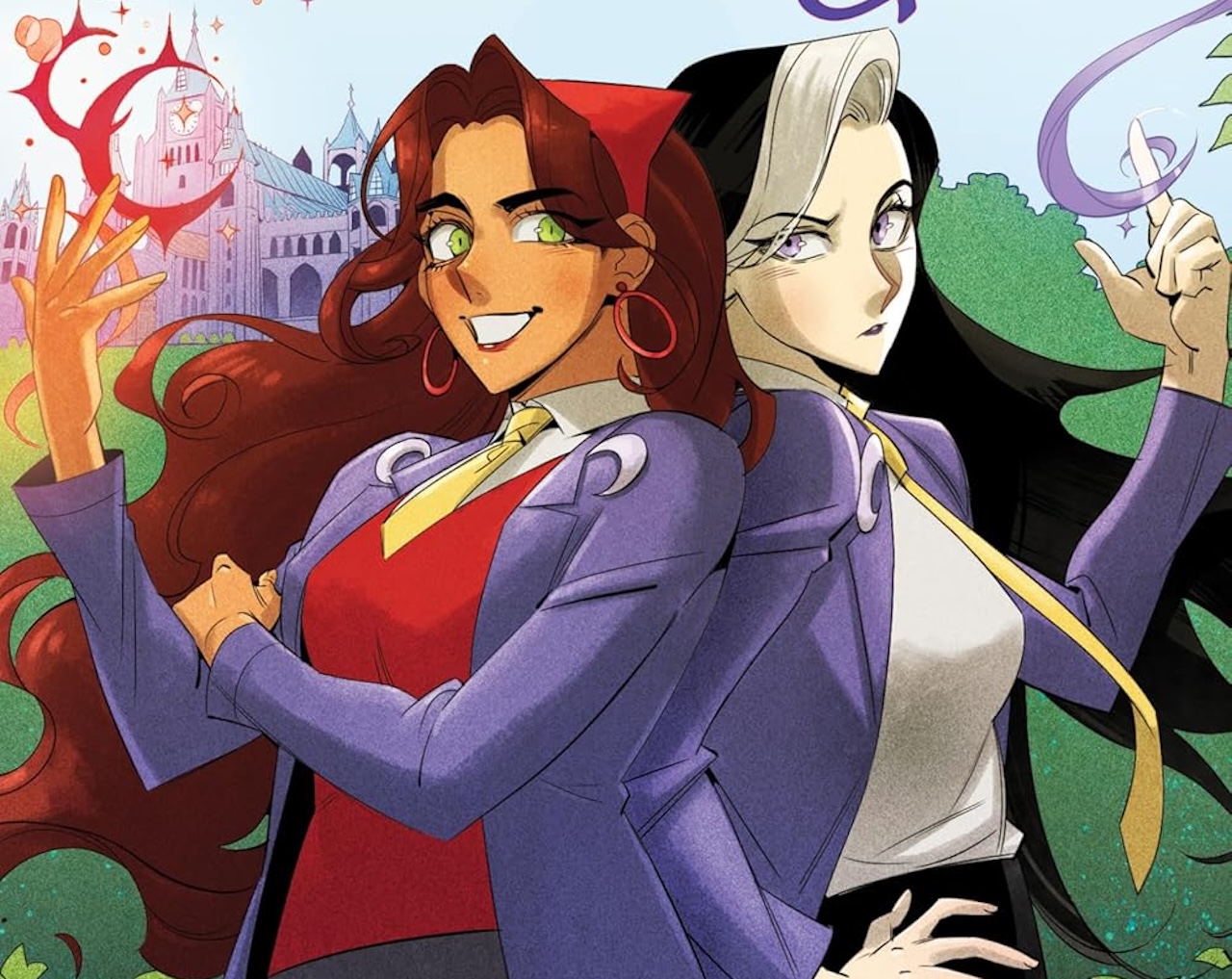

While debates often rage around Marvel Comics’ current line-up of titles, especially those featuring Spider-Man and the X-Men, I feel that Marvel’s Infinity Comics often get short shaft. Part of that is due to the fact that they’re exclusive to Marvel Unlimited, but I also feel that this gives creators the freedom to play with Marvel icons in a way that some of the print titles don’t. Case in point: House of Harkness by Pretti Chhibber, Jodi Nishijima, and Kiichi Mizushima feels like it was tailor-made for True Believers and manga fans alike.
House of Harkness‘s big swings start as early as its premise, which reimagines Wanda Maximoff as a 16-year-old wanting to master her innate chaos magic. The once and future Scarlet Witch finds herself at the House of Harkness, a school meant for magical creatures…and immediately finds herself at odds with top student Agatha Harkness, whose family runs said school. In addition to making friends and dealing with a game of oneupmanship with Agatha, Wanda soon discovers that there are dark forces afoot in the school and might need to rely on Agatha’s help to stop them.
It’s kind of crazy how House of Harkness manages to take nearly every magical character under Marvel’s umbrella and fit them into the “Academy of Adventure” storytelling trope, but Chhibber deserves a gold medal for not only making these changes work but also make sense. Stephen Strange may not be a doctor, yet he still retains the arrogance that led his 616 counterpart to become the Master of the Mystic Arts. Loki and Nightmare both play their usual tricks, though it’s less resigned to world conquest and more annoying their fellow students. Agatha has her own Mean Girls-esque clique consisting of Damion Hellstrom and Morgan Le Fay.

Marvel
Perhaps my favorite moments involve the friends that Wanda makes, and her dynamic with Agatha. On the former side you have Nico Minoru, which I genuinely appreciate as a longtime fan of Runaways, and Jericho Drumm, which calls back to the immensely underrated romance he and Wanda shared in Gerry Duggan’s Uncanny Avengers. On the latter side, Chhibber slowly starts to showcase that Wanda and Agatha may not be as at odds as they think; Agatha is under pressure from her parents to succeed, while Wanda has to jump through hoops to prove that she “belongs” at the House of Harkness. As the oldest of three kids who had to take care of his siblings while also maintaining good grades, I can relate.
Nishijima and Mizushima bring a manga-inspired flair to House of Harkness, particularly in characters’ facial expressions. When Wanda’s surprised, her eyes grow big; when she’s angry, they narrow to slits. The designs for the clothes also stand out, particularly with the House of Harkness’ school uniform that has every student wearing the same shade of purple and twin cresent moons. Nishijima and Mizushima also feature design elements that hearken back to characters’ superheroic identities; Wanda’s billowing hair is wrapped up in a red scarf that resembles her Scarlet Witch headdress, and Strange has a long flowing scarf meant to represent his future Cloak of Leviation.
House of Harkness puts a unique twist on Marvel’s magic characters, mixing boarding school tropes and manga-inspired artwork with a clever and compelling story. If you read this comic and love it, you should definitely check out more of Marvel’s Infinity Comics – particularly Realmguard, which Chhibber is currently scripting and Lorenzo Tammetta is illustrating.




You must be logged in to post a comment.