

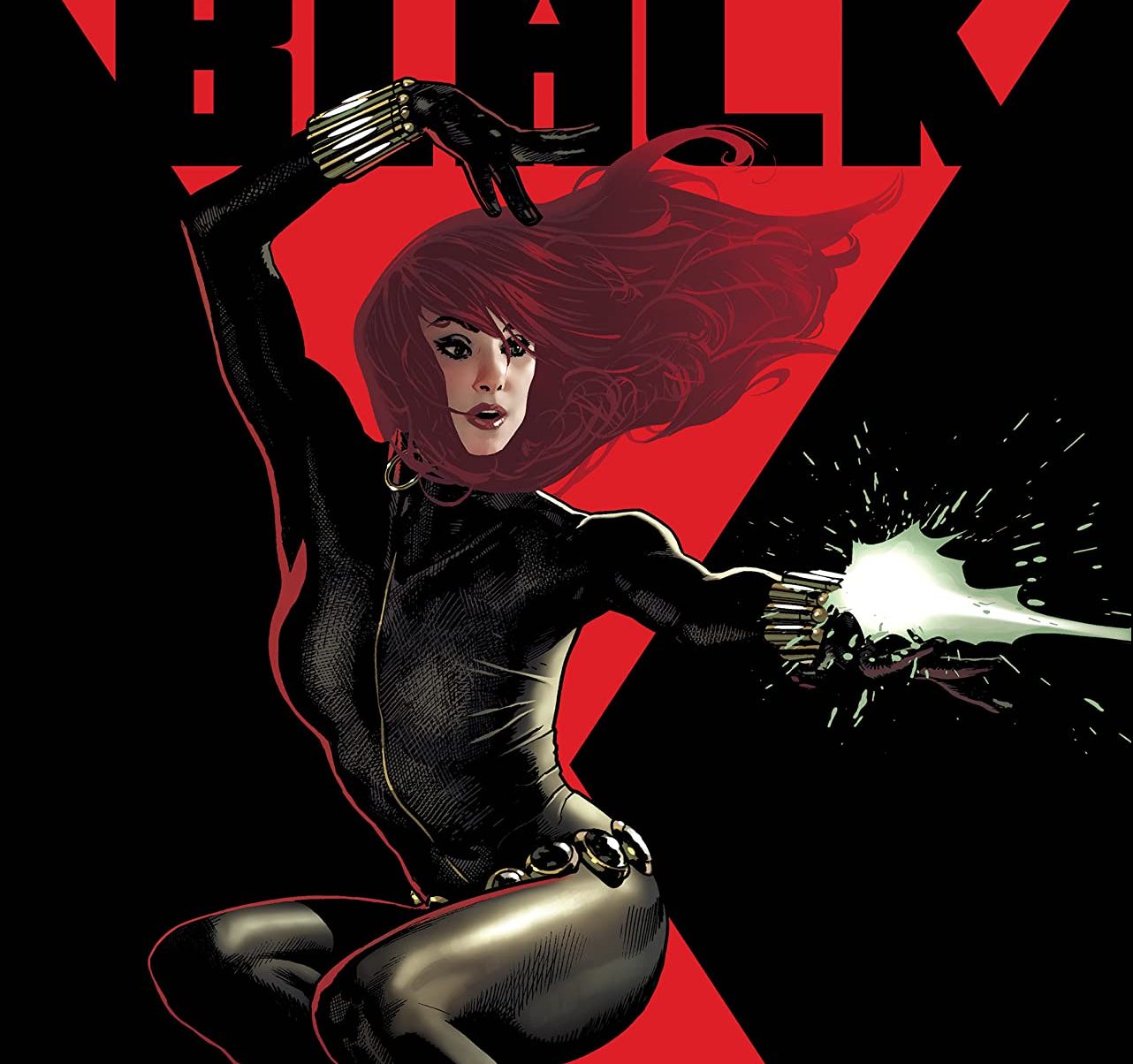

There is a problem with Black Widow, and it’s such an obvious problem: she has no definitive narrative. No primary motivation, no ‘with great power’ catchphrase, no continuous, uninterrupted flow of issues in which the reader can grasp her and the creators can explore her. With a handful of minis and ongoings behind her (not to mention a half-dozen runs paying sidekick to Daredevil, Bucky, and the like), Nat has yet to have a single narrative truly cement the character firmly into her own story.

Kelly Thompson and Elena Casagrande set out to solve that problem in their run of Black Widow, the character’s eighth series. The results, in this first collected volume, are a bit mixed.
Don’t get me wrong: the book is great. Casagrande’s art is immensely gorgeous, each character rendered in such a way that they feel resolutely themselves, solidly in their own bodies, and Jordie Bellaire’s colors make the world feel vibrant and varied, bright in the day-to-day world and gloomy and dark in the realm of espionage.
Recent Marvel heavy-hitter Kelly Thompson’s script is likewise on point — mostly. She exhibits a unique understanding of the characters and their chemistry, from a sulking Arcade wishing he was running Murderworld to a tonal tension between Hawkeye and Winter Soldier that presents the differences between those characters in a subtle, knowing way.

What strikes me as troublesome — a concern that keeps coming up with each friend I discuss the book with — is Natasha herself. The central concept of the story — that a shadowy cabal of Widow’s villains has mind-controlled her into an alternate life — is as solid and celebratory of the zaniness inherent in the Marvel Universe can be; the villains give Widow, and I quote, “her own personal paradise” to distract her from their various, off-panel nefarious deeds. That Nat’s “personal paradise” seems to be a white-bread, happily-ever-after, rom-com domesticity seems to me like a deeply misunderstood reading of the character by either the villains at hand or by Thompson herself.

Marvel Comics
A fiancé, likewise mind-controlled, and a genetically engineered son seem like so much problematic clutter, both within the story and without. Narratively, there’s the question of logistics and resources — shouldn’t we be concerned about this guy’s abduction and the life he has no memory of living before? Is creating a child in a lab so utterly commonplace in the Marvel Universe as to be employed easily by Arcade? Is there a threat of implying motherhood and nesting are the ultimate goals of any woman (even those with a huge inclination for murder)?

These concerns aside, the larger truth is that the book is fun. Thompson does a lot of work to finally jell a supporting cast for a character that has, for most of her career, been the supporting cast. The characters are all familiar faces — one of them was is a Widow with her own dubious titles behind her — but it’s the way that Thompson unites them and plays them off one another that’s the real highlight.
Further, the book does not waver from the most prominent aspect of Natasha Romanoff: she absolutely cleans house. Even trapped in a false life, Nat is incredible and shows that even small-scale action is, for this character, bombastic and exciting, and no matter her situation she is keyed to just utterly wreck people’s lives. Casagrande’s two-page spreads of Nat kicking ass are close to character-defining.
Is this the Black Widow that will, finally, land us a long-lasting Widow narrative? Will this provide, for the character, the unexpected rebranding that might make the character a little more accessible and vital? With regret, I’d say The Ties That Bind answers a half-questioning, “Not yet?”




You must be logged in to post a comment Login