

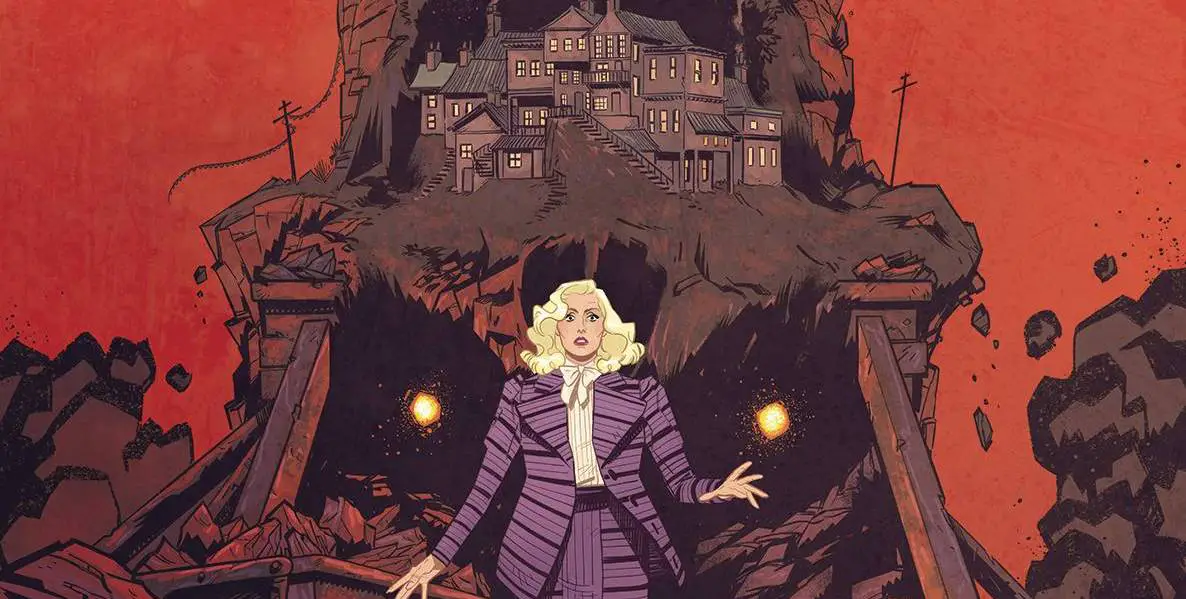

Scott Snyder’s Dark Spaces “imprint” at IDW is growing next month with The Hollywood Special. Crafted by writer Jeremy Lambert, and with art by Claire Roe and colors by Jordie Bellaire, the story drops readers into a Old Hollywood-era adventure as an actress uncovers something truly horrific in a small town. Set to make its star-studded debut on August 16 (retailers have till Sunday, July 9 to put orders in), the first issue is hugely exciting and deliciously unnerving.
Miss Drake, our heroine, is on a tour of America in the early 1940s to help inspire folks to buy war bonds. Once a huge star, we soon learn that it’s hard for Drake and company to gather any audience. That’s especially true of the aforementioned small town, which contains a horrific secret and an even more horrific monster running about. It is, as Snyder himself mentioned, a proper “lockbox psychological drama,” and another compelling instance of the poignant work being done across Dark Spaces.
The mystery is strong with The Hollywood Special, and so what better way to uncover its tasty morsels of secrets than chatting with Lambert directly? Not only do we dig into the inspirations behind this intriguing new horror series, but also uncover Lambert’s personal journey of working in Hollywood, how this series found a home under Dark Spaces, and much more.

Courtesy of IDW.
AIPT: What’s the elevator pitch for Hollywood Special?
Jeremy Lambert: The Hollywood Special is a 1942 luxury train touring the United States to support the war effort. On board is fading star Vivian Drake, doing her part to boost morale and finally give the tabloids something other than her nosediving career and shambles of a family life to talk about. But when the Special pulls into the coal town of Minersville, PA amid the collapse of a mine, Vivian finds herself facing every failure and bad memory she’s bottled up in the form of what the miners found in the dark – the thing they call the Mismatch Man, who feeds on pain and regret… and Vivian’s got both in spades.
AIPT: As a film nerd and one who majored in it, I feel like I can sense some inspiration from classic cinema (Ace in the Hole comes to mind!). What sort of films might one see homages to or connections with?
JFL: There’s so much inspiration from classic movies! Especially playing with how those stories were structured, how stars were introduced in certain movies and how their off-screen lives influenced their on-screen versions and things like that. So, in general, I was looking to films between 1930-1960. Especially 1933-1944. So I had pulled a lot of clips and photos and one-sheet references for the kinds of films that Vivian Drake and Lou Gaines would have starred in to help shape their look and background, but it’s really Claire and Jordie who brought so much more to them.
And for a more specific example – in our story, Vivian Drake used to star in her own pulpy serial (like Flash Gordon, Buck Rogers, or a 1930s update of something like The Perils of Pauline) called The Adventures of Sally Steel. And how that affected the arc of her career in terms of money, but also how she was seen in the public eye and in the eye of critics too. And then we do have a nod to Christmas in Connecticut at some point, as well as King Kong. (I actually haven’t seen Ace in the Hole so I’ll add that to the list, with my thanks for the recommendation!)

Courtesy of IDW.
AIPT: I understand you’ve worked in the biz yourself, with a lot of casting director credits. For the outsider looking in, how has working in Hollywood helped your comics writing?
JFL: Yes, OK, so the history there is I went to film school, worked in extras casting for 5 years, and then I was head of production at Breakwater Studios for the next 5 years, producing mostly documentaries alongside the occasional narrative film.
What’s important to me here is telling stories that work best as comics. Stories that champion the language of comics. But with that, it’s impossible to remove the broader influence of how you experience stories in other mediums too, and my work experience in film has definitely shaped how I write comics. For a decade I was able to watch directors work, writers, editors, cinematographers, producers, production designers, art directors, costume designers, assistant directors, hair and makeup, etc – I was basically able to watch, and be a part of, one massive team work towards one very common goal: what’s best for our story (and on time/under budget)?
I started by learning all this from the vantage point of extras casting, but then I was producing on set and responsible for budgets, and then sitting in edit bays helping to put stories together and just trying to find that story’s heartbeat, one beat at a time. One frame after the next. One line after the next. It was a massive opportunity to learn storytelling, to learn revision, to learn compromise, to learn how to be concise and all of it can be applied to comic writing. (Also, if we’re talking about film editing, I actually believe that is writing.) For me it was constant lessons in trying to achieve the most distilled, essential form of visual storytelling.
Show don’t tell. Show that bit of character, or that emotion through a look, through non-verbal acting or through color/wardrobe/hair, and do it in one frame or in one panel instead of having a wall of heavy dialogue (he says, as he rambles on). And in order to do that – respect for pre-production is key. You really have to know your characters and the story elements that have to shine in a given frame/page. Just constant lessons in character, structure, pacing, and then beyond the world of the story were things I brought into comics writing that were just as important: compassion and respect for coworkers, preparedness, clear communication, and so much more.
If you find yourself in a creative industry like that, I’d say do your job, go above and beyond to deliver on your responsibilities absolutely. But also take the time to watch them work, take notes, study, learn from working professionals. I found that fascinating. Add those weapons to your arsenal, or reject them if you disagree. And if it’s an industry without that element of creativity, you might not get the focus on craft, but you can also learn professionalism and preparedness which are so necessary to work in comics as well, so there’s that benefit too. We just don’t talk about those things a lot because it’s not quite as exciting. But they’re just as important.

Courtesy of IDW.
AIPT: When it comes to a period piece like this, what sort of research goes into getting the finer details right about the era?
JFL: I really love research, so quite a bit. It’s kind of a constant that goes hand in hand with the actual scripting. In a perfect world, I research, then I script Issue 1, then I communicate any visual research to the team via hyperlinks in the script but I also put together a lookbook. But a lot of the time, it’s all happening at once. For Hollywood Special, I made a lookbook of visual references for Claire and Jordie (character reference, costume, props, lighting, color palettes, other visual influences that help translate the tone, etc). I do think it’s the writer’s responsibility to bring that research to the table, especially if it’s a period piece, providing as much as possible for your co-creator/artist to work with and that way, using Hollywood Special as an example, Claire and Jordie can take what they like and leave what they don’t, and then I can hopefully provide a springboard for their own influences and inspirations too.

Courtesy of IDW.
AIPT: This title is under the Dark Spaces label; how was Scott Snyder involved in the project?
JFL: Scott put together the line with IDW co-publisher Mark Doyle. And I had sent this pitch over to Mark back in early 2021. Some time later, I got a call from Mark, who told me that Scott was starting up the Dark Spaces line at IDW and that both he and Scott loved my pitch for The Hollywood Special, which on its own was just kind of shocking to hear. Scott wanted to help shepherd it into existence via the Dark Spaces line. Which, I mean, what a dream come true, Scott being someone whose work I’ve admired for a long time. And from there I had a call with Scott and Mark, and Scott gave some really wonderful feedback on the pitch and answered questions, just being so helpful and supportive. So he’s always made himself available for things like that in terms of support, mentorship, and brainstorming.
AIPT: For the horror aficionado, what does The Hollywood Special have for them they can’t get anywhere else?
JFL: For me, all good horror starts with heart. You have to care. That’s always my North Star, and that’s certainly our North Star here. That you can get elsewhere, sure. I’m far from the first person to say that. But our goal here is to tell a heartfelt horror story within this fascinating snowglobe of a world and clash of personalities in Minersville, 1942. What you can’t get anywhere else is our representation of regret and horror in the form of the Mismatch Man and what Vivian has to confront down in the mine, you’re not going to be able to guess what’s waiting for her down there. You can’t get Claire Roe and Jordie Bellaire shattering your heart into a thousand pieces and putting it back together again inside of a handful of panels anywhere else. I can’t wait for people to see their work. Just as a fan of comics, I’m elated. And so grateful that I get to be a part of the team.
The Hollywood Special – if I’m doing my job right because I know for a fact that Claire, Jordie, and Becca are and then some – has the draw and trappings of a creature feature with the layered mystery and nuanced intrigue of a character driven horror.

Courtesy of IDW.
AIPT: Claire Roe’s art is wickedly good in this. Is there a specific element she blew away your expectations with?
JFL: Every element, truly. I’ve been a fan of Claire’s art for a long time, and I’ve always wanted to work with her. I think what surprised me most is just how much her acting and expression work alone are things that I can stare at forever, whenever those pages come in. The most beautiful thing about making comics for me is the collaboration, and working with someone like Claire is truly a dream. How she structures pages and sequences, subtle changes, major changes, the added or subtracted panel, how she uses (unscripted) repeated motifs to help tell the story, a left field idea that does more to land an emotional moment than anything I could have written in a script, and so on. I could seriously wax poetic for too long but I’ll stop there before she kills me.

Courtesy of IDW.
AIPT: We here at AIPT loved your Doom Patrol run. I believe we’re quoted on one of the trades, and I think a lot of folks will dig what you’re cooking up here. What made you get back into writing comics with this and The Night Mother (or maybe you never left!)?
JFL: Ha, I never left! First off, thank you very much for the kind words on Doom Patrol, that was some of the most fun I’ve had working in comics, just Gerard and I cooped up and writing issues sometimes in as quickly as 24 hours. Which for me is extremely fast. I normally take a much longer time to sit with something and revise it and so does he. But that book was sometimes like a livewire of emotion and us being very much in the present. I loved it.
Second, I think this is a good opportunity for me to comment on just comics writing in general, and I appreciate you bringing it up. I actually left my job in film to work on writing comics full time, which is a gamble. I think some folks could be a bit mystified as to how things come together and I just wanted to say that I’ve been writing mornings/nights/weekends since 2011 (I’ve been full-time since 2021), in the hope that these stories come together in the right way and can find their way out into the world. Luckily The Hollywood Special with Claire is one of those things.
An unannounced original is one of those things. The Night Mother with Alexa Sharpe is one of them too. So all this to say – I know folks who are down about not being on shelves every month or sometimes even for a year but still working their tails off, and I just wanted to put this out there and say (one) that I’m grateful, (two) take care of yourself but also please try to do what you love and spend that time with people you love, and (three) that I see everyone out there working as hard as they can to put their stories into the world. You got this.





You must be logged in to post a comment Login