

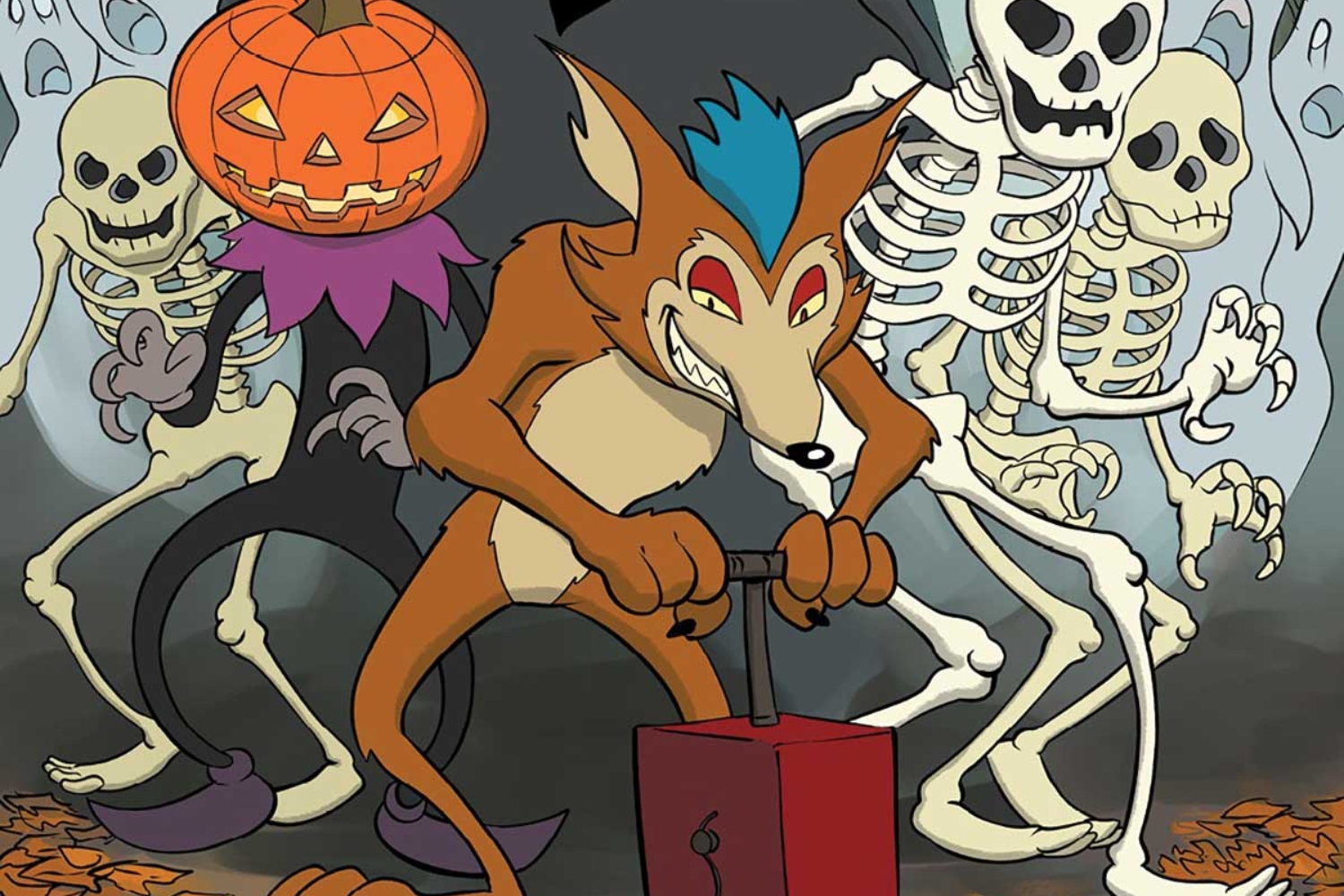

With its third issue, Uncanny Valley reached a level of magic and whimsy that made me think of The Neverending Story. It was a testament to the power of the creative team (writer Tony Fleecs, artist Dave Wachter, and letterer Pat Brosseau), and how they used cartoons, nostalgia, and our own familial connections to tell this perpetually poignant story about fighting for your place in the world.
But the fourth and antepenultimate issue of Uncanny Valley is somehow even more magical than issue #3, as Oliver and company face some real hard truths.
And by hard truths, I mean that Pecos Peet had intended to give up his grandson to The First (as we saw at the very end of #3). Issue #4, then, is all about the resulting fallout, not only between Peet and Oliver but also Peet and his daughter/Oliver’s mom, Margaret. Without revealing too much, it’s less that Peet’s somehow turned heel or something, and the real layout of this chapter focuses on the big but accidental ways family hurts us. It’s extended by delving into Margaret’s childhood, and we see how poorly prepared Peet proved to be when it came to fatherhood.
All of it together shows us how horseplay and whimsy can only go so far, and how the real work of loved ones/family is in being there for others through all the awkward and terrible moments, and to meet someone where they need to be. Peet’s not a bad guy whatsoever, and we see how dedicated he is to doing right by his family, but how he doesn’t have the depth or maturity to really be there as he needed. Uncanny Valley has, at least so far, been about the reality of family life, and how we often deal in make-believe and illusions to get through everyday. That, and finding yourself isn’t just a cartoonish adventure you can complete in 30 minutes, but this painful and uncomfortable path that takes real dedication.

BOOM! Studios
This issue really drove those points home in a truly massive way by giving us this really dedicated look at Peet, and how as someone balancing these two worlds, he’s acutely aware of the gap and how he often can’t measure up. Being good isn’t enough, it seems, and we learn that it takes more deliberate action and concern if you’re really going to save the day and be a proper hero. It was an extra hard-hitting chapter that laid bare a lot of the turmoil these characters are only now just truly facing.
From a visuals/art perspective, there was perhaps just as much joy and whimsy as ever. To begin, I have to give the art team a special shoutout for my favorite visual device/gag thus far, a fleeting but powerful joke lovingly pulled from the Scooby Doo playbook. And beyond that, we got even more hijinks than ever, including a really fun and silly look at how Peet tackles or works through life’s problems. But as you’ve likely guessed from the larger tone of this issue, it wasn’t all fun and games.

BOOM! Studios
Rather, Peet’s whole parenting playbook (ride bulls, wrangle tornadoes, etc.) is just the physical manifestation of his own inadequacies. He’s a man who emits fun and cartoonish silliness, and yet these moments when we do get to speed things up and enjoy life only make the resulting slow down (the next big life problem) cut all that deeper still. It’s all in the way these moments are positioned and layered together; the art team does wonders in comparing and juxtaposing the deeply serious real world and the cartoon whimsy, and through that we start to see Peet and the larger struggle in a way that’s both infinitely clear and yet obfuscated in a sense (in a way that perhaps mimics Peet’s own experiences in the world).
There’s even a point where a really silly cartoon explosion is used to tee up some flashbacks — that device isn’t just super-duper charming, but it also drives homes these ideas even further. It’s the sense that Peet thinks he can escape back to the things he knows when things get hard, and it’s his daughter (and eventually grandson) begging him to just be in this terse, heartbreaking moment with him. He clearly can’t, and we start to see how they can’t hate him for this but how no one can stay with him for any meaningful length of time. It’s a dynamic that isn’t just emotionally potent, but it’s vital for the rest of the issue.

BOOM! Studios
By the time we see The First toward the issue’s very end, part of you welcomes his exaggerated ’80s Saturday morning cartoon take on villainy. As if such a clearly wicked creature has chosen a path for himself, and he doesn’t fool himself in trying to be anything but a cartoon (even if it’s a totally evil cartoon). It’s a decision that’s almost quite refreshing, and comes in contrast to Peet as he tries to have it both ways when he clearly cannot. It all just drives home the core tension at this issue: not being what you are hurts others, and there’s a power in accepting your strengths and weaknesses alike in the name of being a better parent/spouse/friend/etc.
I won’t spoil the end, but it involves Peet in a decision that should prove interesting as it also cements what Uncanny Valley does really well. It’s a moment that whips up some real odds and a sense of danger and firmly attaches it to our old cowpoke buddy. Is he as untouchable as we think? Can he be affected in a way that makes for some big changes? Or, is it all just too late for Peet, his family, and any chances of his “redemption” as a real father in the real, ugly world? Whatever awaits this family, we can be damn sure it’ll be as magical (and gut-wrenching) as all get out.




You must be logged in to post a comment Login