

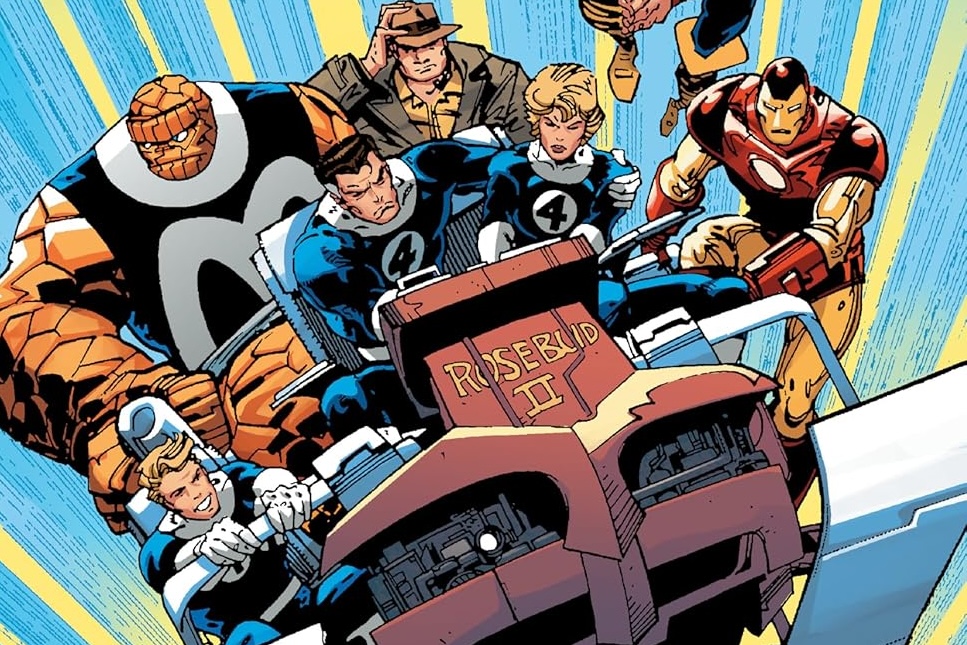

If you had never read any Fantastic Four comic except those collected in Fantastic Four Epic Collection: Into the Time Stream, you might be forgiven for thinking that the Fantastic Four is a team whose sole gimmick was time travel shenanigans. Well, time travel shenanigans and stiff, near-actionless legal proceedings.
The volume begins writer/artist Walt Simonson’s bombastic 1990s run on the book – something fans at the time might have salivated over given Walt’s fan-favorite run on Thor a decade earlier (let alone his phenomenal work across the industry since 1973). His scripting begins in issue #334, but the three issues following suffer the sad fate of being tie-in issues to one of the very loosely engineered events of the 1980s (Acts of Vengeance). While the rest of Marvel’s heroes are being attacked by one another’s supervillains, the FF are stuck in a senate hearing about the first Superhuman Registration Act.

Marvel Comics
It isn’t until Simonson gets his hand on the pencils in issue #337 that things dive into full-tilt, time-sledding action. That action doesn’t stop for the rest of the volume (minus one mediocre fill-in issue), through regular issues and into the FF/X-Book annual crossover Days of Future Present.
The regular issues see the team bouncing here and there through time, initially up against a Celestial’s manipulation of time via Galactus. They interact with time-lost Nebula and Doctor Druid, Marvel UK bounty hunter Death’s Head, and a reanimated robo-corpse of – who else – Joseph Stalin. The TVA makes its first, fleeting one-panel appearance. There are dinosaurs, alternate realities, and Communists; it is exactly the sort of book that Fantastic Four is meant to be.

Marvel Comics
Simonson’s work in the era is of peculiar, singular talent, almost flippant in its dashed-off pen strokes. It would feel sloppy if it weren’t for the clear, draftsman-like purpose, those curlicued faces offset by rigid, drafting-table crafted lines that somehow denote both the scientific and arcane. Stalin’s robotic suit measured and weighty against the man’s almost weightless humanity; energy from Thor’s hammer somehow more solid than the God himself. Then-nascent computer technologies are utilized, creating tessellated energy fields that hurt the eyes. All of this must have been both polarizing and energizing to the reading public – certainly, I wouldn’t have loved it as a child in the ’90s. Like the most profound of Walt’s contemporaries (John Romita, Jr comes to mind), the artwork isn’t a taste one acquires over time so much as work that one appreciates with experience.

Marvel Comics
Days of Future Present, which closes the book, is an interesting – if frustrating – time capsule of the era. The X-books, long the purview of Chris Claremont and company, had been blown open by editorial mandate with the introduction of X-Factor in 1985. Though that series began under Bob Layton and Butch Guice, who didn’t have experience with Claremont’s massive world-building, it didn’t take long before it was commandeered by the much more appropriate Louise Jones Simonson, who had edited Claremont and gone on to write both X-Factor and New Mutants.
Given Claremont’s inclusion of a young adult version of Franklin Richards in the landmark Days of Future Past story, it only made sense for Fantastic Four and X-Men to come together and explore that version of the character; that Walt and Louise were married made the inclusion of X-Factor and New Mutants all the more perfect.
Despite roots in Future Past and ties to the ever-compelling saga of an as-yet fully defined Rachel Summers, Future Present doesn’t quite stick the landing. The older version of Franklin Richards arrives in the present, using his out-of-control powers to remake reality as his fragile and panicked state of mind needs it to be, which is a solid premise; the problem is that he is written too similarly to the Beyonder, who was cast as a sort of overpowered child in the then-recent Secret Wars II. Further, Days of Future Present only highlights lingering disappointments over the stories of Rachel and the mutant hunter Ahab, which were never properly resolved before Claremont was removed from his books a year later.

Marvel Comics
All the same, the concluding issue, Uncanny X-Men Annual #14, features artwork by the incredible Art Adams, one of Walt Simonson’s most talented artistic peers (and a strong Claremont collaborator); that issue is also a ridiculously over-priced issue on the secondary market for one somewhat ridiculous reason: it is (barely) the first printed appearance of Gambit. The character would be narratively introduced in Uncanny X-Men #266, published the month following; read in publication order, his appearance here makes no sense.
With all the high-energy, joyful alternate-reality time travel, Future Present is a perfect cap to a volume titled Into the Time Stream, perhaps making this volume the most time-travel-centric volume of the entire Epic Collection. The book is an incredible rush of dramatic action, spotlighting Simonson at the top of his game and giving Fantastic Four a much more palpable, modern tone than it had ever managed previously.




You must be logged in to post a comment Login