

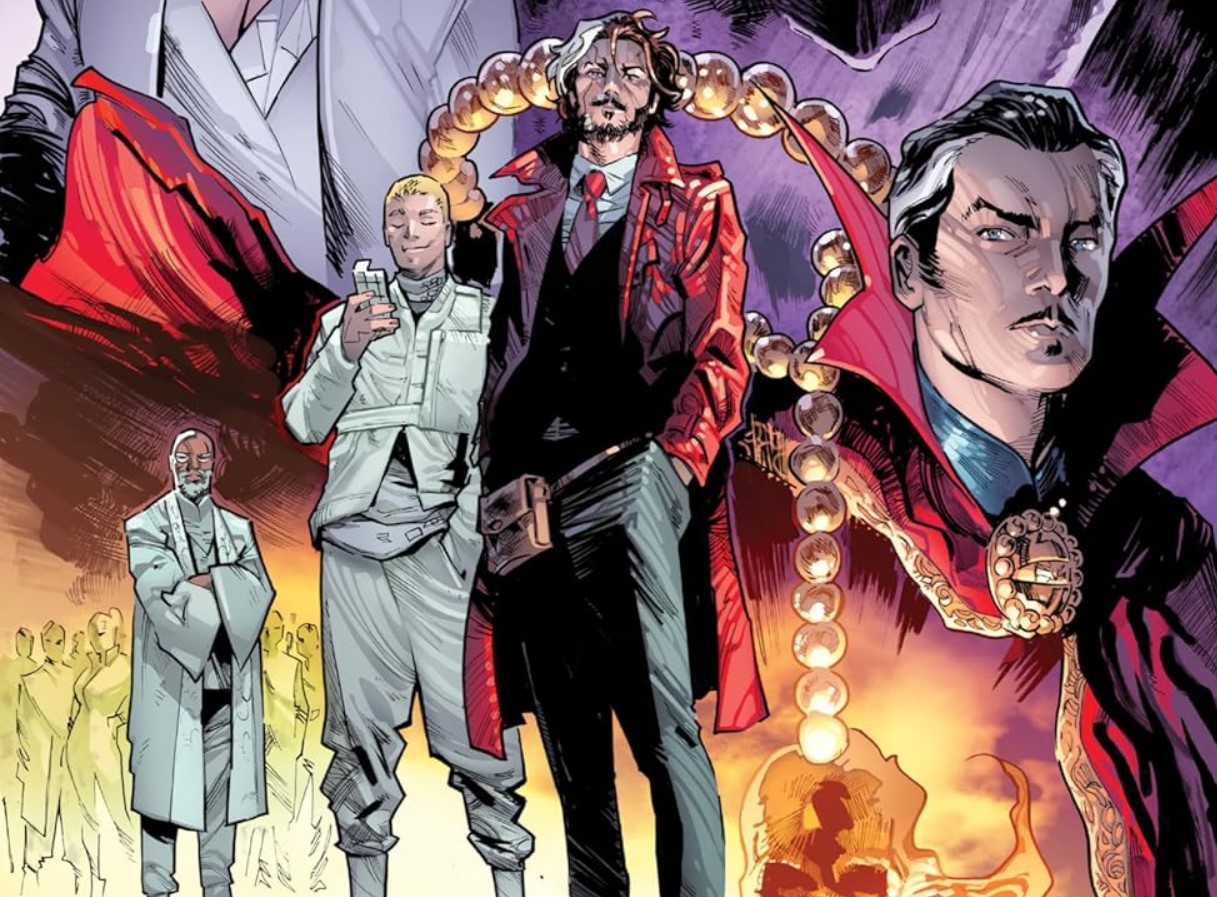

G.O.D.S. is Jonathan Hickman’s book about midlife crisis. He even has a random A.I.M. agent say so in the final issue.

Courtesy of Marvel Comics
Hickman’s thesis statement in G.O.D.S.
Most of Hickman’s work at Marvel starts off with a short, simple, existential, and thoroughly depressing statement that encapsulates the main theme of the series. But Hickman’s works aren’t pessimistic. The narrative usually leads to a reversal of that statement, ending the series with hopeful optimism.
His Avengers run started with the famous, “Everything dies,” but concluded with a joyful, “Everything lives.”
He started the Krakoan Era of X-Men with Moria’s discouraging ‘truth,’ “We always lose.” Unfortunately, Hickman left X-Men before realizing his ending. And I haven’t quite caught up with the conclusion of the Fall of X, yet, so I have no idea if the Krakoan Era ends with a more encouraging, “We’ve already won.”
In a similar vein, although not quite so explicitly negative, Hickman started his Fantastic Four run with Mr. Fantastic’s goal to, “Fix everything.” Which does imply that everything is broken. I also haven’t gotten around to reading this run completely, but I believe it ends with a more optimistic outlook: that life – although not perfect – is not as broken as it first appears.
And so, we come to G.O.D.S. – Hickman’s foray into the magical corner of the Marvel universe. If I had to pick out the short depressing statement that encapsulates the main theme of G.O.D.S., it would be the words of the main character, Wyn, found near the end of issue #1, “It’s all pointless. It’s all pain.”

Courtesy of Marvel Comics
Wyn and the woes of a middle-aged magician
Wyn’s design, from wonderful illustrator Valerio Schiti, is like a mix of Doctor Strange, Gambit, and Don Draper. He’s written as a bit of a rascal – never caring too much about anything, even when the fate of the universe is at stake. He’s disinterested in a kind of arrogant way. He’s an interesting new character, but not completely likable. And I’m not sure the story would be much different if Hickman had just used a disillusioned Dr. Strange instead. Oh, Dr. Strange does appear in almost every issue, often working together with Wyn, serving as the altruistic foil to Wyn’s moral apathy.
But, Wyn’s arrogant disinterest is a front. He knows it’s a front. Everyone else knows it’s a front. And we readers also know it’s a front. He’s hiding how much he really cares, because he’s become disillusioned with the ‘Higher Calling’ he gave his life to.
Wyn is the avatar of The-Powers-That-Be. It’s a career position, serving the personified deification of all magical power, fixing problems in the magical realm. Sure, his work regularly involves saving the universe, but after at least 1000 years of dutiful, immortal service, it’s become a bit redundant and mundane. And there’s no end in sight.
So, he’s lost faith in the seemingly fruitless, unending battle between good and evil. His career hasn’t brought him that sense of fulfillment it originally promised. His life has lost its purpose and he’s full of regrets. It’s all pointless. In other words, he’s having a midlife crisis.
On top of all that, his job has caused quite a bit of personal pain. It’s cost him things he didn’t want to lose, including his wife – the woman he still loves. She left him and shot him in the face.

Courtesy of Marvel Comics
Aiko and the regrets of (logical) decision-making
Which brings us to Aiko, who had to choose between her career and the one she loved. Of course, her career is also a ‘Higher Calling.’ As a Prime Centivar of The-Natural-Order-Of-Things, she also gets to save the universe a few times. She also looks absolutely fabulous doing it, with colorist Marte Gracia finding every shade of white and silver imaginable to make the Centivars look as sleek as possible.
But unfortunately, The-Natural-Order-Of-Things are the personified deification of science – on the opposite end of the axis from and at war with The-Powers-That-Be, i.e. Wyn’s boss. And so – since Wyn’s contract is bound to his soul – she had to make a choice: career woman or family life. (And I’m not even going to get into the dichotomy of science and faith.) She chose the ‘Higher Calling’ and filed for divorce.
Aiko’s whole narrative revolves around making choices. She approaches them with the cool logic of a scientist, but that doesn’t make all of her decisions right. For although science may follow the rules of logic, magic does not, and neither does love or romance.
Later, Aiko too falls prey to the sting of midlife crisis. We see the consequences of her choices and the regrets they’ve left. Although she thought she had devoted her life to something bigger than herself, it now feels like just another thing she has to do. There is no sense of fulfillment. It’s all pointless.

Courtesy of Marvel Comics
Fortunately, in the sixth issue, Aiko decides to do something about one of her regrets. So, we also see how far she is willing to go and what price she is willing to pay to make at least one of her wrong decisions right again.
Mia, Dimitri and what others are living for
Which brings us to Mia, the one Aiko wronged. She represents the vibrant optimism of youth with a future full of possibilities. Wait, that’s not right. She represents the youth whose future potential and purpose is robbed from them by the older generation.
Mia is introduced as a young college student, obsessed with her studies of science, but failing, because that’s not where her natural gifts lie. She only starts to flourish when she discovers her abilities in magic. Aiko promises to teach her, as long as The-Natural-Order-of-Things can study her magical evolution.
What Mia doesn’t know – but Aiko does – teaming up with The-Natural-Order-of-Things cuts off Mia’s connection to The-Powers-That-Be and any hope of fully realizing her potential. How typical: the gains of the older generation coming at the cost of the youth. And what disappointment, realizing your future potential has been stripped from you by decisions completely out of your control. At least Aiko makes things right by Mia – and pays a price for it. But even that doesn’t guarantee Mia the bright future she hopes for.

Courtesy of Marvel Comics
Mia’s mirror image on the other side of the axis is Dimitri, who is actually much older, but also represents youth in a way. As an envoy of The-Natural-Order-of-Things to The-Powers-That-Be, he is Wyn’s scientific assistant – juxtaposed to Mia being Aiko’s magical minion.
Whereas Mia’s narrative arc is all about her future, issue #7 reveals that Dimitri’s whole life has been fixated on the past. He lost his cosmonaut parents in childhood and has been searching for a way to find them ever since. In this way, he represents young adults so obsessed with regaining their past they can’t move forward into the future.
His quest feels different – of actual worth and meaning – because his motive is love. But, in the end, he’s willing to give up his future in order to recapture his past. And it eventually ends in tragedy. Again, it feels like a noble sacrifice, but it also reveals a life of pain. And the reward is so fleeting; I can’t help wondering if the sacrifice wasn’t pointless.
If that weren’t enough, Hickman creates many side characters to further reinforce his thesis statement in G.O.D.S. For example, Cassandra, who has the ability to foresee catastrophic future events. Unfortunately, she is also cursed to never be taken seriously, her doomsday prophesies ignored. She represents the employee in the midst of a midlife crisis, realizing she could’ve had an incredible impact in her field, if she hadn’t been overlooked her whole career. Cassandra’s only solution is to take things into her own hands, but that also doesn’t end up exactly as she’d hoped.
And Hickman brings back the Black Swans, who have also lost their purpose (assumingly after Secret Wars) and now viciously feed on innocents in an attempt to find the secret formula that will return them to their former glory. Now that’s certainly one way to react to a midlife crisis.

Courtesy of Marvel Comics
Even gods go through midlife crises
The magical corner of the Marvel universe often involves a pantheon of gods – cosmic beings or universal abstracts. The ones Hickman uses in G.O.D.S. also underscore his exploration of the midlife crisis.
The In-Betweener is a good choice for the enemy god in G.O.D.S. His name itself and what he represents, when applied to age, basically means midlife. He’s indoctrinated his minions using a simulated reality created for them within a box. Oh, that longing to escape the struggles and burdens of everyday life within a fictive reality of our choice. It’s driven the minions insane. They are willing to destroy the real world in favor of the escapism found in their box. And there are so many such boxes.
We also meet Oblivion, the universal abstract personifying chaos and ruin. Well, you can’t get more symbolic of the fears of midlife crisis than that. Valerio Schiti draws his human form as a hobo – representing the loss of career, home and wealth – who uncontrollably loses all structure, morphing into grotesque and nightmarish forms.
Oblivion symbolizes the nihilistic fear that life will always, eventually end in purposeless ruin. Nothing ever has or ever will matter, because it all leads to nothing, to oblivion. It’s all pointless. It’s all pain.
In G.O.D.S., Oblivion, the In-Betweener and other cosmic beings are apparently working toward some great conflict which Wyn, Aiko, Dimitri, Mia, Dr. Strange et al. strive to hinder. The motivation for this conflict seems to be the gods’ own midlife crisis. Religions are dying out. The people have forgotten them. What purpose does a god have without followers? Does that make them pointless, too?

Courtesy of Marvel Comics
Where’s the optimistic turning point?
So, does Hickman eventually turn the nihilistic depression of midlife crisis into a more hopeful concluding mantra? Kind of. Not really. Maybe?
If anything, G.O.D.S. is one of Hickman’s more obtuse and meandering narratives. Almost every issue feels like the start of a new story instead of the continuation of the previous issue. Sure, the first four issues definitely have that connecting thread – the In-Betweener and Oblivion working toward some conflict of the gods. But that plotline basically goes missing in the last four issues, abandoned in favor of character-focused stories.
Maybe Hickman is practicing some meta-storytelling about having a midlife crisis – the series losing the main purpose of its plot at the halfway mark in the same way life starts to lose its meaning in middle-age. Or maybe Hickman was expecting to have a longer series to work with and then had to condense the most important things into just eight issues.
To be quite honest, I completely understand this series being cut short. It’s definitely not as good, not as instantly compelling as Hickman’s X-Men, Avengers, or Fantastic Four series. G.O.D.S. is much more confusing at the beginning, Wyn not completely likable and the series harder to get into.
Hickman kind of wraps up what needs to be wrapped up in the final issue, but mostly through dialogue. Even then, it’s not very explicit. No real details are given. Accordingly, the conclusion to the overarching plot is at the very least unsatisfying, if not infuriatingly frustrating. The conflict started is not finished on panel. We’re left to guess what actually happened.
Instead, Hickman uses the final four issues of G.O.D.S. to focus on the thoughts and decisions the characters make. He ends the series with that hallmark of midlife crises – reflecting on the past, wondering where everything went wrong, dreaming about what life could’ve been. And since this is a comic book, Wyn actually has the chance to travel through time, review the past (and the future) and potentially change that one choice that sent everything down the wrong path.

Courtesy of Marvel Comics
In midlife, it’s so easy to feel like your career is your identity. And it’s so natural – especially in our current society – to view your job as your ‘Higher Calling,’ which justifies devoting almost all of your time and energy to it. But it’s also just as normal to realize that that career doesn’t bring the fulfillment you originally expected and desired. And too often, a life devoted to work leads to some unfortunate consequences, including the loss of relationships.
Maybe there is a better choice. Maybe your relationships are actually the ‘Higher Calling.’ Or maybe both career and relationships can find unity in the middle, rather than existing on far ends of a dichotomy. And maybe I can change that in my life right now.




You must be logged in to post a comment Login