


If you recall June’s Biker Mice from Mars interview, you’ll have noted how excited I was for the return of this solar system’s raddest rodents. But this following book makes that look like the brussel sprouts of comics. Because, thanks to the good folks at AHOY Comics, we’re getting a brand-new Toxic Avenger comic series. (Not his first foray, FYI.) Excuse me while I puke in excitement.
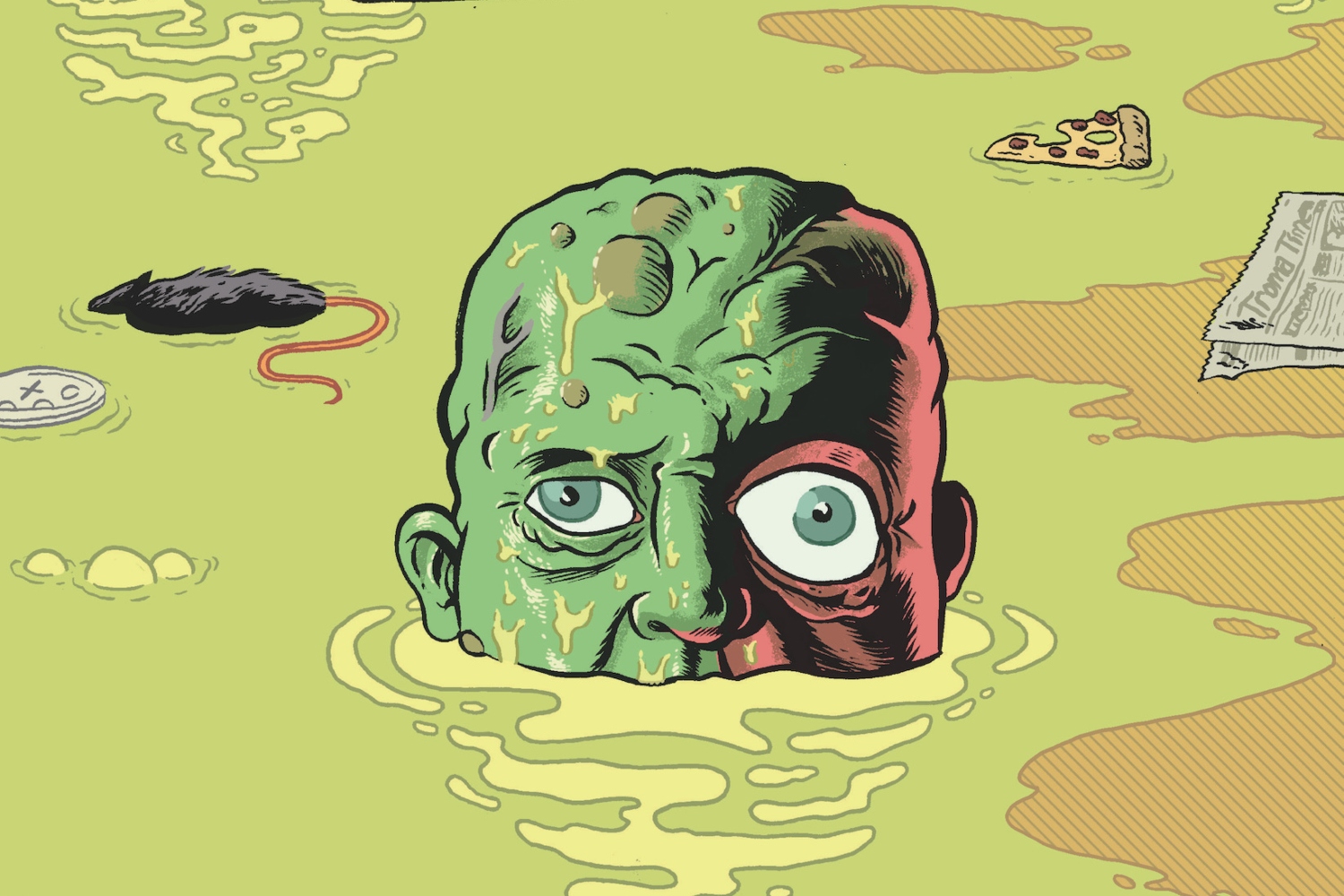
The radioactive brainchild of writer Matt Bors and artist Fred Harper (Doctor Strange, Sorcerer Supreme, Animal Man), The Toxic Avenger is a “reboot brewed especially for the 21st century.” While the origin may differ (and you’ll understand why a little later), this Toxic Avenger is basically the same: (mostly) lovable loser Melvin is transformed into the “massive, mop-wielding” Toxic Avenger, where he’ll fight jerks and villains as he tries to clean up his hometown of Tromaville. Expect some solid political and social activism, lots of teenage attitude, weirdness galore, and, of course, the greatest tutu-wearing hero in the whole wide world.
The Toxic Avenger #1 is due out October 9 (the FOC is Monday, September 9, FYI). For some reason, the folks at AHOY had the genius idea to set me up with Bors to ask some especially nerdy, slightly uncomfortable questions. That includes what he thinks of the Toxic Avenger fandom (including this writer’s, er, unique connections), the story’s development process and unique timeline, the use of modern social media in the story, the ins and outs of reworking a Troma property in 2024, and even the fresh approach to Melvin.

Courtesy of AHOY Comics.
AIPT: I want to begin by saying that watching Toxic Avenger in 1993 (at the age of 7-ish) is my very first conscious memory (or “when I came online,” as the kids say). Does that obsessive love for Toxie enhance or complicate your own work?
Matt Bors: Oh man, you might have been younger than me! I don’t remember how old I was when I first saw Toxic Avenger, but I couldn’t have been older than 10. The covers were cool as hell and that’s how I decided what to rent from the video store back then. My dad and the people running the store didn’t give a shit. A scene from the third one was emblazoned on my brain back then. Toxie is pulling out a guy’s intestines and spinning him around and feeds his hand into a VHS rewinder — a quite powerful one because it rips his fingers off. I’ve thought about it an inordinate amount over the decades. I’m sorry, what was the question?
AIPT: What’s your elevator pitch for The Toxic Avenger? And, perhaps without revealing too much, why opt for this specific timeline of this debut issue?
MB: Melvin Junko is transformed into the Toxic Avenger when a train derails, covering both him and his bullies in toxic waste. Now the town of Tromaville is placed under quarantine by the mysterious Biohazard Solutions corporation, who is in charge of the cleanup effort, and Toxie has to become a hero to the town and people he hates.
A #1 issue is important. You only have one of them, is I believe how numbering works. I wanted to grab readers, to tell an origin story in a unique way, but also relay to the confusion of the crisis they are living through where all information is not apparent to the characters or readers in the moment. So after I finished my script for the first issue I promptly threw it away and challenged myself to write something more interesting and that resulted in how I approach the timeline of the story.

Courtesy of AHOY Comics.
AIPT: Along those lines, do you consider this a re-imagining? Is this more akin to a spiritual successor than anything else?
MB: I’m combining elements from the original movies with the Toxic Crusaders cartoon for a new story that takes place in modern day Tromaville, New Jersey, the bucolic city we all know and love. Right out of the gate you’re going to see references to Bonehead, Melvin’s antagonist bully, and Yvonne, his sight-impaired friend originally based on Claire from the movies. There will be more familiar faces popping up too — the train spill is the new origin story for a slew of characters and plotlines. So it’s an entirely new story but it will have plenty of familiar touches.
AIPT: I think you prepared for a series like this with the totally excellent Justice Warriors. Are there any direct parallels/connections between the two?
MB: Yes, they are both satires featuring a lot of fun violence and mutants that are soon to be breakout hits with discerning readers everywhere. I love mutants, man. If you read my political cartoons through the Trump era, you saw a lot of mutants and post-apocalyptic genre elements popping up. That was to keep myself entertained while dealing with current events, but also just embracing the fact that I’ve loved this stuff my whole life and wanted to create stories with mutants, cyborgs, the wasteland, and dystopias.
AIPT: Similarly, do you see this as a kind of extreme extension of The Nib — grappling with social/environmental issues albeit in a different framework or tone?
MB: I’d say I’m retreating from the nonfiction and political cartooning of The Nib to go full into gonzo genre comics. For me, that is merely a shift into a kind of comic that I’ve wanted to create my whole life. I had some success with my editorial cartoons early on though and ran with that for a good 20 years of my career. I consider this different—it’s not nonfiction where we are fact-checking comics and trying to portray reality. But I’m still talking about real-world issues — Justice Warriors: Vote Harder is topical, to say the least. That book even has assassination attempts on candidates!
In The Toxic Avenger, there’s elements about the environment. It’s hard to brutally mutate teenagers through corporate polluter malfeasance without saying something about the world we live in, but like you say, it’s a different tone.

Courtesy of AHOY Comics.
AIPT: How do you go about updating a Troma film for 2024? A lot of those flicks wouldn’t really fly (tonally, politically, etc.) these days.
MB: I rewatched all the movies in the lead up to writing this series, and you’re right — some of it doesn’t age well. But it was all in good fun, I think. Troma has touted itself as Grade Z cinema and that’s why the films are fun—gory, cheap, and relishing in its own low-budget and absurdity. They sort of exist in spite of more professional filmmaking techniques, enjoy their own plot holes, and celebrate trash culture.
I don’t think you can intentionally make a Grade Z comic in the same manner and have it be as enjoyable. I’m trying to make a good comic, yes, but I’m not taking things too, too seriously. There are obvious environmental and anti-corporate themes I’m emphasizing but it’s got a lot of that Troma spirit. To that end, if the first issue isn’t violent or gory enough for everyone, just wait for issue #2. I’m hoping to warp some young children with body horror.
AIPT: What kinds of things does that more modern sensibility and even technology and Gen Z do for updating or extending Toxie’s story?
MB: Social media will be a big feature of this series in a way that feels appropriate to the original setup of Melvin Junko being a perpetually bullied teen. In our story, it’s even worse because his tormentors run a hugely popular streaming prank channel where Melvin has become an unwitting star.
In fact, there’s a viral incident that shaped him long before the toxic waste and we will be getting to that later in the series. When this book opens, Melvin is already transformed into a hideously deformed creature of superhuman size and strength, and in each issue we will be going back to the “before times” and seeing his life wasn’t that awesome. In fact, he may enjoy becoming a muscled hero capable of leaving his past life behind. We’ll see.
AIPT: What was it like working with artist Fred Harper? I feel like his approach and style balances something essential but still very new/novel.
MB: Fred Harper is perfect for this book and I’m lucky to be working with him. His gritty inks and skill with mutation, expression, and texture all work great on a book about mutants. He’s got a [Simon] Bisely and [Richard] Corben quality to his inks — heavy blacks, spatter, the scritch of the nib is on the paper. I love that about him—and he’s excelled at everything I’ve thrown at him so far.
I’ve loved getting to know Fred and collaborating on Toxie. He is redesigning all the characters so look for new versions of notable Toxic Avenger characters as the series goes on.

Courtesy of AHOY Comics.
AIPT: What were your interactions like with Lloyd Kaufman? He’s deeply committed to Toxie, and it might not be easy to get him on board if you’re not truly honoring the character.
MB: Lloyd has been great through this whole process and very encouraging. I think given the new Toxic Avenger movie and video game in the works, the Toxic Avenger is having a little moment. A deserved moment because so many people remember the movies fondly, or perhaps infamously, but not much has been done with the character for a while. So I think Troma is happy to have people carrying on the character and doing new versions that feel faithful while updating various aspects of the “intellectual mop-erty,” as Lloyd might say. Sorry. I love his whole deal. He’s always on.
AIPT: I think so much of my core politics comes from the Toxie-Troma “model”: telling hugely important things through a dumb/silly framework. Is there something extra powerful about that approach to politics?
MB: I’ve always gravitated toward merging high and low culture into a richly entertaining slop. I want viscerally thrilling, upsettingly violent, delightfully strange stories that are about something. The high water mark for that, to me, is Paul Verhoeven with movies like Robocop. We’re chasing that tradition in Justice Warriors, which is at once highly political and also dumb as hell. It’s not really about the good guys winning, or imparting lessons, but we are attempting to say something about the way the world works, maybe even something profound. You can have a lot of humor and action while doing so. I’ve never quite understood people who insist on this separation in stories.
I think comics really want to be taken seriously and writers strive for a kind of seriousness with their material that is—the word we use now is elevated. Well, I’ve taken the elevator down to the sub-basement. I want to be below sea level. Dank, dark, ugly, not quite the best air quality. In the sewers making good art and talking politics with my good friends, the Morlocks! We prepare for war on the surface world.
AIPT: If you look at the ’84 original, you’d maybe see a lot of similarities to our post-Trump world. Do you think you tried to lean into that or maybe play against that here?
MB: At the time of its release, the environmental issues of the day were nuclear meltdowns, almost-comical corporate dumping, smog, and endless piles of trash and litter. You see that reflected in what The Toxic Avenger is. Today, we have a cleaner world on the surface of things. We’ve picked up the cigarette butts from the highway, but global warming creates the hottest summers we’ll ever see. Until next summer.

Courtesy of AHOY Comics.
We’re still dealing with straight up green, bubbly toxic waste in this comic, but I think all sorts of modern anxieties are on display with social media, corporate control, and the conspiracy theories — true or not — that take over Tromaville in this series.
Also, I can’t deny there was a toxic waste train spill in my home state of Ohio last year and I’m very much riffing on that. There’s even some quarantine-related drama in the first issue that everyone should be able to relate to a little bit.
AIPT: Is there a more positive or romantic tone overall here? (I’m thinking of Melvin’s tutu wearing especially in this debut.) Do you think that goes against the original, or is that something of your own viewing?
MB: We had to keep the tutu, but the way it was acquired in the original movie didn’t work for what I was doing, which is fleshing out the friendship of Melvin Junko and Yvonne a bit more and spending some time with them before the big spill. They’re both outcasts who loathe their small town and whose fashion sense sometimes is a little punk, intentionally offbeat, and includes random shit pulled from a junkyard — Melvin’s mom business, hence the name. I described Melvin’s fashion sense to Fred as similar to Kurt Cobain. You might see him in a tutu one day, plaid the next, and he might relish in the fact that it tweaks peoples’ small town sensibilities.
AIPT: What other tidbits or highlights can you tease for the series at-large?
MB: The original subtitle for the series was “Major Disaster.” I’ll let Toxie heads piece together what that might mean. I really don’t want to give a lot away because there are some story revelations later that I’d like to preserve, but there are forces behind this toxic waste spill that will have huge implications once they are discovered. Those will set the stage for a much larger story I intend to tell in future volumes.
AIPT: The 1984 film has great/stupid taglines. If this book had a tagline, what would it be?
MB: Gotta have an array for different markets:
A mutated weakling mopping up a corporate mess.
Toxic Boy Summer.
He was 98 pounds of solid soy until he became a mutant Giga-Chad.
Environmental body horror as a way to explore processing Troma.



You must be logged in to post a comment Login