

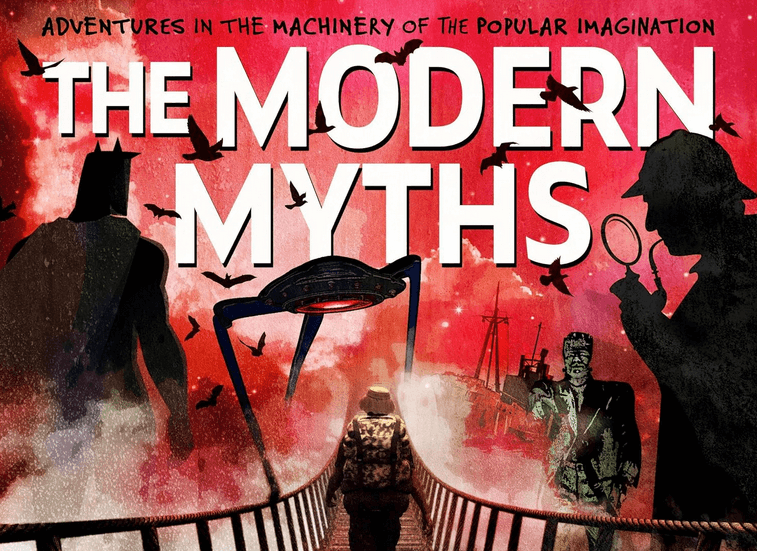

In her 1988 book Other Peoples’ Myths, religious studies scholar Wendy Doniger lamented the “demythologized” state of the modern world in which young people, in their search for meaning, were now forced to turn to the “degraded mythology” of “films and children’s literature,” which are but mere shadows of the classical myths of antiquity. The irony here is that while Doniger, and other scholars like her, consider myths vital for a healthy society, she also saw them as something at odds with modernity. For her there could be no “modern myths,” new stories which had arisen to supplement the old.
Science writer Philip Ball wants to challenge this kind of thinking and in his recent book, The Modern Myths: Adventures in the Machinery of the Popular Imagination (University of Chicago Press, 2021), sets out to do so with a series of eight highly readable, incredibly comprehensive, and at times extremely provocative examinations of what he considers the “modern myths” of our time: Robinson Crusoe (Chapter 2), Frankenstein (Chapter 3), Dr. Jekyll and Mr. Hyde (Chapter 4), Dracula (Chapter 5), The War of the Worlds (Chapter 6), Sherlock Holmes (Chapter 7), Batman (Chapter 8), and the zombie apocalypse (Chapter 9).
The first thing you might notice about Ball’s examples is that they all have their roots in popular novels, films, and comics – in other words, exactly the kind of “degraded” material which Doniger was so quick to dismiss. Ball is keenly aware of this, and opens The Modern Myths with a robust argument as to why the label of “myth” should be extended to include certain select figures from pop culture. His central claim is that in each of his examples, the character has clearly outgrown the confines of their source material.

By his own admission, Ball’s strongest case study is Frankenstein. Ask anyone on the street if they know Frankenstein, and they’ll say yes (ask them if it’s the name of the mad doctor or his monster, and you’ll probably get a 50/50 split). Ask them what the monster looks like, and nearly everyone will describe the flat-topped, green-skinned giant from the 1930s Universal Studios films. Ask them about the doctor and most will describe an elderly gentleman reminiscent of Peter Cushing’s portrayal in the Hammer films of the mid-20th century. Ask them if the doctor has an assistant and they’ll tell you yes, a hunchback named Igor. Ask them what the story’s about, and they’ll say, with absolute conviction, it’s about the dangers of scientific hubris.
What this proves is twofold: first, that everyone is intimately familiar with the modern myth of Frankenstein. It also shows that this mythical Frankenstein has little or nothing to do with Mary Shelley’s 1818 novel, in which there are no hunchbacks, Frankenstein is the name of a young medical student (he never earns his MD), the monster is described as beautiful, and the moral of the story has nothing to do with hubris, scientific or otherwise. You can see why Ball’s other examples of modern myths are weaker contenders — Chapter 5 is more about vampires in general than Dracula in particular, while Chapter 4 quickly dissolves into a discussion about werewolves.
This matters because it indirectly highlights Ball’s only major methodological shortcoming, that while he spends a lot of time in the introduction agonizing over the meaning of the word “myth,” he never bothers to define the term “modern.” Vampires, as Ball correctly notes, have their origins in the 17th and 18th century folklore of Eastern Europe, which historians recognize as the Early Modern Period, so they could still be considered examples of a modern myth. But werewolves are decidedly not modern, with their roots stretching all the way back to ancient Greece.
The chapter in The Modern Myths on Batman is guaranteed to be the most controversial. In it, Ball argues that Batman is an unoriginal and inherently absurd character, and that notorious child psychiatrist Fredric Wertham may have been on to something when he declared Batman and Robin “the wish dream of two homosexuals living together.” But Ball also declares that Batman is the only superhero to which the label of modern myth can be accurately applied — Superman, he writes, lacks the complexity needed to ever be truly mythical.

The Modern Myths continually dances around the question of if one needs to believe in the literal reality of a story for it to qualify as a myth. Ball raises this early on but just as quickly dismisses it, citing several well-regarded mythographers who have all opined that myths don’t need to be believed in, but only adhered to. The issue still comes up throughout the book, whether it be the fact that Daniel Defoe spent decades claiming that Robinson Crusoe was a real person, that Sherlock Holmes fans insist on treating the Great Detective as if he were real, or that Count Dracula has become conflated with the historical 15th century Wallachia warlord Vlad the Impaler (about whom Bram Stoker knew very little).
The only chapter of The Modern Myths in which Ball doesn’t shy away from this topic is the one dealing with The War of the Worlds (1897) which, as with the chapter on Dracula, is less about H.G. Wells’ novel and more about the emerging modern mythology of ufology. Ball traces a direct line from Wells to Kenneth Arnold, Roswell, and Betty and Barney Hill, arguing that what started as overt science-fiction has become a lived reality for millions of people around the world. Perhaps Ball (or his publisher) felt the existence of this phenomenon couldn’t be substantiated in every case, but as Joseph Laycock and Eric Harrelson aptly demonstrate in The Exorcist Effect, such developments are surprisingly common.
In the conclusion of The Modern Myths, Ball returns to the argument from his introduction, urging that the continued refusal to see Frankenstein, Dracula, Sherlock Holmes, and Batman as “modern myths” will only result in our failure to understand these characters’ continued relevance and ongoing appeal. I’d add that for researchers interested in the intersection of the fictional and the Fortean, such a refusal also stymies our ability to fully understand where the belief in paranormal phenomenon like ghosts, UFOs, and cryptids really comes from.
AIPT Science is co-presented by AIPT and the New York City Skeptics.


You must be logged in to post a comment Login