

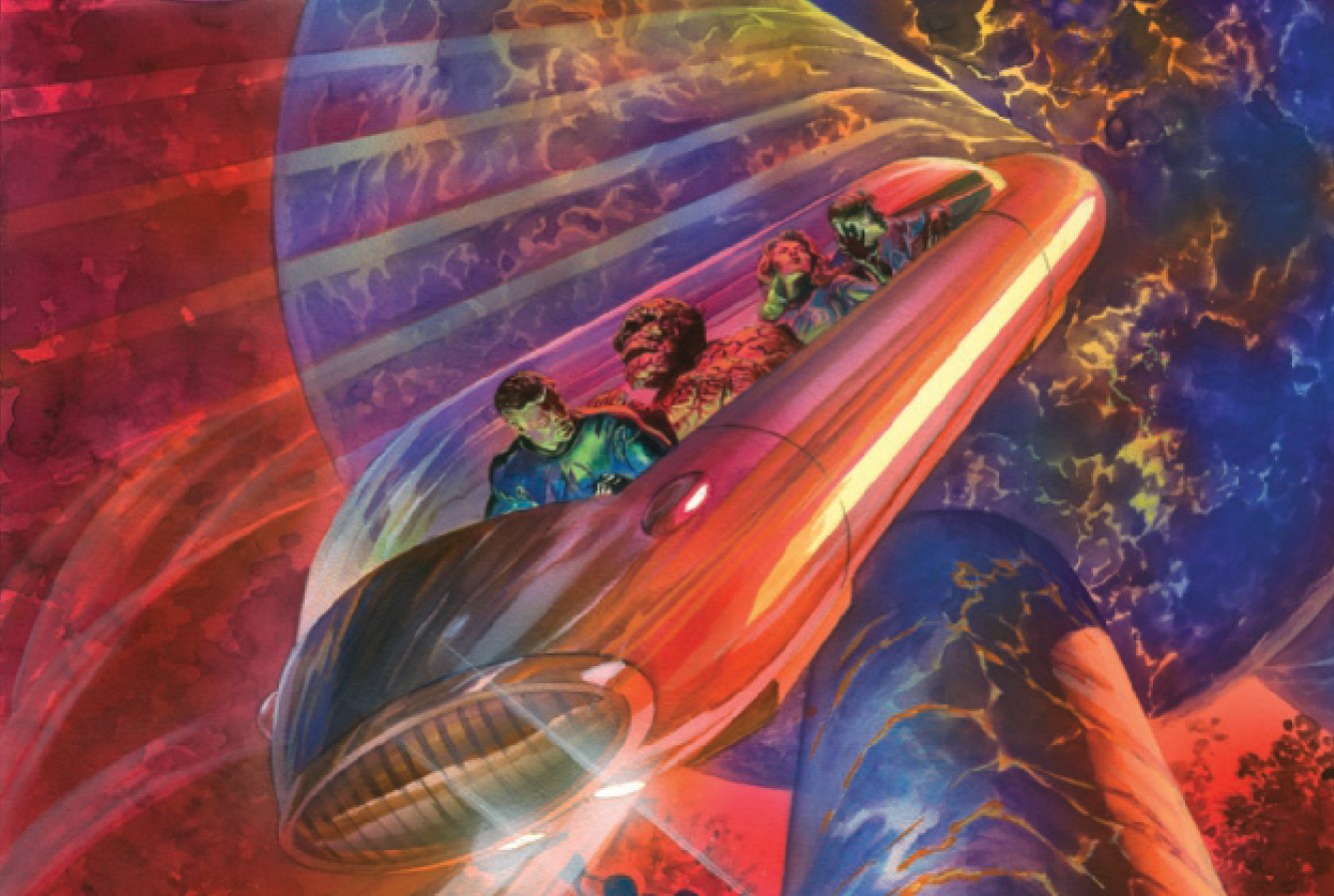

Since writer Ryan North’s Fantastic Four series began in 2022, it’s basically been Marvel’s SciComm book. Which makes sense, considering Mr. Fantastic – Reed Richards – is characterized as the foremost scientist in the Marvel Universe. In nearly every issue, North fills the dialogue and narratives with so many fun, sometimes obscure scientific facts and ideas. It’s enough to make this comic book-loving physics teacher smile every time.
The recent Fantastic Four #23 exemplifies this. Although the main plot involves time dilation according to the special theory of relativity, as well as some of the fastest particles to have ever been discovered, I want to focus on the very brief moment Reed mentions the inverse-square law. It’s interesting because Reed suggests magic must obey this scientific law.

Marvel Comics
So, what exactly is the inverse-square law?
Well, most often people think of it in reference to Newton’s formula for the gravitational force between two point-like or spherical masses (like the Sun and a planet), or Coulomb’s similar formula for the electric force between two charged particles, but it actually applies to any phenomenon in which something radiates out in all directions at once. That’s because the inverse-square law isn’t actually a scientific law as much as a mathematical one, based on geometry.
Imagine a room, empty except for a small table exactly in the middle. In the middle of the table a single candle burns. There are no other light sources, and let’s assume the light radiates out from the candle’s flame in every direction equally.
If you could see the light rays as arrows as they move outward from the candle, the ends of those rays would build perfect spheres around the flame. Accordingly, the light originating in the candle flame would have to distribute itself equally over the whole surface of any given sphere.

http://230nsc1.phy-astr.gsu.edu/hbase/Forces/isq.html
The surface area of a sphere is equal to 4πr2, where r is the radius of the sphere, and I assume everyone knows π = 3.14…. Therefore, as you move away from the candle, increasing your distance (or radius) from the flame, the intensity of light would have to diminish with the inverse of r2, as the light distributes itself over the whole 4πr2 surface area.
That means when you double your distance from the candle, the intensity of light would drop to one-fourth, or 25%, of what it was before. Triple your distance and now you only have one-ninth, or about 11.1%, the intensity. All simply due to geometry.
So in Fantastic Four #23, Reed apparently assumes that when Doctor Doom uses Sorcerer Supreme magic in Latveria, some sort of magical energy or aura radiates out of Doom in every direction. If that’s true, then I’d agree – the strength of that aura should obey the inverse-square law.
But as Reed mentions, Latveria isn’t very close to his and Ben’s current residency in Arizona (having grown up in Arizona, I know where it is). In Marvel Universe lore, Latveria is situated in Eastern Europe where Hungary, Serbia, and Romania meet. Using approximate latitude and longitude coordinates for Phoenix, Arizona, and where Latveria is supposed to be, I crunched the numbers and calculated the shortest distance between the two places – nearly 9,000 kilometers (about 5,600 miles). Of course, the shortest distance is a straight line through the Earth, so I’m not sure why Reed thinks being out in the open will help his machine detect the Sorcerer Supreme magic better, but okay.

Is this where Latveria is?
According to the inverse-square law, at a distance of 9,000 km, the magical “aura” radiating off Doctor Doom would be approximately 81 million times weaker in Arizona than at a point only 1 kilometer away from Doom. So, either that Sorcerer Supreme aura would have to be very powerful to start with, or Reed’s detector had better be very, very sensitive.
But I have to question whether magic would obey the inverse-square law in the first place. Does magic radiate out from the sorcerer in every direction equally?
Returning to the example of light – many light sources (probably most that we normally use) certainly do radiate in all directions at once. But some don’t! Lasers direct light in almost a straight line, and even a simple lens can bundle a bunch of light rays into one direction. The intensity of that light does not drop according to the inverse-square law.
And don’t most sorcerers in the Marvel Universe use their magic in certain directions? They’re usually shooting magical energy beams or hexing a specific person or something like that, right? As soon as the magic is focused in a particular direction, you can’t apply the inverse-square law.

Marvel Comics
On the other hand, it’s not hard to imagine that a very powerful sorcerer continually emits some sort of magical aura as a byproduct of all that energy. In that case, the inverse-square law definitely makes sense, but as we’ve seen, the thing about an inverse-square-relationship is just how fast it weakens with distance. It’s hard for me to imagine any measurable magic being detected by Reed’s device in Fantastic Four #23. That is, if it doesn’t get destroyed by stupidly fast cosmic particles in the next panel (spoiler alert).
AIPT Science is co-presented by AIPT and the New York City Skeptics.



You must be logged in to post a comment Login