


In December 2018, the manga magazine Weekly Shōnen Jump began publishing Tatsuki Fujimoto’s Chainsaw Man. Although the magazine is known for publishing some of the best-selling Shōnen manga, ranging from Dragon Ball to My Hero Academia, Fujimoto’s manga feels untraditional in playing with the Shōnen tropes, centering on a teenager who is not on a journey of power fantasy, and more about the pursuit of simple pleasures like grabbing a woman’s breast. Mixing gory violence and crude humor, Chainsaw Man could have been a turn-off from its initial premise, and yet it remains one of the best-selling titles in the medium, as well as leaving an impact on subsequent manga authors, including Yukinobu Tatsu.
Having worked as an assistant for Fujimoto during Chainsaw Man, you can see the influence from that book in Tatsu’s Dan Da Dan, in terms of mashing up genres to an insane degree without losing sight on exploring the lives of its teenage protagonists. With fifteen volumes released (at least in Japan), Dan Da Dan has proven to be a success, paving the way for Science Saru to produce an anime television series, of which the first three episodes got a theatrical screening.
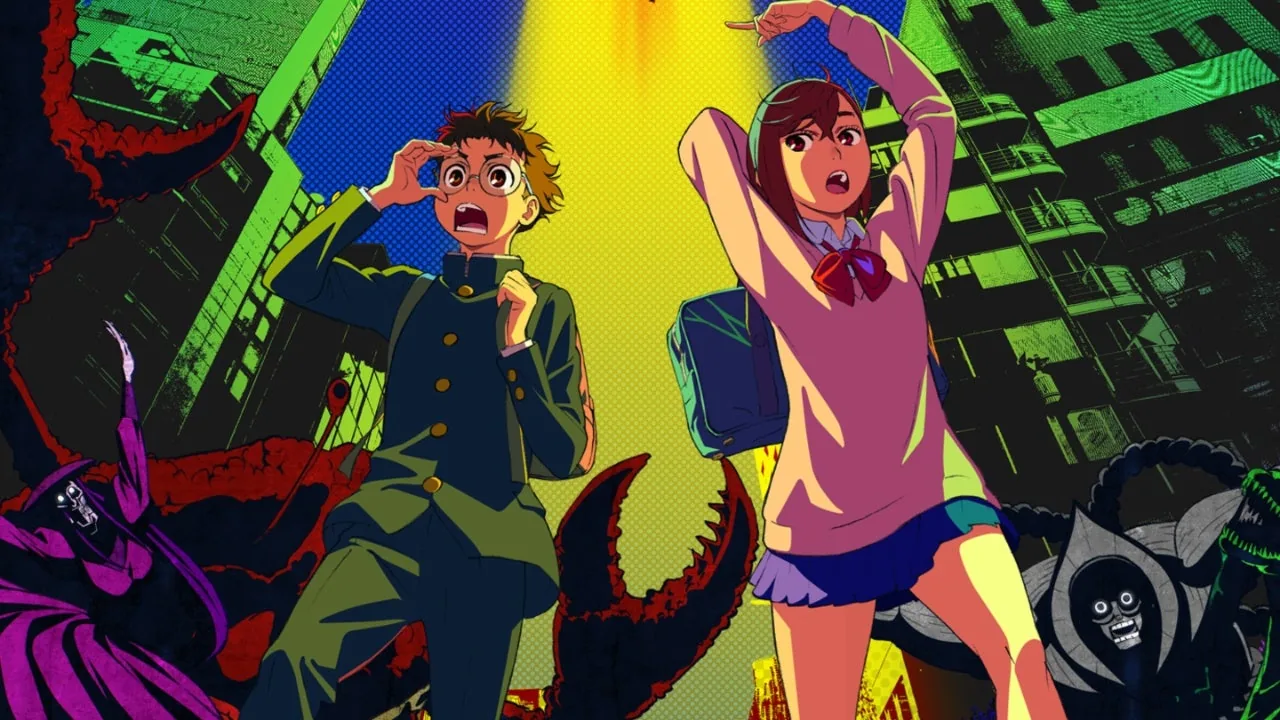
In a boy-meets-girl scenario, Momo Ayase (voiced by Shion Wakayama) is a high school girl who believes in ghosts but not aliens, while her classmate Ken Takakura (Natsuki Hanae) believes in aliens but not ghosts. On a bet to determine who is correct, the two decide to separately visit locations associated with both the occult and the supernatural. When the two discover that aliens and ghosts exist, they confront various threats where Momo has to use her newly psychic powers, whilst Takakura is possessed by a spirit who takes over his body by robbing him of his testicles.
The moment you hear of a male protagonist losing his genitalia as a key story point, it is not far off from what Denji experienced at the beginning of Chainsaw Man, leaning into dark humor and eventual bloody spectacle featuring various devilish monsters literally “chainsawed”. In the case of Dan Da Dan, both in its manga and Science Saru’s animated handling of the material, tonally it has more in common with the OVA series FLCL, where there is this high energy in the comedy that is often delivered by the two leads, whilst the action is a full-on assault of color and flash. While the animation can have this quickness to convey the visual humor, there is still a sense of weight and impact in the action sequences, as seen the second episode.
As previously stated, for as much insanity this show can throw, it never loses sight of what is the heart of Dan Da Dan. With two amazing vocal performances by Shion Wakayama and Natsuki Hanae, the banter between Momo and Takakura is what drives the storytelling, each with their own quirks which make them outsiders to everyone else, and even though they make fun of each other, they open up on an emotional level. As cliched as it sounds, Dan Da Dan is really about friendship and to some extent, family as Momo has to resolve some issues with her unusually attractive grandmother who is a spirit medium. A special shout-out to Mayumi Tanaka – the voice of Luffy in One Piece – sending a chill down the spine as she voices the chilling Turbo-Granny.
With a running time of 83 minutes, it is worth noting that before the screening of the first three episodes, there was a BTS video featuring series director Fūga Yamashiro, the two leading actors and the faceless Yukinobu Tatsu giving insight about the manga and its transition to animation. Giving enough context about what it is you are about to watch, the first three episodes lay the foundation so excellently and when it gets abruptly ended, there is enough excitement for the later episodes as the whole show will be streamed at Netflix next month.



You must be logged in to post a comment Login