

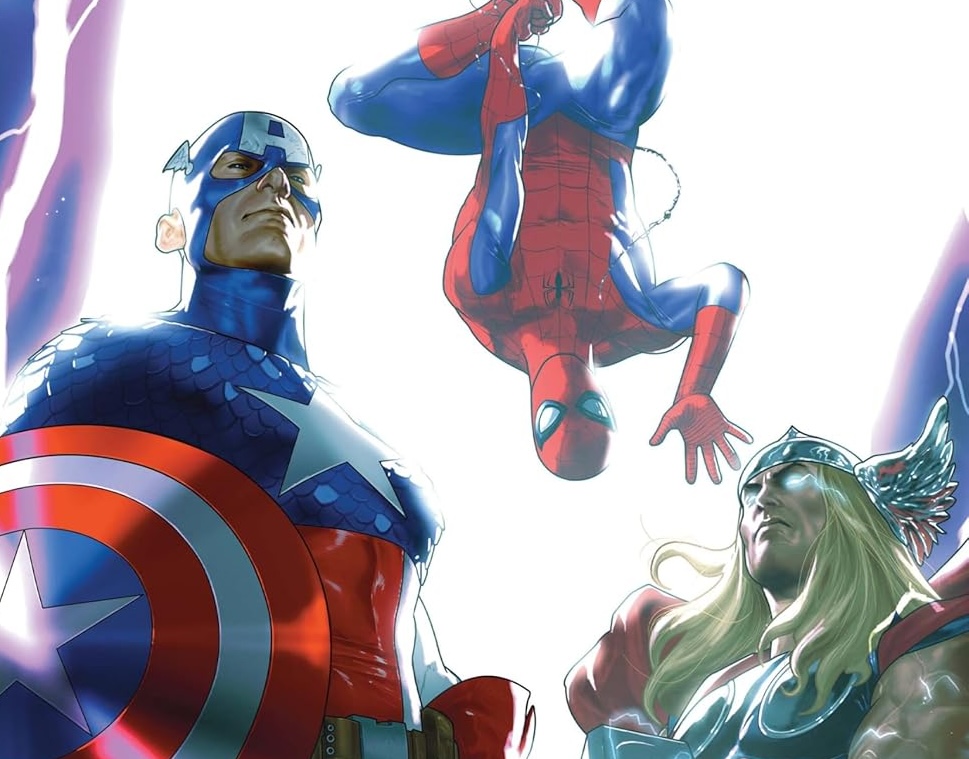

After helping some mutants escape Death, Captain America is back home. Now, it seems Steve Rogers could use a shoulder or two to lean on. And who better than the Amazing Spider-Man and the Mighty Thor? Plus, when superstar writer J. Michael Straczynski has a bit of a history with these two heroes, what better opportunity to bring three giant faces of Marvel together? With the news that Straczynski will be leaving the title at issue #16, it seems this farewell will also revisit the two other famous characters he’s worked on. Here, these three heroes unite to uncover the mystery behind the destruction of Broxton.

Marvel Comics
The story works quite well as a jumping point for new readers and follows a generally simple premise, yet Straczynski always finds a way to make the simple into something truly meaningful. Steve Rogers is incredibly lonely. Things have been moving a mile a minute, and it seems to finally be getting to the guy. As he debates which friends to reach out to for dinner, he’s faced with a problem: those darn secret identities. It’s a funny juxtaposition that seems quite like how easy it is for us to make excuses to not reach out to an old friend, thinking they’re probably busy, they’ve got things going on, et cetera. But for Cap, it’s the plight of the hero. Enter the man who revealed his secret identity before putting making everyone forget: Spider-Man. This to me might be one of the funniest parts of the issue. We see Peter talking with Cap about getting together with Thor, and his concern is whether Thor knows who Spider-Man is. Knowing Straczynski has written all three characters now makes small moments like these far more numerous. Altogether, this is a very enjoyable story to read and ends with a strong hook.

Marvel Comics
As the book progresses though, it takes quite a turn away from lighthearted humor and becomes far more serious. When the trio (I think Trinity is taken by another group of heroes, otherwise I’d call them that) finally decide to uncover the mystery behind Broxton’s destruction, things take a turn. Each character’s voice is perfectly fitting as they work together to get behind the city’s destruction. This is also where the magnificent art of Carlos Magno elevates the story. Magno’s art throughout the book is extraordinarily detailed and fits the tone of the story perfectly.

Marvel Comics
But, as the story progresses, the art gets more and more creative. There’s a series of pages where Spider-Man is explaining the science behind the current mystery, and naturally, he’s hanging upside down. But it’s how he is that adds to the whole sequence. Magno’s creative use of paneling here works very well to provide focus on where Straczynski is focusing the story. However, if the tone of the series was elevated by Magno’s line work, then Espen Grundetjern skyrockets it even further. In the last few pages, the story ends on a startling, jarring, and intriguing cliffhanger in a place that’s unlike anywhere our heroes are prepared for when they set out for Oklahoma. But, with Grundetjern’s colors, this new plane of existence really comes to life. Altogether, the teamwork of these two helps provide direction and weight to the story.
Altogether, Captain America #14 is a very good book. I have to admit, one of the biggest selling points to me was seeing Straczynski return to Spider-Man. I’ve never read his Thor before, either. However, he seems to have a deep understanding of these characters, and it makes for a far more enjoyable story. Here, readers can enjoy three lonely heroes attempting to right a wrong together while leaning on one another. Although it feels like there is some prior reading to understand what’s going on, readers can get by just fine without it as the Straczynski details the preceding events rather well.
Conclusion Content: With Captain America #14 being the beginning of J. Michael Straczynski’s last arc on the title, the story works to revisit some of his most popular prior books as three lonely heroes team-up.




You must be logged in to post a comment.