

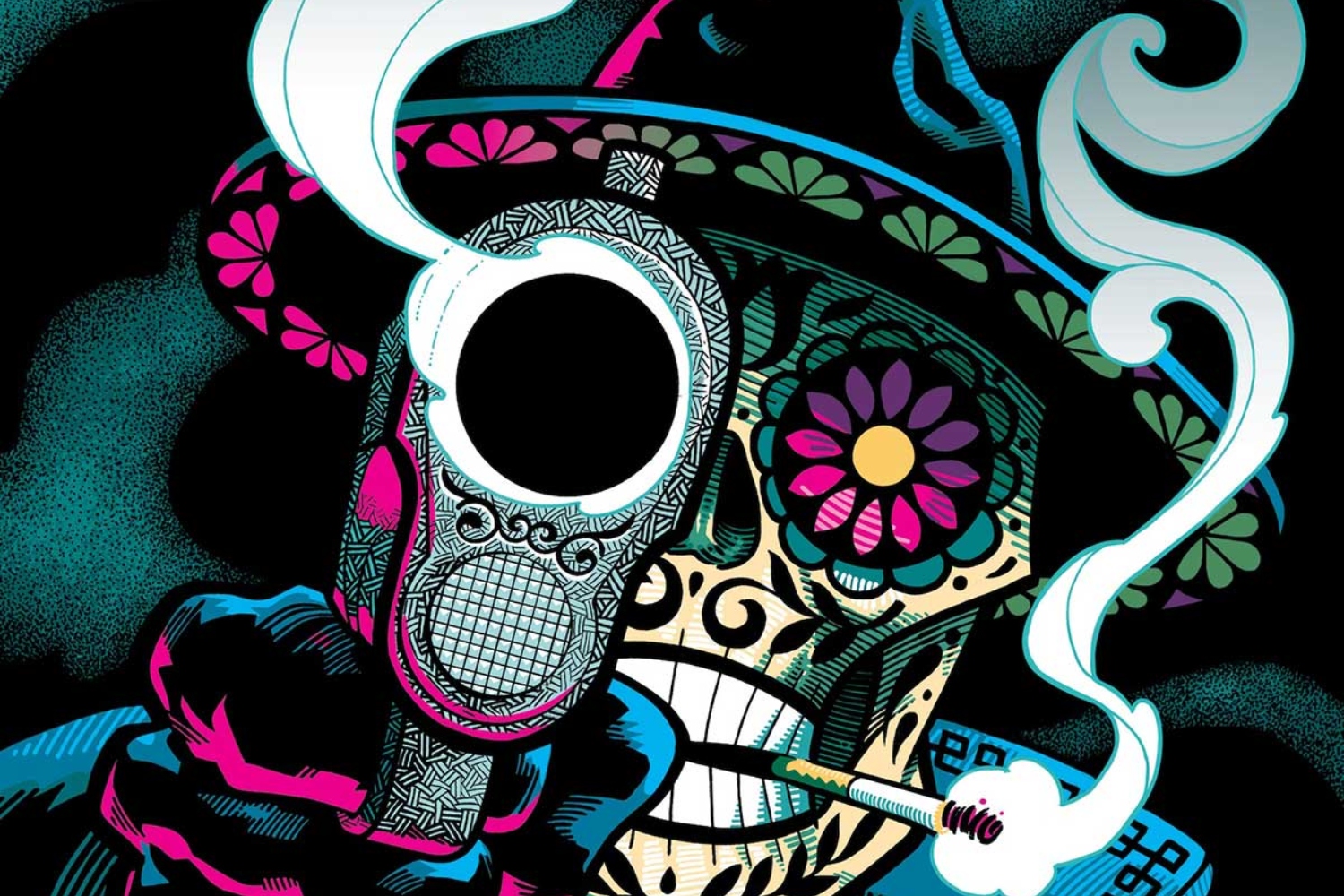

P.I.s and private dicks are a dime a dozen in fiction, and that’s especially true in comics. There’s something about this archetype (uncouth lone wolves with a heart of gold and a penchant for dangerous love interests) that just resonates with readers. But what about a Latino P.I. to add some new perspective/context? And what about if he’s dead, too?
That’s basically the premise of Calavera P.I., from writer-artist Marco Finnegan (Morning Star, Night People). Some five years after he dies a hero, detective Juan Calavera rises from the grave on Dia de Los Muertos. Together with a friend/colleague named Maria, Calavera will “unravel a kidnapping all too close to home.” Along the way, he’ll have to deal with a “masked human trafficker known as La Fantasma” and try to solve his own murder, all before he’s summoned back to the underworld.
That Latin influences are obviously a significant part of Calavera P.I.‘s initial appeal, as it creates a rich history of stories/mythology and cultural nuance to add to the tale. But it’s also just a solid tale outside of the noir and supernatural elements, about a man trying to do good for his people at a time/place when that wasn’t always so easy or straightforward. RIYL: ghosts, Mexican culture, pulp vibes, and complex hero types.
Calavera P.I. #1 is due out November 13 from Oni Press. In the lead up, we caught up with Finnegan recently to tackle some of the book’s biggest ideas and accomplishments. That includes the story’s origins, its use of folklore, how Calavera ranks as a lead, Maria’s vital role, and teasers for issue #2 and beyond.

Main cover by Marco Finnegan. Courtesy of Oni Press.
AIPT: Where did the idea for Calavera P.I. come from? Have you had a lot of experience with making noir stories/projects?
Marco Finnegan: Calavera P.I. came out of my love of film noir, [Dashiell] Hammett, all crime fiction really, Caniff comic strips, and EC crime comics. I’ve always loved the private eye, who is a knight errant, and wanted to take a stab at creating one. I had a lot of false starts and couldn’t find my way in, but then I kind of doodled up a Calavera at a bar based on a Posada drawing, and it kind of just sparked. Making my gumshoe a returned spirit gave me the rules (he can only be on earth two days a year) and then the rest was just about picking the best time to start.

Courtesy of Oni Press.
AIPT: I think noir is having a real heyday in comics. But this is the first I recall rooted in Latin culture — is there a big vein of crime and PI stories from Mexico, South America, etc.?
MF: I don’t know of many other comic P.I.s that are Latino. There are a few great ones in crime fiction — Alex Segura’s amazing Pete Fernandez books, Rudolfo Anaya’s Sonny Baca books and a few others—but I cannot think of any who made the leap to comics. Back in the 40’s in Fight Comics, there was a wonderful strip called Senorita Rio, who was a Mexican actress that fought Nazis. She was pretty rad and drawn by Lily Renée, who escaped the Nazis and came to New York. Pretty wild story. But, by and large, Chicanos have been left out of the noir tapestry.
AIPT: Is it a conscious thought for you to try and expose people to Latin culture and history, or just to tell a story? Is that why you picked Dia De Los Muertos — to let people know what it’s really about beyond any perceptions?
MF: I think that once I landed on the concept of an undead detective, bound by the rules of Dia De Los Muertos, I was also reading a lot about Los Angeles history and in particular how it was affected by the Mexican Repatriation Program and how it affected Los Angeles specifically. So it just kind of came about organically. Most of my favorite noirs take place in LA around the 1930s and ’40s, so having a Chicano gumshoe around made me think about how he would interact with that world. He couldn’t be the Continental Op or [Philip] Marlowe, it wouldn’t be his reality. So digging into that landscape and weaving it into his adventures just made sense. I do think it’s neat to kind of reinsert Mexican-Americans and Latinos into the golden age of noir. Especially since at the time, LA had one of the highest populations of Latinos in the world.

Courtesy of Oni Press.
AIPT: How do you think Mexican folklore varies from some similar, American-centric tales? What appeals to you about these kinds of stories/ideas?
MF: I think Mexican folklore has a better view of death not being the end. Growing up Chicano, I was always surrounded by the idea of magic/religion/ghosts/etc. all kind of peacefully coexisting. My mom would casually talk about her mom being a Curandera and the presence of the supernatural but not always in a spooky version. I think as Americans most of us fear death and see it as an end, but for many in the Mexican community, it’s just another place that we go and sometimes can visit. I think it’s quite lovely, that death is just on the other side.
AIPT: What’s it like working as both artist and writer? Did you feel compelled to tell this story mostly on your own?
MF: It’s a lot of work but super fun! I had originally talked to some writers about co-writing a version of this (it was less supernatural) and both of them passed and suggested that I didn’t really need a co-writer, it was all there. Writing this has really helped me build my confidence in my “voice” but most of that is due to the guidance of my editor Gabriel Granillo, who keeps me from derailing this train and embarrassing myself. Artist me sometimes gets irritated at writer me for asking for tricky things and colorist me wishes artist me would not leave so many open lines that he has to clean up, but overall it’s a blast. I mean, I get to make up my own stories and draw them! It’s the dream!
AIPT: How would you describe Juan — is he a pastiche and/or homage to anyone? Do you find him especially likable?
MF: Juan is a blue collar guy. He treats his work as a job, very much in the vein of the Continental Op and Spade, but I think Juan is even more jaded. Unlike the two Hammett heroes, Juan knows that he will never (as a Mexican-American) be afforded the same respect as other law men or gumshoes. In 1925, when we meet Juan, the idea of a Mexican-American detective on the LAPD payroll was not common, but he isn’t really good at anything else except being a detective. He can only get the cases that “legit” cops and detectives won’t touch and that kind of makes him a hero to the Latino people of LA. That’s what puts him on Maria’s reporter radar. She wants a romantic hero and what she finds is a man unhappy with his station in life who is on his way to being a jaded drunk.

Courtesy of Oni Press.
AIPT: Can you talk about the look and feel of this world. Where was your head at while developing the world — did you really try and lean into some old-school, pulp-y style?
MF: I am a huge fan of the early days of newspaper strips. Milton Caniff, Noel Sickles, and Frank King in particular and EC’s Crime and SupenStories done by Johnny Craig. These dudes created a lot of the visual vocabulary that resonates with me: clear compositions, silhouettes, melodrama, etc. It’s all the things I love about the medium. So when I had an idea of what I wanted to say I imagined that if this book had been created in the same time as those guys, what would it look like? So I leaned into that, the clear staging, melodramatic acting and the limited color palettes. I wanted it to sit beside those books at the drug stores or on the Sunday funnies page. That was the goal anyway. Also, I wanted this to be Los Angeles in the way Joseph Losey’s M depicts it. A city of shadows, secrets and paranoia…and maybe some spooky monsters.
AIPT: Maria is also such a really great character early on. Why is she so important, and do you almost see her as a secondary lead/maybe even the main character in some ways?
MF: Maria is not only my homage to the strong women in classic films—like Rosalind Russell in His Girl Friday, Myrna Loy in the Thin Man flicks and Katherine Hepburn in Woman of the Year— but also to strong women in Golden Age Mexican noir films — Andrea Palma in Distinto Amanecer (Another Dawn) and Maria Felix in the Kneeling Goddess. These women were all forces of nature in those films and I think Maria is cut from the same cloth. She is the real catalyst for this story; she believes in Calavera’s ability to be a hero, sees him as an honorable man and challenges him to be better. I think she could carry her own book if the opportunity was there.
AIPT: What about this time period in LA felt important/interesting to tell this story?
MF: The 1930s is the perfect moment to really tell this tale. You have Black Mask magazine printing Hammett stories, comic strips with beautifully drawn Caniff fisticuffs. Hollywood is in full swing, but you also have prohibition. The Great Depression, and as a result the Mexican Repatriation Program, and all the upheaval that this all caused specifically in L.A. It’s just such a great backdrop and the city is such a great character and so different from the roaring ’20s when Juan was alive. It wasn’t perfect then, but the world he returns to five years after his death is vastly different to the one he left.

Courtesy of Oni Press.
AIPT:Do you have a favorite moment from the first issue? Something that sets the tone?
MF: There’s a nice moment in the middle of the issue where Juan and Maria are sitting and waiting for the police to arrive and they share this nice little conversation. It’s a glimpse into something that could’ve been in another universe. These two could have had something, but life and death get in the way. It’s my Casablanca moment.
AIPT: Is there anything you can tease about how the rest of the story unfolds?
MF: I hope that this will have all the fun twists that classic noir has, but there is also quite a bit of the supernatural. We will get to take a tour of this new world with Calavera as our guide. I think that one of the best things about fiction is when we (the reader) get to discover the unfamiliar buried in the familiar. Also, fights and stuff.
MF: Is there anything else we should know about Calavera P.I., comics, Hispanic heritage, etc.?
MF: This book is my love letter to the genres I love (pulp/noir/horror), filtered through a lens of people who were there but removed from the lore. Hopefully people will dig.



You must be logged in to post a comment.