

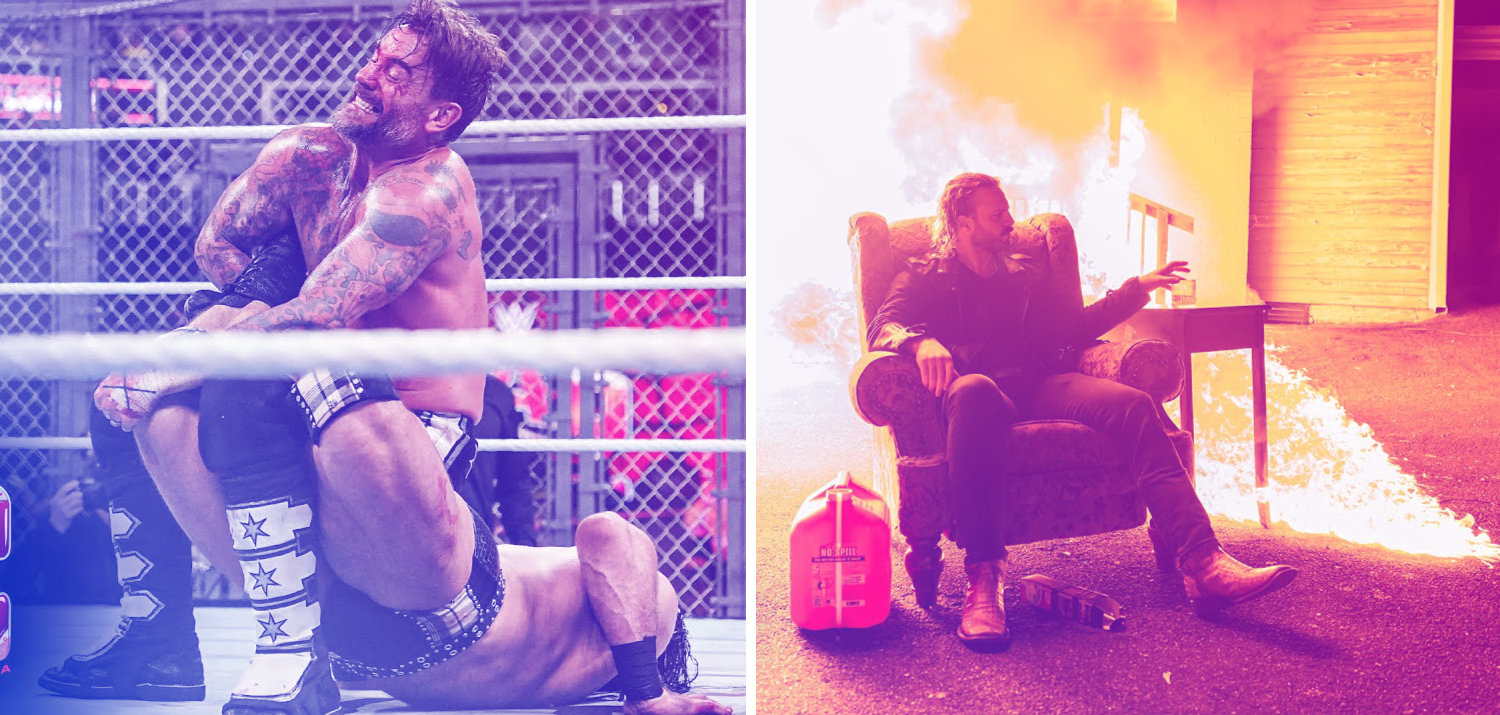

At its heart, professional wrestling is about masculinity. In art, reality affects fiction and we can see the way the lived masculinity affects the art about it in the ring. Through the 2022 feud of ‘Hangman’ Adam Page and CM Punk, as well as each of their respective 2024 feuds, readers can see and understand this. The environment each performer came up in, the way each performer chooses to perform masculinity and the reality behind the scenes will inform that understanding.
Masculinity is an experience which necessitates people relate to each other hierarchically, rather than socially. Measurements of power and acknowledgments of positioning are central in defining one’s capacity for performing masculinity. These were central themes in Sean Durkin’s 2023 film chronicling the tragic lives of The Von Erichs The Iron Claw, which demonstrated for viewers the way men might only develop tools for violence, rather than for joy or healing.
Throughout the modern history of wrestling, the emphatic view of mainstream wrestling promotions was that the performers who deserved the highest positioning on the card were those who were physically the largest. Size is one of the simplest ways to signal masculinity: being bigger, taller, stronger, than others.
This means that many performers’ fights both on and off screen have been to prove that they are worthy of being in the highest position on the card and in the masculine hierarchy despite their size. This is the fight that Bret Hart fought. It’s the fight that Bryan Danielson fought. And, importantly, it’s the fight that CM Punk fought.
The History
When Punk entered into the wrestling industry, the culture of wrestling was not a healthy one. Incidents of alcohol and drug abuse, hazing and violence against women were rampant within wrestling in the early 2000s. This was something which would be especially difficult for Punk to navigate, not just because of his relatively small size and lack of athletic background, but because Punk was vocally ‘straight edge,’ which meant that he didn’t participate in the use of alcohol, drugs or any other substances. These differences quickly marked him as a performer with a well-documented chip on his shoulder.
There have been many times this has been explicitly brought on screen to help better define who Punk as a character was, such as his ‘Straight Edge Messiah’ character, or the infamous ‘Pipebomb’ promo.
In contrast, ‘Hangman’ Adam Page’s wrestling career has emerged in a markedly different environment, both in our broader culture and within wrestling specifically. Independent and non-American wrestling were breaking out as fans and performers alike were hungry for something outside of WWE’s seeming monopoly of the industry.
In America, Page came up through the indy-darling Ring of Honor, which once had been Punk’s home. Then in Japan he joined the Bullet Club, the nWo-inspired wrestling faction which had become so popular that their merch was being sold at Hot Topic. Everywhere Page went the industry was primed to try new and exciting things, with new and exciting performers.
Then in 2019, Page found himself as the central figure in the creation of All Elite Wrestling (AEW), with the trust of folks like Kenny Omega, the Young Bucks, CEO Tony Khan and more.
This explicit validation Page received from very early on in his career likely affected the way he tells stories. The multiple-year story of the Elite’s split and his feud with Omega held as its central question not simply whether Page could assume Omega’s place in AEW, but whether Page could conquer his anxiety around his masculinity.
Page’s storytelling has been marked by awareness of his masculinity and his vulnerability about how he feels compared to others, rather than a straightforward competition for positioning. In contrast, Punk’s career has most often been about a straightforward fight to assert his place, and the place of other wrestlers like him, at a higher position within the pro-wrestling hierarchy.
Punk was excellent at telling this story, so much so that he amassed a cult of fans who would chant his name at any and every wrestling show for the seven years he was retired. When he returned to wrestling at AEW Rampage: The First Dance, the context of the wrestling industry had changed. Punk’s identity as an independent wrestling legend and a smaller guy were no longer challenges to overcome, particularly within AEW, which was built by independent wrestlers. Even Punk’s identity as ‘Straight Edge’ had inspired a wave of followers within the industry, which firmly rooted his choices as normal. This meant that Punk no longer represented a marginalized figure within the wrestling industry.
When Punk traded barbs with Page in their feud for the AEW title, his assertion that he’d “paved the roads” that Page and the Elite had traveled on the independent scenes no longer functioned as an argument for why Punk was good enough to be there, but instead punched down at Page and the accomplishments of the AEW roster.
His career is meant to supersede the whole of the company, implying the company’s need for him as opposed to his need for the company. Punk’s position is advocating for himself as opposed to others, and the ‘Voice of the Voiceless,’ has become the Voice of the Vocal. This is why Punk’s feuds with Eddie Kingston, Jon Moxley and MJF were at least partially built around the concept that Punk was a pretender, only there to elevate himself. While this likely would’ve been an interesting angle for a heel Punk character, this is not how it was performed.
The Feud: ‘Hangman’ Adam Page vs CM Punk
The matchup between first time AEW World Champion ‘Hangman’ Adam Page and returning superstar CM Punk was emblematic of the most exciting encounters in pro wrestling. It featured two wrestlers with the highest positioning in the company setting out to establish a pecking-order with no caveats. Given Punk’s short tenure on the roster, few losses and history never challenging for the title there was a clear and interesting question to be answered about who was better. The possibility of their feud was exciting.
Page played the self-conscious youngster who viewed Punk as a threat to both his position and the company he called his home, while Punk played the professional competitor, bemoaning Page’s overt emotional investment in their match. “It’s just business,” he’d declare.
This should’ve been a worthwhile opportunity to examine the way masculinity and Page’s character respond to an outside challenge to the AEW hierarchy, which Page’s legitimacy was dependent on. Additionally, Punk had the opportunity to portray the outsider in a new way, no longer marginalized, he’d have been free to craft his own narrative. What happened instead was a mess, muddled by each man’s different approach to storytelling and the explosion of real-life tension between the two.
It can be argued that both Page and Punk used future feuds as a “do-over” to right the wrongs of their misfire, establishing their versions of what should have happened: Page vs. Swerve Strickland in AEW, and Punk vs. Drew McIntyre in WWE. Each is heavily informed by the way their performer tells stories and the environment each performer emerged in and thus ended up being wildly different feuds.
A Do-Over
In AEW, a complacent Page was confronted by Swerve Strickland, who was more over with the fans and sought to use him as a stepping-stone to elevate his career by directly challenging the legitimacy of Page’s positioning in the company. Similar to Punk, it wasn’t personal for Swerve, at least not initially. However, as Page struggled to rein in the anxiety he felt regarding losing his place in AEW, things quickly became more personal and more violent.
The choice to tell a story about the way fear drives a man to violence when his masculinity is challenged and discredited is a vulnerable one. It’s also one which is difficult to imagine not being informed by Page’s real life interactions with Punk. He seemed to allude to as much when early in the feud with Swerve he noted the disappearance of a “dark cloud” recently (note that the Hangman/Swerve feud began the Wednesday after All Out 2023, just over a week after Punk had been fired).
Punk’s arrival in WWE was met as a threat on-screen by many of the promotion’s most prominent wrestlers, which allowed him to slip back into the comfortable role of the outsider. One star, Drew McIntyre, stepped up to go after Punk who was simply chasing his dream of being a world champion and main-eventing WrestleMania. This was a nuisance blocking Punk from achieving that which he’d desired since his first stint in WWE. Here again, we find a recreation of the situation Punk found himself in when in AEW, complete with McIntyre embodying a characterization which could’ve come verbatim from Punk’s discussions of Page.
Both feuds were about the reaction to Punk’s presence as an outsider threatening the order and legitimacy of an established hierarchy. This is a reality which in the context of the 2000s would’ve seen Punk justified and vindicated for the violence he participates in, but in 2024 must be recognized as a self-aggrandizing scenario for him.
At the forefront of each feud was a different significant object which its competitors were fighting over: Punk’s friendship bracelet and the AEWWorld Championship. For the latter, Page and Swerve centered on an object that represented the highest position in AEW and had no inherent morality. As storytellers, they understood that violence committed in order to defend or attain a certain standard of masculinity isn’t always righteous, and thus they forced the characters of Page and Swerve to consider what they would trade for it.
Punk’s friendship bracelet created a different dynamic within the Punk and McIntyre feud because it came with a specific moral weight. McIntyre has robbed Punk, yes, but he’s also allegorically taken Punk’s wife and dog from him. This was played out in reality as Punk noted that he wasn’t sleeping at home because of the feud. It’s by design that Punk is the good guy, and it requires no interiority of him to consider his masculinity and his relationship to it. There’s no fear of loss of power, or loss of position which Punk’s character struggles with. Instead, he’s able to stay perfectly in control and retaliate by simply winning matches and cheating McIntyre out of championships.
It seems that it’s intended for the audience to believe this lack of response to Punk’s family being threatened is meant to convey his strength and iron will. However, this further solidifies the simplistic view of masculinity which the feud has committed to. For Punk, even the personal isn’t personal. This denial of the self-evident is an attempt at domination which is rooted in fear. It’s the same trick John Cena would pull anytime he’d tell someone “Fine speech.”
Compare this to Swerve’s invasion of Page’s home in AEW, which also represents a threat to a performer’s family. There’s a dramatic escalation in violence which happens both within the ring and outside of it, driven primarily by Page’s fear at his threatened masculinity. He goes so far as to burn down Swerve’s childhood home, while explicitly stating that he’s willing to sacrifice his children’s good opinions of him for retribution. It’s a story which prominently sees Page the performer bare his own concerns and fears about his masculinity to elevate his art to a level which can only be achieved through vulnerability.
The Three-Count
As a character, Page is dynamic and complex, and as a performer he exhibits an incomparable awareness of himself, the structures he exists within and the price of violence within those structures. There’s also a considerable confidence with which Page approaches his storytelling, bringing to mind the early validation Page received from his peers and AEW management. Page’s position in AEW outside of kayfabe must undoubtedly be very secure. In fact, there aren’t many times in history where a wrestler in his position could take an extended paternity leave twice in five years and be able to return routinely to the top of the card.
Did this change in wrestling culture towards acceptance, and away from hazing and chronic drug and alcohol abuse allow wrestlers to be more vulnerable in how they portray masculinity? If desires to dominate and control stem from fear, then would providing more physical and emotional safety for performers allow them to go even further in being open in their art? Considering Punk, who spent the majority of his career in locker rooms that weren’t safe because folks didn’t think he belonged there, is the lack of vulnerability in his performance, somewhat, inherited? Punk might feel as if he must defend his masculinity because there is still some fear of it being challenged, and why wouldn’t there be? He was almost killed, and then fired on his wedding day before retiring in 2014.
Both feuds culminated in cage matches – Punk/McIntyre inside Hell in a Cell, and Page/Swerve in a Lights-Out Steel Cage Match. The major spots in each match clearly demonstrate the dichotomy between the two performers. Punk and McIntyre’s use of the friendship bracelet beads was a way to emphasize the moral high ground that Punk had. McIntyre’s grievances weren’t given legitimacy, but instead were communicated as petty. Punk’s masculinity was never in question. In contrast, Page’s use of the hypodermic needle represents a dramatic elevation of violence that felt truly transgressive. In fear of his loss of social positioning in AEW and his loss of control over his family’s safety, he chooses to change. He chooses to give up his ideals for the security of his masculinity. To tell that moment of that story requires the real-world safety to be vulnerable about yourself.



