


“You seem to be behind on the news. You seem not to know that the Justice League is now the largest, most powerful force for good in the universe.”
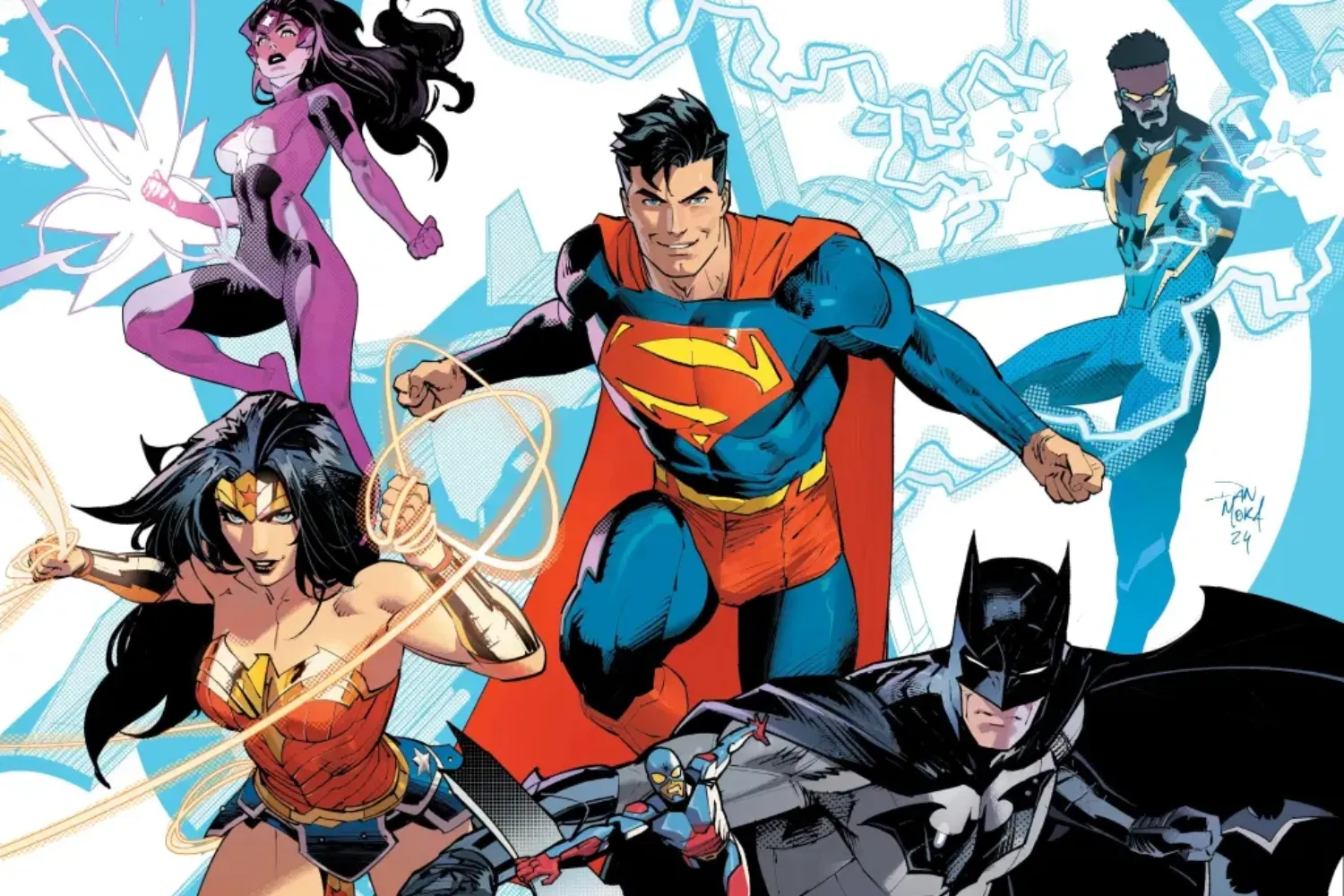
Absolute Power took every superhero’s powers away, and yet they are now bigger and better than ever. In Justice League Unlimited #1, the heroes of Earth have become action figures in a universe-sized sandbox under the dominion of superstars Mark Waid and Dan Mora. With two years worth of World’s Finest under their belts to play around with a wide assortment of heroes, this book has the same ambitions while instead being set in the present day with the unlimited resources and promise of the modern DCU.
The creative team introduces their new iteration of the team through a “meeting your new coworkers” approach. This first issue begins as a day in the life of the new League, working as a massive, well-greased justice machine, as rookie Leaguer Air Wave navigates his first day on the job. A quick tour of the new Watchtower given by Wally West, Waid’s favorite son, helps set the scale, pace, and tone for the story immediately: the League undoubtedly feels bigger than it ever has, each page is rife with quick wits and action, and it carries a confidence in such things that makes for a purely fun superhero tale worthy of its long legacy.
Influences for this book are worn very much on its sleeve, with some being less obvious than others. The most obvious thing to get out of the way is the animated show for which it gets its namesake, Justice League Unlimited, which shares a similar premise in how it tackles the usage of every hero as a member of the team despite typically telling more personal episodic stories. And aside from being an immediate successor to his own work on World’s Finest, this book indirectly continues the work Waid did on JLA in the ’90s with Grant Morrison, another run notable for its fast paced action and use of rotating characters, and to which JLU serves as a clear spiritual successor.

DC
Less obvious here in the structure, but something that fits exceedingly well, is the work of Paul Levitz and Keith Giffen on the Legion of Super-Heroes, another team Waid has done significant work on over the years. Even barring mentioning that the new membership cards echo the purpose and intent of the Legion’s flight rings, there are always background stories amidst the main plot, and even backgrounds in the backgrounds, which help to keep the massive cast of characters in mind without losing focus on the main story. In this case, that main story is centered on Air Wave’s first day, a new large scale threat looms in the shadows, and other rookie heroes like Star Sapphire are getting used to hitting the ground running.
Another thing of note for this new direction is that it feels somewhat like a response to Jonathan Hickman’s acclaimed Avengers run at Marvel, particularly his concept of the Avengers World in which that team was also grown to a global—and universal when needed—scale. Though Hickman focused on the grander cosmic narrative that eventually led to Secret Wars, Waid’s lens is more finely tuned to the personal side of things, which allows us to get to know this charming team all over again in more ways than one. Packed to the brim with A, B, C, and D-listers, there’s surely something in this book for any DC fan who tunes in. I mean, who wouldn’t want a cameo of their niche favourite drawn by Dan Mora?
And speaking of Mora, the artist further proves that he’s a force to be reckoned with. He and Tamra Bonvillain depart from their more cinematic event visuals for the modern DCU in Absolute Power in favour of panelling more attuned to older comics similarly to their World’s Finest approach. This approach employs simpler panelling akin while retaining the packed cinematic elements that artists such as Howard Porter put into JLA’s numerous splash pages back in the day. And at no point does Mora lose track of the book’s epic scale or emotional crux, making the art appear as effortlessly gorgeous as the script is focused and witty.

DC
Conversely, the quality of the main story cannot be said for the backup it features. After 22 years, Jeph Loeb and Jim Lee reunite for the sequel to their famous Batman story, Hush. The story is one that has lived in the mind of readers ever since its conclusion in 2003, with many debating on whether the story still held its weight as the years passed by. The story ended up being a major success with the pre-order sales skyrocketing the first issue to the number #1 spot, leading to the character of Thomas Elliot getting the spotlight in various Batman adaptations from Batman: Arkham Knight to CW’s Batwoman.
After the unexpected reveal of Hush 2, readers are given a taste of what’s coming to the main Batman title with Loeb and Lee’s Hush 2 prelude, “The Promise”. Unfortunately, there is nothing good to be said about this prelude. In fact, the prelude doesn’t say anything about the upcoming storyline because it primarily exists for Loeb to pat himself on the back with an overtly simplistic four-page script that does nothing beyond saying that the villain has somehow returned.
Loeb’s scripting over the years has experienced a decrease in quality judging by his various The Long Halloween sequels, his 2005 Supergirl run, or some would argue even Hush itself. Loeb is unfortunately not the creative star he once was. The dialogue and narration of “The Promise” is the worst part of the four-pager as we get simplistic narration from Batman and, of course, an Aristotle quote from Hush.
The script ends with “He became Hush. I became Batman,” a final piece of narration that is supposed to be the hard-hitting note that gets readers pumped up and excited for this year-long Hush takeover. But it doesn’t succeed, in much beyond reflecting how convoluted Hush has become within Batman’s history. As for the art, Jim Lee’s pencils are phenomenal but are held down by Scott Williams’ inks and Alex Sinclair’s colors. In the past, this artistic trio used to be superstars, but now as comic art has evolved, the inks and colors make Jim Lee’s art feel outdated. Recapturing DC’s 2000s-aesthetic for Hush 2 isn’t a bad concept, but the execution is lacking in its intent.
Ultimately, “The Promise” is as flawed as the concept of a Hush sequel in the first place, and doesn’t reflect well on the upcoming storyline nor does it add anything to the main comic the prelude is attached to.
The main story of Justice League Unlimited #1 provides an excellent revamp for the world’s greatest heroes on an epic scale, packed with superhero wit and kinetic energy. Unfortunately, the anticipated backup prelude leaves much to be desired.




You must be logged in to post a comment.