

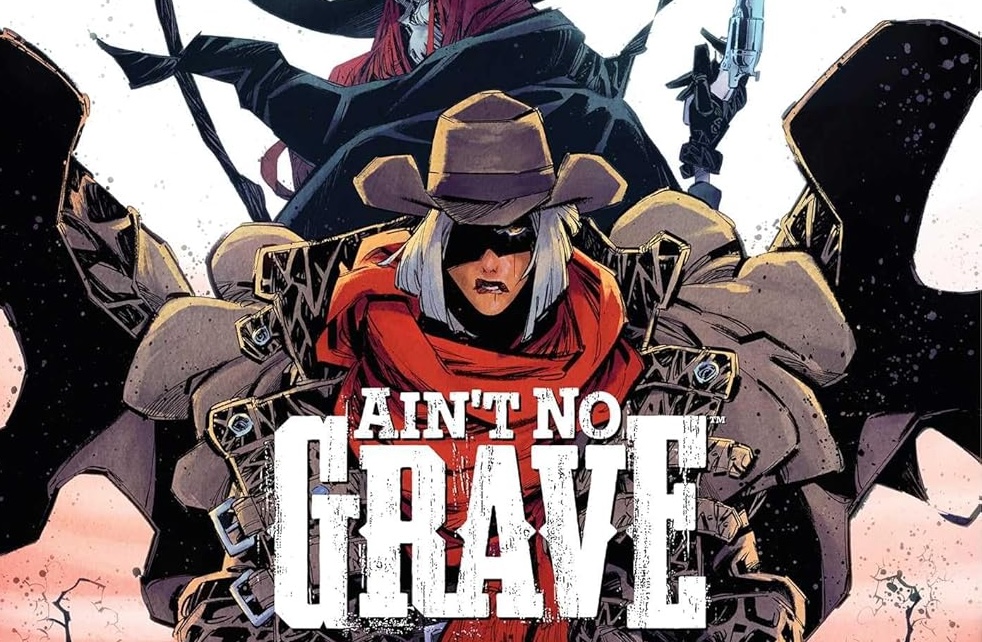

Death is certain. He never wavers.
Death’s portrayal in the media has always fascinated me. An entity or a concept? Good or evil? Just or unjust? There are so many ways in which it can be explored through storytelling. And the best part? There are no right or wrong answers because each time, some valuable lessons are imparted to take away. Ain’t No Grave is one such story. It is not easy to fight the very thing that determines the end as we know it. For Ryder none of that logic matters, she is a survivor after all. But Death doesn’t forgive or forget. After all, it comes for all of us.
Collected in five issues, Ain’t No Grave takes its readers through a western-fantasy journey that reminded me of a mix between Red Dead Redemption 2 and Elden Ring. Our main character, Ryder, is a strong-willed woman, wife, and mother who left her long bloody past as an outlaw to be with her family. All is well until one day she learns of the sickness that will soon rob her away from her husband and daughter. With limited time and double the determination, Ryder dusts off her holsters and hat and begins her long, arduous journey to the city of Cypress so she can fight Death.

Image Comics
At initial glance, Ryder’s character feels complex, like an onion with so many layers to unwrap. The one detail that touched me the most is that she is first and foremost a mother who loves her daughter to death. So, the moment she abandons her daughter for the “greater good,” that is cheating death infinitely, it feels emotional, borderline cruel, and, most importantly, human. Being an outlaw in the past comes with its own baggage, something Ryder understands and tries to overlook by telling herself that she has changed. Yet, it is seen how easily she slips into her old habits as an excuse to support her family, something her husband greatly disapproves of. Ryder, however, barely bats an eye at her morally gray decisions. This tug-of-war between her own selves confuses Ryder and it somewhat acts as a catalyst through the book.
The first issue of Ain’t No Grave starts off a little slow and I won’t lie, it took me a while to understand what was going on. There isn’t any narration or monologues to guide the reader, so the story just flows naturally. Ryder’s broody personality and her solo journey doesn’t leave much to say, so the book isn’t overflowing with dialogues. But when the words strike, they strike hard. Writer Skottie Young made sure of that. I was a bit surprised with how little Ryder speaks throughout the book; instead, the characters she interacts with do most of the talking. Also, with Young injecting each character’s personality so vividly with words using the support of Eisner-nominated letterer Nate Piekos, I could almost hear their voices in my head. During important moments, Young’s writing shines and feels poetic that gives this book so much depth and gravity.
Jorge Corona and Jean-Francois Beaulieu’s work breathes life into this book since much of it is carried by the art and colors. In fact, there is an entire issue that just talks to its readers using Corona and Beaulieu’s artistic expression and it perfectly illustrates Ryder’s pain and sorrow with such haunting scenes. It is also my favorite issue in this series.

Image Comics
Ain’t No Grave continuously transitions between flashbacks and present events so smoothly, it almost feels like you are watching a movie. The differentiation between past and present events is smartly done with the play of colors and Ryder’s noticeable features like her hair. Long shots of Ryder’s journey as she travels through lonesome deserts or is fleeing away from enemies gives the reader a glimpse of this beautiful mythical western world that feels vast and treacherous in its own way.
There can’t be a western style book without action, and Ain’t No Grave gets that. Such moments were thoroughly enjoyable as Corona and Beaulieu deliver engaging action and violent sequences that flow easily from page to page. Lastly, I absolutely cannot close this review without mentioning how good the character designs are. Fantastical, unique, and so fitting to the folklore genre, the character designs elevate the overall story further enriching the reader’s experience of this world.
Five issues felt too short to explore more characters and the world this book offers but with what was crafted, Young, Corona, Beaulieu and Piekos deliver some masterclass storytelling that begs to answer the question – how far will you go to get more time with your loved ones? Because ultimately, this is a story about how fragile and short life is. It is a story about the strength and determination of a mother who doesn’t want to leave her child. It is the story about acceptance that Death is the end.




You must be logged in to post a comment.