

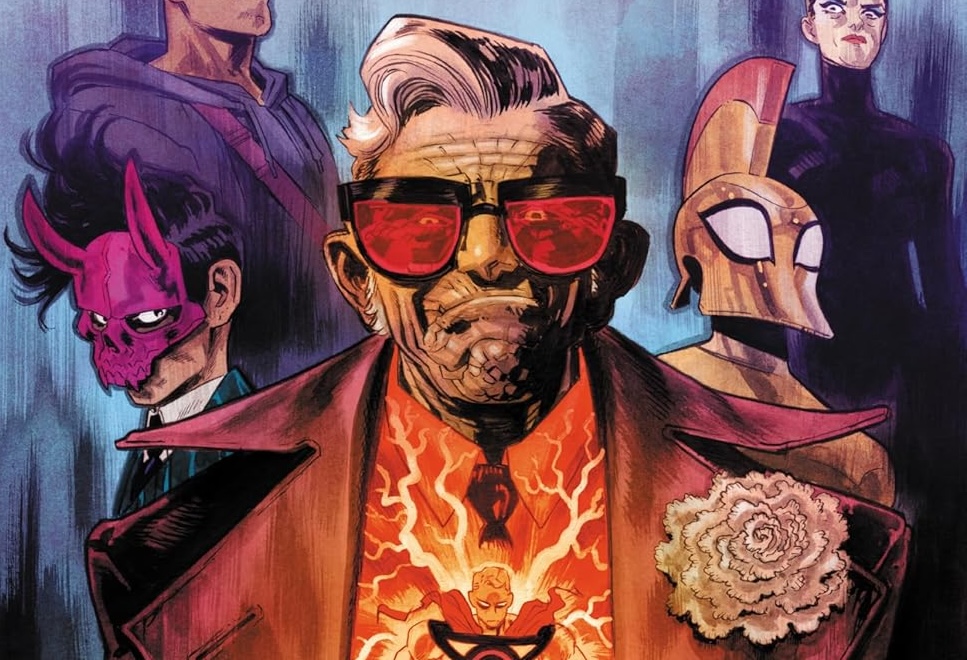

What’s drawn me to Dark Horse’s Minor Threats series is how Patton Oswalt, Jordan Blum, Scott Hepburn, and a whole host of creators have explored tried-and-true superhero tropes through the lens of characters you wouldn’t expect. The original Minor Threats and its sequel, The Fastest Way Down, showcased the struggles of supervillainy, and the underlying humanity of certain villains. Barfly asks if a former villain can change, while The Alternates was about surviving the trauma of a world-ending event. Now Minor Threats: The Brood #1 asks, “What kind of legacy would a supervillain leave behind?”
The answers are unfurled over the course of the issue, as readers are introduced to Napoleon Archimedes, the “greatest criminal mind the world has ever known.” Archimedes has been locked in battle with the superhero Searcher for decades, but those battles are taking a toll on his health. So he decides that one of his three children will inherit it: Agatha, Benjamin or Simon. Each of them have their own reasons to want (or not want) the throne.
The Brood writer Heath Corson described the story as “Succession meets The Royal Tenenbaums“, and the former’s influence can be felt in the dynamic between Archimedes and his kids. Corson’s script explores the connection between him and his children, and their different relationships; Agatha wants to be his heir, Benjamin doesn’t have any interest, and he looks down at Simon for practicing magic. As The Brood #1 proceeds, it turns out each of the Archimedes kids has their own secrets to hide, which provides fodder for future issues. Corson even pens a line for Archimedes that stuck with me long after I closed the book: “I have dragged the Gods to Earth. Soon, I will prevail.” That’s the kind of supervillain speech Lex Luthor or Norman Osborn would envy.

Dark Horse
The Brood #1 also features a unique visual style courtesy of I.N.J. Culbard. Culbard’s artwork plays with a variety of shapes, from the multi-shaped helmet Archimedes wears as part of his battle armor to his robotic companion Intellectus, who’s forgone legs in favor of a spherical lower body. Culbard’s best artistic moment comes with how he depicts the passage of time; one page is laid out like a scrapbook, with the photos serving as panels that chronicle Archimedes’ various fights with the Searcher. It’s a unorthodox way to sum up a decades-long rivalry, but I appreciate it.
Culbard plays with a unique color scheme; no matter the setting, whether it’s a pinkish-warm sunset or the cold dark green of an Amazon jungle, blue is the most prominent color. It shows up in Archimedes’ captions, which letterer Nate Piekos lays out with the cold precision that a criminal mastermind might have. It’s in his armor. Even his secret base on the moon (because what self-respecting supervillain doesn’t have a base on the moon?) is awash in a cold blue. It’s rather fitting that the places closest in hue to Archimedes’ armor are where he feels the safest.
Minor Threats: The Brood #1 is yet another solid expansion of the Minor Threats universe, showcasing the intricacies of a supervillain dynasty. The stage is set for an intriguing story, and I hope Corson and Culbard continue to build upon one of the best modern comic book universes out there.




You must be logged in to post a comment.