

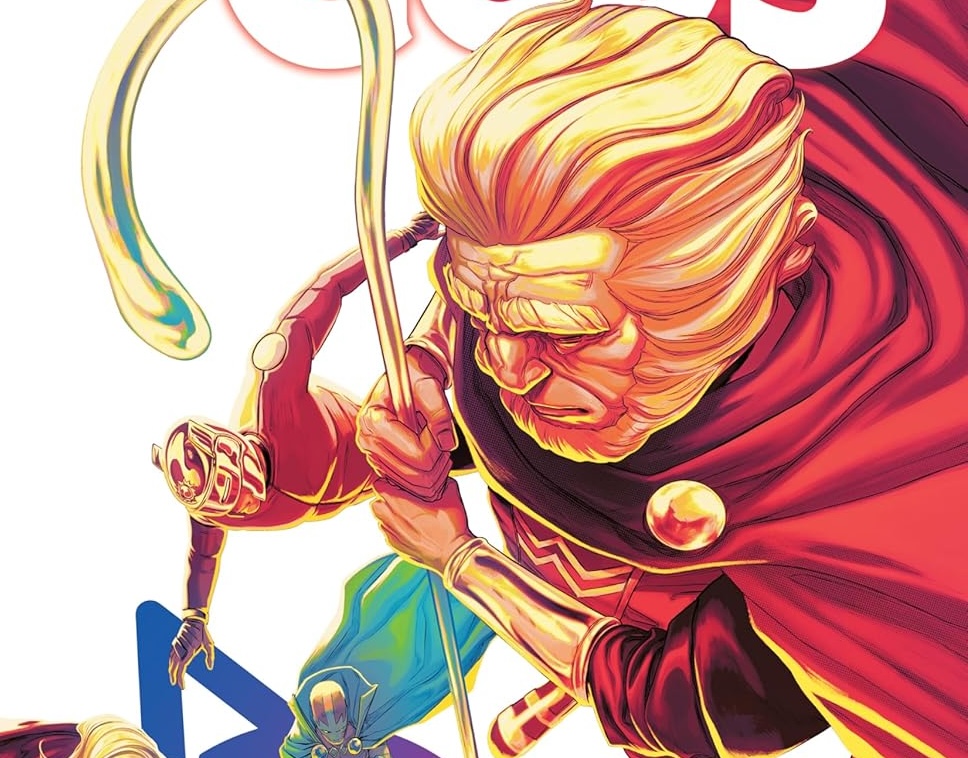

The New Gods haven’t been the titular characters in a DC Comics ongoing book in nearly 30 years – not in my entire lifetime. Even in the 21st century they’ve mostly been relegated to big event comics and other characters’ titles since Jim Starlin’s The Death of the New Gods in 2008. It is significant that Ram V and Evan Cagle have been entrusted with this particular title.
The fingerprints of their predecessors which have made the New Gods a pillar of the comic industry include Grant Morrison, Mike Mignola, Gerry Conway, the aforementioned Jim Starlin and of course, Jack “The King” Kirby. Fair or not, V and Cagle will find their work measured on a weighted scale, their distance traveled measured on hallowed ground.
DC’s All-In initiative has established the context for this work. Darkseid is dead, and V will hold readers’ hands as they begin to discover what the Fourth World looks like without its great devil in the sky. This premise is a gift and it would’ve been a captivating question to begin with for anyone, however, it’s V’s choice in how to develop it which will crawl into reader’s minds and demand attention as they suffer through the whole month long wait until issue #2.
While much of Kirby’s original work creating the characters stems from his fascination with Norse mythology, blended with Judeo-Christian and occasionally Greek mythological concepts, V has said that he’s taking inspiration from his “reading of Hindu mythology.” This is apparent from the earliest pages of New Gods #1, as V subtly introduces the concept of reincarnation. He narrates a god’s death, but where readers would expect to see a word confirming her end, he uses a word synonymous with beginnings ; “she allowed her end to bloom.” He further characterizes this approach as one which features the gods, “often making silly mistakes because they are powerful, not because they are perfect.”

DC
Readers should be excited to pick up this book and discover that Ram’s swing on the book is every bit as big as the occasion demands. I don’t know if I’m ready to say that the book feels entirely unpredictable, but it certainly feels as if there are things which might happen in this book which might have never happened in this world before.
There’s a scaling here which spans questions of the very nature of reality, and the intimacy of new parenthood. Specifically, the prose will at one time attempt the philosophical grandeur of godhood, yet also the banality of faceless, working-class aliens readers will never meet again. As a reader it’s spectating a tight-rope act, which ensnares your attention throughout the performance, and washes over you in fascination once it’s been completed. It is very good.
In this context, Ram returns to what has become a pattern in his work at DC, which is his choice to reinvision our heroes as something different, less comfortable, less predictable. This is where the marriage of artist and art really shines. Highfather in particular encapsulates the way in which Ram makes these gods feel like more than simply heroes. The stakes are higher. The morality is different. The end result is all but assured.
Readers will notice that V has only worked with a handful of these characters so far, notably none of the Fourth World’s Apokoliptian cast. Considering the series reconsidered morality, casting its characters in shades of gray rather than black and white, one might wonder how this will affect the depictions of the series’ more villainous characters.
This isn’t to mention The Forever People who could force tonal variance in the book, and test how far V can really stretch. Luckily, there doesn’t seem to be much continuance from the tone of Tom King and Mitch Gerads’s Mister Miracle, which was the Fourth World’s most recent and recently popular outing.
Cagle is suited for that variety, and should give readers some confidence either way. His style and choices present the story in a hyper-reality which is appropriate for the New Gods, and likely gives it the malleability to handle most of Kirby’s main cast.
With that being said, the style of hyper-reality which Cagle creates is vastly different from the style of one created by the King. If readers are expecting something which looks and feels distinctly like Kirby, then this isn’t necessarily going to be that, though it is something which feels worth trusting. The balance Cagle pulls off between the complex backgrounds, classic designs, dramatic emotion and immersion of brand new influences into the New Gods’ world is as impressive as anything an artist has produced in a monthly comic in a long time.
And, he’s barely scratched the surface of the rich world they get to play with.
What this offers the book and the characters is an opportunity to be reconsidered. Kirby’s influence and the New Gods in general have merged so much with DC’s “house style” over the years, that many readers may not know what a New Gods comic which is completely distinct is like to read. Readers have new eyes to see these characters though because Cagle has chosen to depict them differently, somewhat boldly in some instances. There’s an excitement and punch in this world, which has not existed there in a long time.
What’s left to see in regards to Cagle’s work is the same thing which is left to see for Ram’s: does the marriage of new and old work out over time?
I’m extremely hopeful that it does, but either way I can already feel the excitement of watching Ram and Cagle get up on the tightrope again for the next issue. I want to see every trick they can pull off and the ways they defy the gravity which pulls on and threatens every big swing like this one. Even as I write this, I’m constantly going back to the issue, finding new little questions I have and finding new things to look forward to. Ram and Cagle have thus pulled off my favorite type of comic experience: the kind which reminds me why comics were my first love.




You must be logged in to post a comment.