

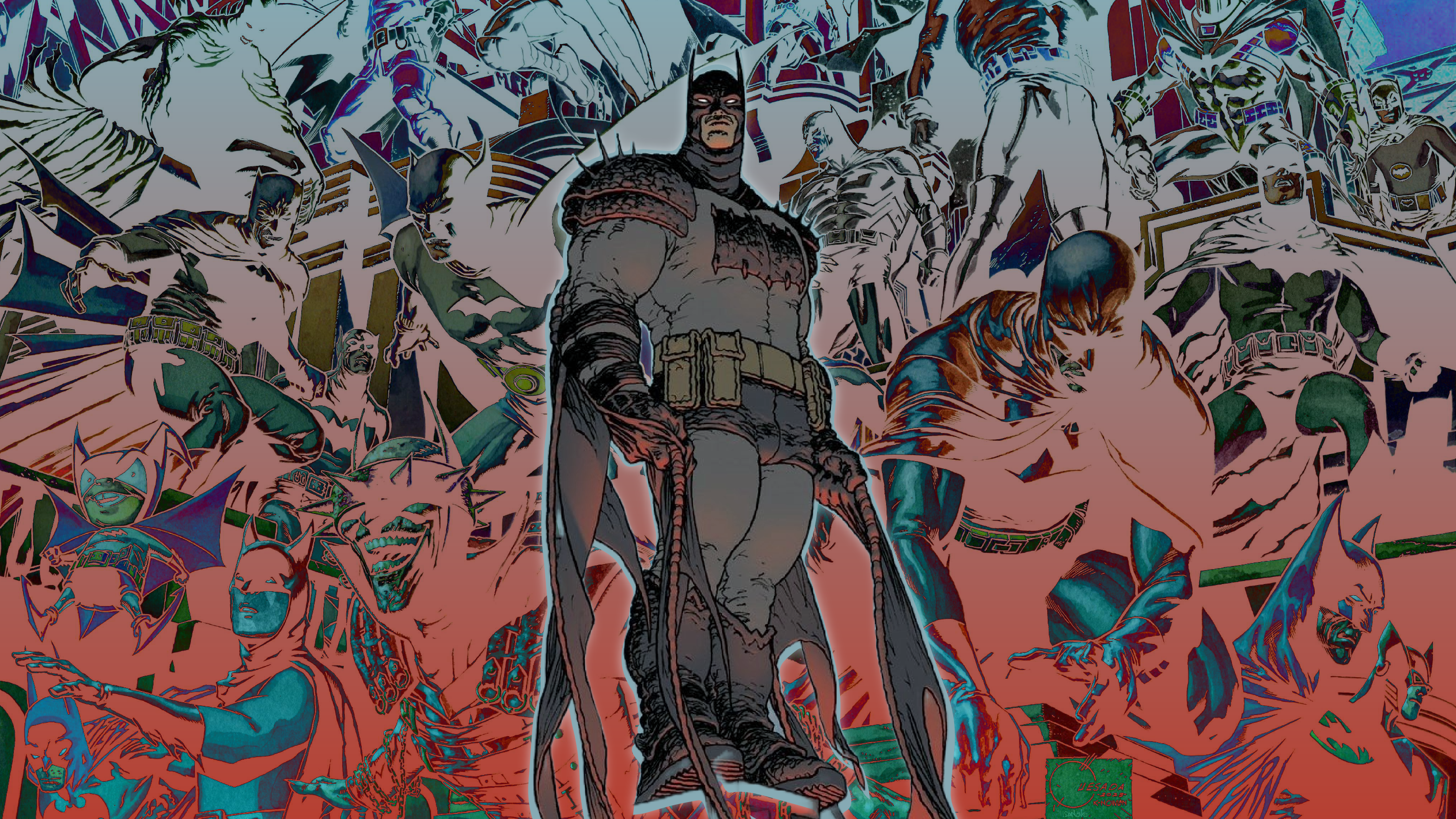

Batman is older than Star Wars, he is older than the Big Mac – and yet he remains on storefront shelves and coming soon posters. With the most ongoing comic book titles, an award-winning VR game, a prestige spin-off series, and a long-awaited sequel film in development, he’s like a rock star who never stops touring. Compared with his other superhero peers, Batman is arguably the most successful. Believe it or not, he even outlasted all the other heroes from the 30s that inspired him.
How is that possible? He survived wearing a zebra costume and having nipples on his suit. 85 years and counting, and his success both critically and commercially seems to have buried his handful of slip-ups. Last year alone, the best-selling comic book was Absolute Batman #1 – Scott Snyder, Nick Dragotta, and Frank Martin’s effort at a modern Batman for our times – capped with a revamped working-class origin that crosses out the zeroes in Bruce Wayne’s bank account.
This begs the question, what makes a character from 1939 so enduring? And how many of his elements can be shuffled around until he becomes someone else entirely? Can he still be Batman without his billions?
His Contemporaries
While Superman is an immigrant story, and Wonder Woman is a counter-cultural feminist icon, Batman is the simplest of the three. He doesn’t have any superpowers. There’s no need to invent a new mythology for alien planets or women-only islands. On the contrary, his whole existence informs the myth around him. Batman’s attributes determine the place he lives in. He has a dark cape and cowl, so his city has to have gargoyles for him to perch on, making it a living, breathing maze with crime in its airways. Gotham City slowly shifts after every appearance to become a place that accommodates a creature of the night such as he, just as DC owes its name to Detective Comics, the strip where Batman first appeared. He has such an effect that the late DC Extended Universe, which started with Man of Steel, owed its somber look and feel to the Dark Knight trilogy before it.
But you take off the pointy cowl, roll everything back, and it’s apparent how much Batman is a product of his time. He is based on 1930s pulp heroes, crime magazines, men with hats, trenchcoats, and guns. Looking at the characters of that era, some even have movies released around the time Batman 89 broke records. You have The Phantom and The Shadow, all appeared in comic strips years before the caped crusader, yet following him late to the silver screen, riding on his success.
However, not one of them grabbed critical or commercial attention the same way Batman did. So maybe he lasted this long in the cultural evolution despite his inspirations, not because of them. But what made him stand out?
His Fashion Sense

DC
Maybe it’s his looks. His iconic silhouette that kids could doodle easily. Batman’s costume that originally, wasn’t even supposed to be drawn the way he is now. Artist Bob Kane wanted stiff wings right out of Da Vinci’s drawings and domino masks straight from Zorro. It was not until writer Bill Finger gave his input that we have the classic look today. Maybe there’s a parallel universe where Batman’s original design was used, and he never lasted longer than an issue. Funnily enough, veteran Batman writer Grant Morrison wrote a story in Detective Comics #1027 about a character who went through a rough patch not unlike Bruce Wayne, but instead of donning a bat-themed symbol and arsenal, he chose a generic trenchcoat and Tommy gun, leaving him hopelessly obsolete in Batman’s shadow. So maybe the suit does have a lot to do with it.
In the 1930s, pulp heroes were a dime a dozen. Where now we have million-dollar budget streaming shows, then there were only radio broadcasts and cheap funny papers. There, Batman stood out by being a composite of different influences. His first story, Case of the Chemical Syndicate, is straight out of The Shadow, while his backstory is eerily similar to Zorro. Other heroes like The Phantom also had caves for a base of operations. In fact, that was the reason Bill Finger opted not to write in a “Bat” cave. That was a later addition invented for the serials, presumably to make the background sets more interesting.
All of this is to say that Batman didn’t come out freshly baked out of the oven. What made him iconic keeps being added over time by a number of creators, and that includes his wealth. He wasn’t as wealthy as he is now, both in the amount of stories and the fictional money he possesses. Most of what made him, him, gradually came out after his first appearance. So when was he made rich? He was made of noble birth in the first place because of the era that the comic medium was in. An era that has passed.
His Deep Pockets
Both The Shadow and Zorro before him had socialite secret identities, so Bruce Wayne followed in their tracks. Bill Finger said that he chose the name as it sounded like old money. The simpler answer for his wealth, and the aristocratic background of the other heroes, might be that they came either from comic strips that cost ten cents, with pages juggling different characters and ads, or audio dramas that would rather go straight to the action to keep people from tuning out. So the solution was that characters just had crime-fighting as their day job.
Being sensational dime-store entertainment, its simplicity was never a question, it was a selling point. Comics were accessible and popular, and in the two-dimensional plane of paper, all that mattered was the war between good and evil. They were never confused for high literature. But times have changed. Comics aren’t ten cents anymore, which means there has to be more thought put into them and more dimensions. And they do, with art that feigns the third dimension, advanced coloring that renders lifelike lighting, and writing that produces heightened depth.
For Batman, the most noticeable shift in quality started in the 1980s, from Frank Miller’s handiwork.

DC
Having had creative control handed to a coterie of experienced writers and artists over the years, Batman’s myth had been building over time. Some of these inspired additions worked more than others. And what worked stayed.
Bill Finger and Bob Kane’s Batman was a canvas that kept being worked on long after they’d stopped, and this flexibility, being contributed by talent with different sensibilities, made him timeless. Campy Batman could work, James Bond Batman could too, and in Frank Miller’s back-to-back seminal works, a trend was set for years to come: a serious anti-establishment Batman, appropriate for ’80s political turmoil.
In his 4-issue mini-series The Dark Knight Returns, Miller was also the first to give tribute to Zorro, making Mark of Zorro the last movie that Bruce Wayne watched before his parents were murdered. This tiny detail would later be cemented into Batman canon, while the original character and The Shadow and The Phantom slowly disappeared from the zeitgeist.
Young Bruce Wayne was inspired by Zorro, the hero, the way Batman’s creators were inspired by Zorro, the fictional character. Just as later Batman writers are inspired by previous iterations, new ideas are created from prior takes and earlier interpretations.
38 years after that, writer Scott Snyder invents Absolute Batman with Nick Dragotta, a new iteration of our favorite octogenarian. But I’m getting ahead of myself. Eight years before that, he and Steve Orlando wrote a Batman and The Shadow crossover, paying another tribute to his roots. They made The Shadow into Batman’s many mentors, teaching Bruce to be his successor, a double meaning with the characters’ real-life connection. It’s a poignant way of honoring the original heroes, acknowledging their influences, and at the same time, subtly showing how Batman surpasses them in pop culture.
But does Batman surpass them? Or is he on par with these forgotten heroes of old?
His Infamy
Graphic novel legend Alan Moore argued that Batman is a simplistic comic book character and should be treated as such. He publicly regretted writing his award-winning story The Killing Joke. A 64-page comic that inadvertently caused an infamous adaptation and decades of shallow comic book imitators attempting to recreate Moore’s magic.
Moore, along with Frank Miller and others, was one of the writers who changed the majority’s opinions on comic books as something more sophisticated. Though their works were radical at the time, their success resulted in copycats, which imitated the dark mood of the 80s without any of the nuances.

DC
Maybe Moore’s right. The downside of having the inherently silly concept of a billionaire wearing a Batsuit being read critically was that people started asking questions like, “Why doesn’t Batman just donate his riches?” Maybe a Batman comic shouldn’t have a killer clown monologuing philosophical musings and shouldn’t be taken too seriously.
Or, maybe what made The Killing Joke so renowned was the creators themselves: Having a talented writer and artist pulling out all the stops, taking the source material seriously as a vehicle to tell a good story. Unfortunately, it also meant that the story’s proven success became a formula, and for years, a lot of Batman comics were seen as Killing Joke-lite. This was what killed the pulp heroes in the first place: procedural storytelling that had gotten old. Batman was able to endure because he adapted to the rise of the colorful superhero, but if he stopped evolving, he’d be in danger of being worth ten cents again.
In an interview with AIPT, Scott Snyder said that the current comics industry was in danger of facing a similar crisis. People started to think that superheroes were over and the genre was dying. That’s why he wanted to take the risk of spearheading the Absolute Universe and, with it, make Absolute Batman, creatively jump-starting the character. Instead of trying to relive the 30s or 80s and adhering to the status quo of past successes, readers needed a story that woke them to the realities of the modern day.
Just as the conditions of the world inspired Frank Miller and Alan Moore to revitalize Batman then, the world feels like it’s at a turning point where it needs a new brand of comic book justice now.
His Absolute Clean Slate
This is what’s being attempted with Absolute Batman. Scott Snyder and Nick Dragotta have updated the 85-year-old character, stripping him down to his absolute core, without the cave or the money. With rising tensions against real-life billionaires, Batman’s lack of wealth makes his character easier to echo that resentment. If you take the privilege away, can Batman as a concept survive? Four issues in the series, I’d argue his lack of wealth is a relatable human challenge that enriches his heroism.
Batman was created in a specific era of the world, right after the Great Depression. He wasn’t meant for the 21st century in mind. He is a cultural touchstone whose essence is trapped in amber. The details may change, his net worth fluctuates with each new decade, and what he wears may follow the current fad, but his primal idea persists.
Bruce Wayne said “The idea was to be a symbol. Batman could be anybody.” Anyone could turn a trauma into something positive, not just the insanely wealthy. This idea is finally fulfilled in Absolute Batman, where the only thing that separates him and regular people, is not class privilege, it’s the awareness to help people, the commitment to doing it, and the experience to do it well.
Scott Snyder finally made a Batman for the people: a 24-year-old who takes the subway to work, someone who’s not content in punching criminals but wants to take down the corrupt system that churns them out. And it turns out all those changes didn’t stop Batman from being Batman. If “Batman could be anybody,” it should also mean that writers and artists get more chances to go wild with creative freedom.

DC
So what makes Batman so special? It’s the generations of people that sculpted him, storytellers and artists that took the pulpy idea seriously, and made him bigger than he was first imagined to be. Batman is popular because the accumulation of his stories gave him a library to learn from, tropes that can be subverted, bad ideas that could be improved upon, and endless hindsight that refines the myth into something useful and appropriate for all times. With his simplicity came an identifiable symbol that can be retrofitted to the current culture’s conditions.
The longer Batman exists in public consciousness, the more his existence is challenged and the ever-changing cultural opinions question aspects of his character. In these gaps of history, writers and artists can retroactively contribute to published stories with outdated concepts, rearranging them to keep them relevant. The more media appearances, the more Batman takes on multiple inspirations and produces limitless iterations of an altered but faithful character. It’s a positive feedback loop, each iteration fueling the next story, feeding his myth, from one medium to the next.
The closing lines of Grant Morrison’s 6-year Batman run said as such, “Batman always comes back, bigger and better, shiny and new.” Well, Scott Snyder definitely took the “bigger” part to heart. As long as someone tells or retells Batman stories, more creativity would be added as a necessity. If Batman has shown anything, it’s that he changes with the world, bringing hope that no matter how hard we have it now, the world can change just as it has before. And in the next world, he will still be there. Because of that, there will always be a relevant Batman story.
Though he may not be the hero that we deserve, he is always the hero that we need right now.


You must be logged in to post a comment.