


Wonder Woman as a concept has more integrity when feminist themes are centered. Her creator (Marston) knew this, and subverted the Greek myth of Pygmalion in service of this truth. Radically for the time, Marston insisted on the self-possession, and interiority of female comic characters, as well as the idea that womanhood and femininity did not need to proceed from manhood and masculinity to have value. Readers have seen this story thread pop up again recently in Absolute Wonder Woman, but where did it go to begin with?
If you haven’t already, be sure to read part one.
Wonder Woman, Post-Marston’s Death
Over time, the reference to the Pygmalion myth has fallen out of fashion in the character’s depictions. In 1954, psychiatrist Frederic Wertham published Seduction of the Innocent, which accused the Wonder Woman comics of promoting a homosexual lifestyle and also having a bondage subtext. While the latter is certainly plausible, it’s the former which is more important. Many have read Marston’s works on the character and have also come to the conclusion that the book featured queer characters, while disagreeing on Wertham’s specific moral claims. Instead, this is a reading which can further support the feminist intentions of the book. That being said, DC Comics were forced to take many of Wertham’s accusations to heart as they coincided with the creation of the Comics Code Authority.
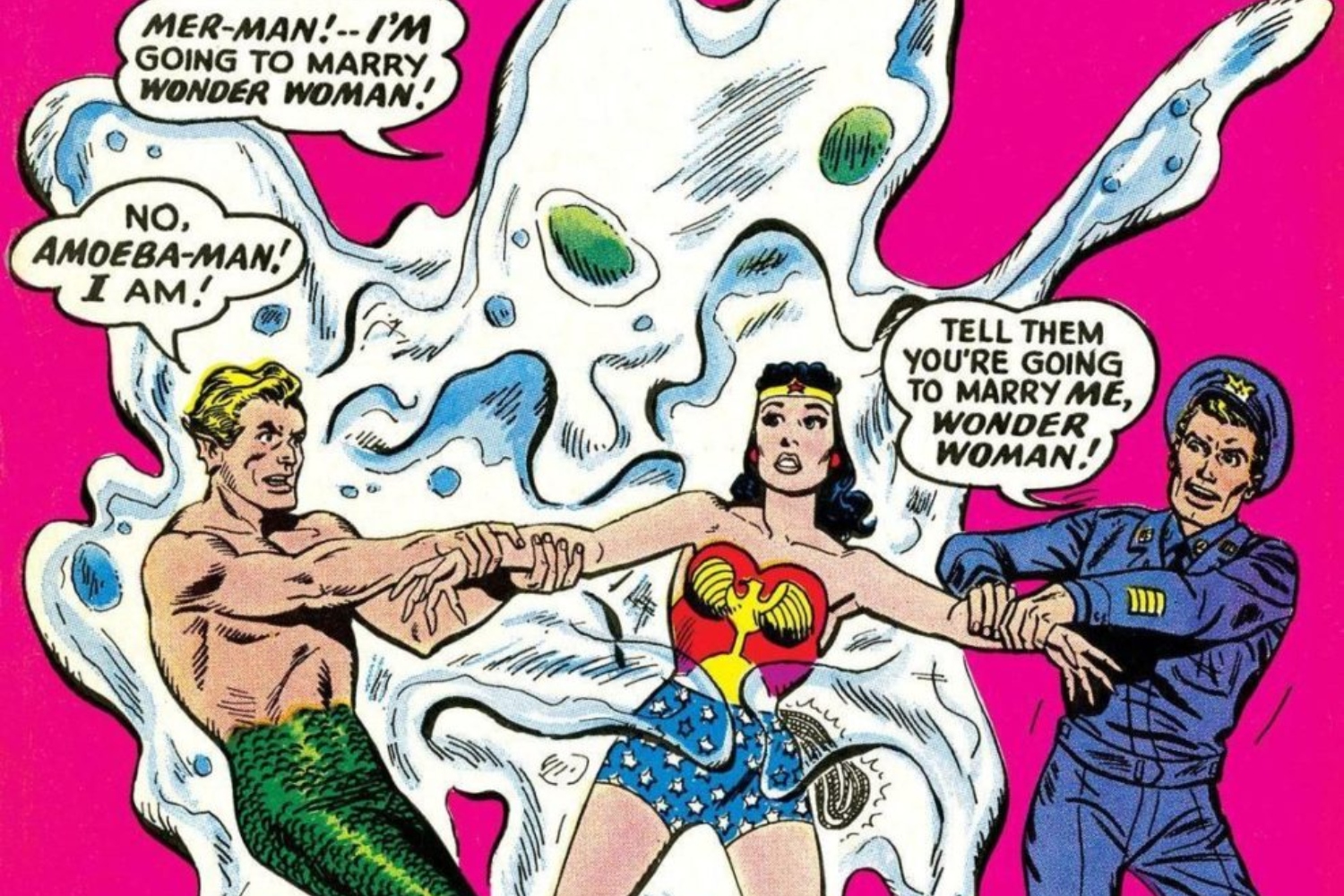
Following Marston’s passing in 1947, Robert Kanigher took over the book and had begun to transition it away from the radical politics it had been infused with since day one. Wertham’s accusations and the creation of the Comics Code Authority only furthered Kanigher’s pivot into the trendier and more conservative romance genre. No longer was Wonder Woman the place readers would find the damsel trope subverted by having a man in the role, but now Diana would be pining after marriage to Steve Trevor.
In regards to the character’s origin, any reference to the Pygmalion myth was completely stripped from the text; rather, Diana was simply a special child who received gifts from the gods and whose father died in war. Kanigher’s pivot was entirely one towards establishing a patriarchal take on the character. Thankfully, this isn’t an interpretation which has had much influence over the character throughout the years.

Art from a Robert Kanigher-penned Wonder Woman story. Courtesy of DC Comics.
Gender-Blind and Feminist aren’t the Same
When it comes to influence, readers should look to George Perez’s 1986 Post-Crisis reboot of the character, which has defined the character artistically, tonally, and thematically for every reader and creator since.
Perez, hot off industry defining work with Marv Wolfman on both The New Teen Titans and Crisis on Infinite Earths, was tasked with redefining the character alongside John Byrne’s Man of Steel and Frank Miller’s work on Batman. When interviewed by 13th Dimension in 2019, Perez explained that at the time, despite DC’s publisher being a woman, there wasn’t a single woman who worked in the company. And he was motivated to work on the book when he saw which artist DC was planning to have done it, whom he felt was “more used to drawing stuff like a Penthouse magazine.”
Instead, Perez would go on to write Wonder Woman for over 60 issues and would preside over her first big event story, “War of the Gods,” which saw Diana and her compatriots violently defending the patriarchal status-quo.
One of the most predictive changes that Perez made from the very beginning of his run was to again change the overarching genre assigned to Wonder Woman. Under his pen, the book firmly sat in the mythological-fantasy genre, with the exploits of the Greek gods more prominent than ever and many of Diana’s key antagonists replaced with the monsters of myth.
This meant that more often than not the book would begin to center violent contests of power, such as the titular clash in the aforementioned “War of the Gods.” While mythological-fantasy was nowhere near the conservative and regressive genre that romance had been for the character, it still represented a significant movement in that direction from Marston’s feminist utopia.
Further, his reinvention of the character saw much of its feminist character re-worked and cast in a “gender-blind” perspective, such as when Artemis references the Amazons’ creation and asks, “does their gender truly matter?” Now Diana’s origin was told in the mold of patriarchal Abrahamic religions, complete with a formerly enslaved people group escaping through a parted sea to a promised land.

Courtesy of DC Comics.
In this interpretation, the Amazons’ creation itself is not a feminist act, but one which sets as its end goal that they should seek out equally more men and women to worship the gods. From the beginning, Perez is centering patriarchal power as the reason for these female heroes’ existence.
There is no prescription for the specific ways in which these characters should help the women of the earth, which specifically contrasts Marston’s take. He had written Aphrodite claiming that the goal of the creation of the Amazons was to “conquer men.” A more modern example of this take can be seen in Kelly Sue DeConnick’s Wonder Woman Historia: The Amazons, which features the statement that the Amazons “[ensure] that man reaps what he sews.”
With this choice, Perez fails to even establish the context for the Pygmalion myth to matter. Later in the narrative, once the Amazons have been captured by Hercules, Hippolyta prays to Aphrodite for their freedom; in Marston’s version, the goddess admonishes Hippolyta for trusting a man and delivers their freedom. They’re then delivered to Paradise Isle as an act of love and protection.
Perez, rather, depicts Aphrodite admonishing the Amazons for growing isolated, bitter and corrupt, despite the fact that this is not clearly depicted on the page. Thus, when the Amazons are advised on how to regain their purity a page or two later, it is not their supposed corruption which sits front of mind, but their being enslaved and implied being raped which had just been depicted. Paradise Island then becomes an unjust form of penance for the Amazons as a whole.
This establishes a larger context which overrules Hippolyta and the Amazons’ agency with the patriarchal will of the gods, so that when it comes to depicting Diana’s birth, Perez isn’t then able to center Hippolyta and her interiority. Instead, it is the gods and their prophecies which direct the circumstances of Diana’s birth. While Perez’s Hippolyta can at least be described as sentient, it is only feeling things which she does in this narrative, as the gods identify her feeling of yearning as one for a child and what she must do about that.
The influence of the birth control movement which so fascinated Marston is completely lost here, as even the intimate choice to become a mother is one which Hippolyta is not afforded. Similarly divine will in this narrative has reverted to existing in response to patriarchal power. Diana’s birth is a function of the needs and desires of Zeus and his court, even if that support is enacted by the goddesses. Once again, womanhood and femininity find themselves proceeding from manhood and masculinity, despite the moment being framed as feminine triumph.

Courtesy of DC Comics.
Wonder Woman’s marriage to the Status Quo
Perez’s choice to ultimately center patriarchal power is an anti-feminist one. Even in rebellion, his goddesses are ultimately subservient to Zeus. This means that his portrayal fails to represent the full range of heroic feminine experiences which often exists in opposition to power. This is cemented in the climax of Perez’s run, the aforementioned War of the Gods, which concludes when Diana and the gods recruit Chronus, an even older Patriarch to defeat Circe and Chronus’s “errant grandchild Hecate. This is, to be clear, not a unique fault of Perez’s work, however, because he’s a talented enough creator that his work has influenced so many, it nonetheless becomes the work worth discussing the most.
Readers can see here how unfortunately removal of the Pygmalion storythread and the themes associated with it have damaged Wonder Woman’s character. They’ve made her less explicitly feminist and left future creators to parse out the mess of themes previous creators had worked with. Fortunately, a couple of modern works have taken the opportunity to experiment with these threads again, and readers can see how that turned out in our final installment.



You must be logged in to post a comment.