


Much like Neil deGrasse Tyson or the late Carl Sagan, Yuval Noah Harari is gifted with the capacity to break down complicated scientific concepts into conversational anecdotes that are comprehensible to the layman. Specializing in world, medieval, and military history, Harari received his PhD from the University of Oxford and remains a Distinguished Research Fellow at the University of Cambridge’s Centre for the Study of Existential Risk.
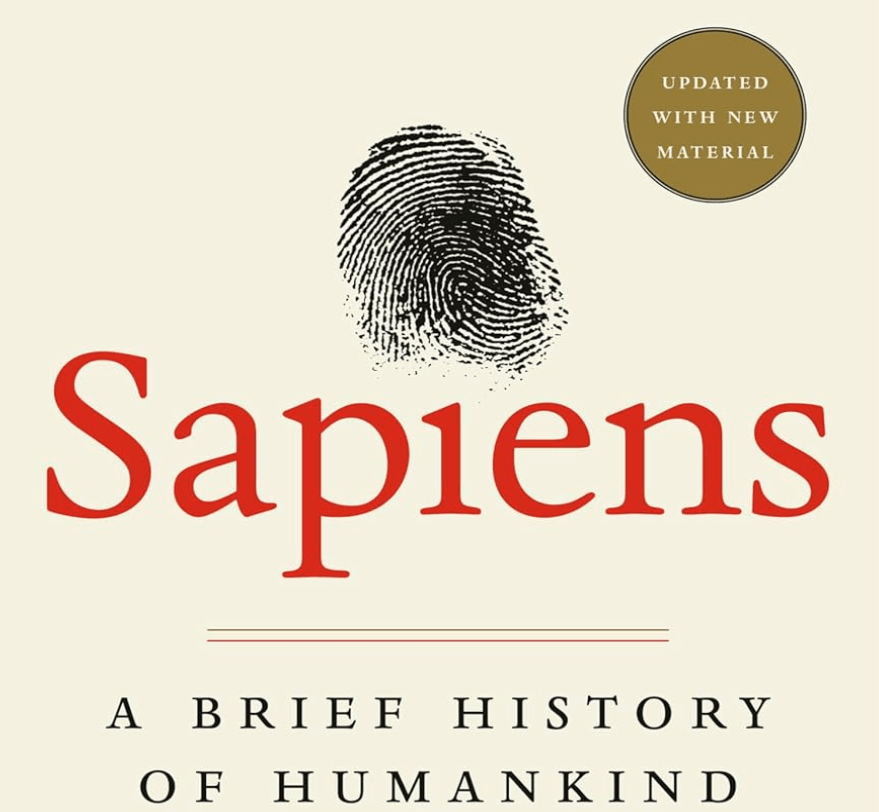
Inspired by Jared Diamond’s Guns, Germs, and Steel: The Fates of Human Societies, what began as a series of lectures Harari gave at the Hebrew University of Jerusalem (where he’s currently teaching history) became the book Sapiens: A Brief History of Humankind.

Now translated into over five dozen languages, Harari’s New York Times Best Seller explores both the natural and social sciences of humankind, namely Homo sapiens (in his book, Harari’s definition of “human” includes all of our ancestors and late cousins within the genus Homo). After a brief breakdown of the Big Bang and the origins of life, Harari zeroes in on humanity’s origins in east Africa, our migration away from the continent, and the lead-up to the Stone Age.
Sapiens explains that we weren’t the only human species to utilize stone tools or fire, as our predecessors Homo erectus and the Denisovans also did. “The earth of a hundred millennia ago was walked by at least six different species of man,” Harari says, and that “from about 2 million years ago until around 10,000 years ago, the world was home, at one and the same time, to several human species.” Most us have learned that Homo sapiens for a time co-existed with Neanderthals, who not only used stone tools and fire, but likely cared for their injured, based on discoveries of individuals with long-term handicaps.
In Sapiens, Harari details the cost of our evolved thinking. Due to our ever-increasing brain and (by proxy) head size, natural selection favored premature births. “A colt can trot shortly after birth; a kitten leaves its mother to forage on its own when it is just a few weeks old,” Harari says. “Human babies are helpless, dependent for many years on their elders for sustenance, protection and education.” Harari goes on further to explain how this paved the way for our increased social abilities:
“Lone mothers could hardly forage enough food for their offspring and themselves with needy children in tow. Raising children required constant help from other family members and neighbours. It takes a tribe to raise a human. Evolution thus favoured those capable of forming strong social ties.”
Arguably the most interesting portion of Sapiens pertains to what Harari calls the Cognitive Revolution. He discusses the importance of gossip and how this otherwise maligned ability was in fact essential for cooperating in large groups:
“The new linguistic skills that modern Sapiens acquired about seventy millennia ago enabled them to gossip for hours on end. Reliable information about who could be trusted meant that small bands could expand into larger bands, and Sapiens could develop tighter and more sophisticated types of cooperation.”
With the Cognitive Revolution also came our unique capacity to create fiction, to “transmit information about things that do not exist at all”:
“Legends, myths, gods and religions appeared for the first time with the Cognitive Revolution. Many animals and human species could previously say, ‘Careful! A lion!’ Thanks to the Cognitive Revolution, Homo sapiens acquired the ability to say, ‘The lion is the guardian spirit of our tribe.’ This ability to speak about fictions is the most unique feature of Sapiens language.”
Harari further drives home this point by saying, “you could never convince a monkey to give you a banana by promising him limitless bananas after death in monkey heaven.” Without our capacity to craft fictions, we’d have no gods, no money, no laws, no justice, no human rights nor nations (concepts that he insists ultimately have no tangible reality outside of humanity’s common imagination). This all leads to Homo sapiens‘ ability to organize into corporations and countries, groups far larger than any of our primate cousins could ever achieve (only in rare instances have zoologists documented chimpanzee societies of larger than 100, yet humans can develop nation states of hundreds of millions).
“People easily acknowledge that ‘primitive tribes’ cement their social order by believing in ghosts and spirits, and gathering each full moon to dance together around the campfire,” Harari says. “What we fail to appreciate is that our modern institutions function on exactly the same basis,” and that lawyers and modern business execs are, in many ways, akin to the powerful sorcerers of our forefathers.
While Catholicism acknowledges evolutionary biology, there are still vocal segments within Protestant denominational groups (such as Baptists or Pentecostals) who deny human evolution, and view it as a threat to their religious worldview. The notion that there were multiple tool-wielding, fire-starting Hominini flies in the face of a biblical literalist notion of Adam and Eve. Yet our comprehensive fossil record, breakdown of the human genome, and the narrative that Sapiens: A Brief History of Humankind lays out, informs us that selective survival, selective breeding, and adaptation (both biological and cultural) did, in fact, transpire.
Every February, to help celebrate Darwin Day, the Science section of AIPT cranks up the critical thinking for SKEPTICISM MONTH! Skepticism is an approach to evaluating claims that emphasizes evidence and applies the tools of science. All month we’ll be highlighting skepticism in pop culture, and skepticism *OF* pop culture.
AIPT Science is co-presented by AIPT and the New York City Skeptics.




You must be logged in to post a comment.