

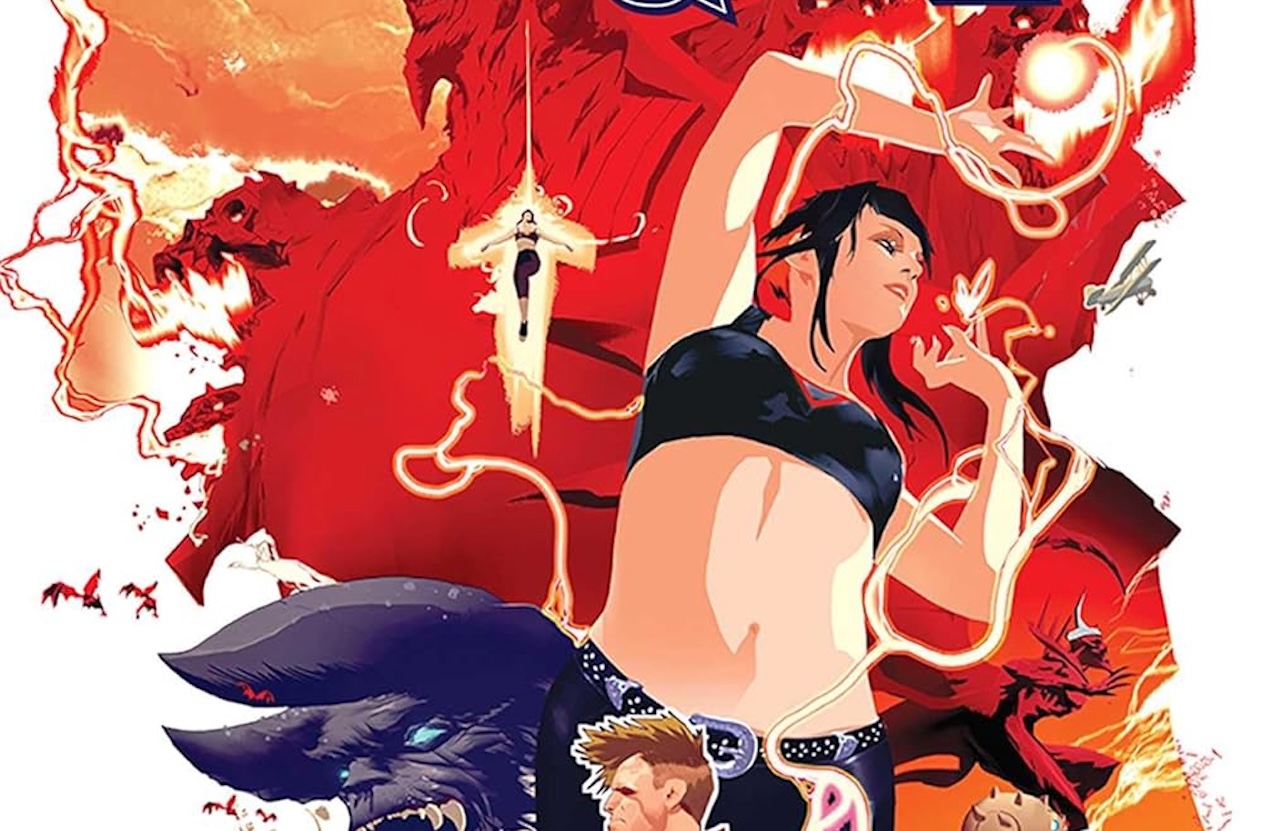

I was not wowed by Strange Girl, Eric Nguyen and Rick Remender’s 18-issue apocalyptic religious horror road story. I am, however, glad to have read it, and that it’s getting a complete hardcover collection for its 20th anniversary. It includes some solid back matter — the best of which is a thoughtful essay Remender wrote in 2011 looking back on Strange Girl, how it was inspired by his experiences growing up as an atheist kid with a Mormon extended family, and how he related to the book six years after its original run. And, since it collects the run in its entirely, it’s a prime opportunity to see Nguyen, Remender, and their creative teammates develop as comics-makers—from an intriguing if very rough start to a solid, moving conclusion. It’s a neat artifact from talented creators, albeit one that I would only recommend to hardcore fans of their work or comics history/craft lovers who enjoy tracing creative evolutions.
On a ruined, post-Rapture Earth that the legions of Hell have turned into their playground, a young woman named Bethany learns that there might be one last portal to Heaven still active. As a rebellious kid, Bethany had chafed against her intensely religious parents’ harshness and questioned their obsessive adherence to dogma. Now, with a decade of definitive proof that Hell is real, Bethany wants to seek out God and, among other things, ask why. It’s a long way from California to Italy — the alleged portal’s home — and Bethany is more important to Hell, Heaven and the world than she knows. Her journey will be fraught. Fortunately, she’s not walking alone. Over the course of Strange Girl, Bethany’s joined by a small and sometimes rotating crew of survivors, human and demon alike, drawn together by necessity and obligation and ultimately care.

Credit: Image Comics
In his introductory essay, Remender is refreshingly frank that 1: Strange Girl’s characters mean a lot to him, it was a cathartic book to write, and he’s both grateful to his creative collaborators and proud of the finished work and 2: Strange Girl gets off to an extremely rough start. He and his creative collaborators should be proud. Strange Girl is an ambitious story, one that happily tackles the thorny questions that surround religious faith and all that comes with it. When Bethany and her final party click as characters, they’re a likable crew whose bonds read as genuine. Nguyen and his fellow artists (Jerome Opeña, Harper Jaten, Nick Stakal, Micah Ferritor and Peter Bergting)’s demons take the classic image—horns and tails, and spin it in a fun variety of ways — from Bethany’s lovable/gross gremlin best friend Bloato to the traditional big red devil Belial to the Mignola-esque terrors unleashed late in the story. Likewise, his blending the frayed remains of life-that-was with Hell’s grotesqueries results in unsettling, eerie imagery, which his fellow artists make the most of. In particular, Nick Stakal’s mid-series portrayal of Hell as a constantly mutable place that can and will attack its prey from every angle is unsettling. Closing an issue of elaborate torments with the simple, stark image of Bethany being thrown into an endless, void-like pit will stick with me.
Remender is likewise correct that Strange Girl’s opening is tremendously flawed, and those flaws stick with the series throughout, though they do lesson as the creative team figure out how they want to tell their story. Narration and dialogue are both overwritten to the point that they sometimes get in the way of the art. The pacing is wonky as all get out, hurtling between sudden rapid story developments and too-long-drawn-out long-term plots. Strange Girl is at its best when it takes the time to explore its cast and contextualize their adventures, but there too, it can struggle.

Credit: Image Comics
Bethany and Bloato, the comic’s most consistently present cast members, do not click as characters until the party expands. More castmates give them a wider variety of experiences to play off, letting the two grow beyond their “exasperated snarker and goofy wisecracker” dynamic and creating space for their longtime friendship to start showing its depths. This is welcome for both, but especially Bloato. To be blunt, early on he’s downright insufferable — an obnoxiously horny quip machine with a perilously low volume-to-impact joke ratio. Early Bloato is emblematic of Strange Girl at its worst — clinging to edge and bombast to shock when it’s neither all that edgy nor all that shocking. Steve Dillon and Garth Ennis’ Preacher had been wrapped for five years when Strange Girl launched, and while the two comics have different priorities, they have enough in common narratively, structurally, and thematically to be cousins to each other. It is not a flattering comparison for Strange Girl.
Nor, indeed, does Strange Girl work as well as Remender’s later comics, which explore some of the same themes and deploy some similar narrative structure. Outside of folks who loved it during its original run, I think the reader who will get the most from Strange Girl is someone who loved Fear Agent or Black Science and is curious to see how Remender has developed as a writer and creative collaborator over the course of his career. There are real sparks here, particularly later in the series, when Bethany and her crew have both a clear mission and a multifaceted dynamic. Remender’s later comics would take those sparks and light a fire with them.

Credit: Image Comics
So, for folks who’re longtime fans of Strange Girl and haven’t had a chance to pick it up or fans of Eric Nguyen, Rick Remender, and their fellows who want to track the progression of their careers, Strange Girl’s 20th Anniversary edition’s worth checking out. Otherwise, there are better comics that explore religion (in particular American Christianity and its cousins) — Gary Frank and J. Michael Straczynski’s Midnight Nation, for instance, or Preacher, and better work by these comicsmakers — the abovementioned Fear Agent and Black Science.




You must be logged in to post a comment.