


“None of it matters now…”
Jeff Lemire and Diego Olortegui’s epic storyline, “Ragnarok,” reaches its conclusion in JSA #6, complete with a major character death. Despite the Justice Society of America and Infinity, Inc. working on seemingly unrelated missions, their individual arcs don’t quite come together the way that they should. Throughout “Ragnarok,” the Injustice Society of America has been orchestrating a plot behind the scenes to divide the heroes and procure several of the JSA’s tools to acquire the Spear of Destiny. Where Kobra factors into these plans, however, remains a mystery.
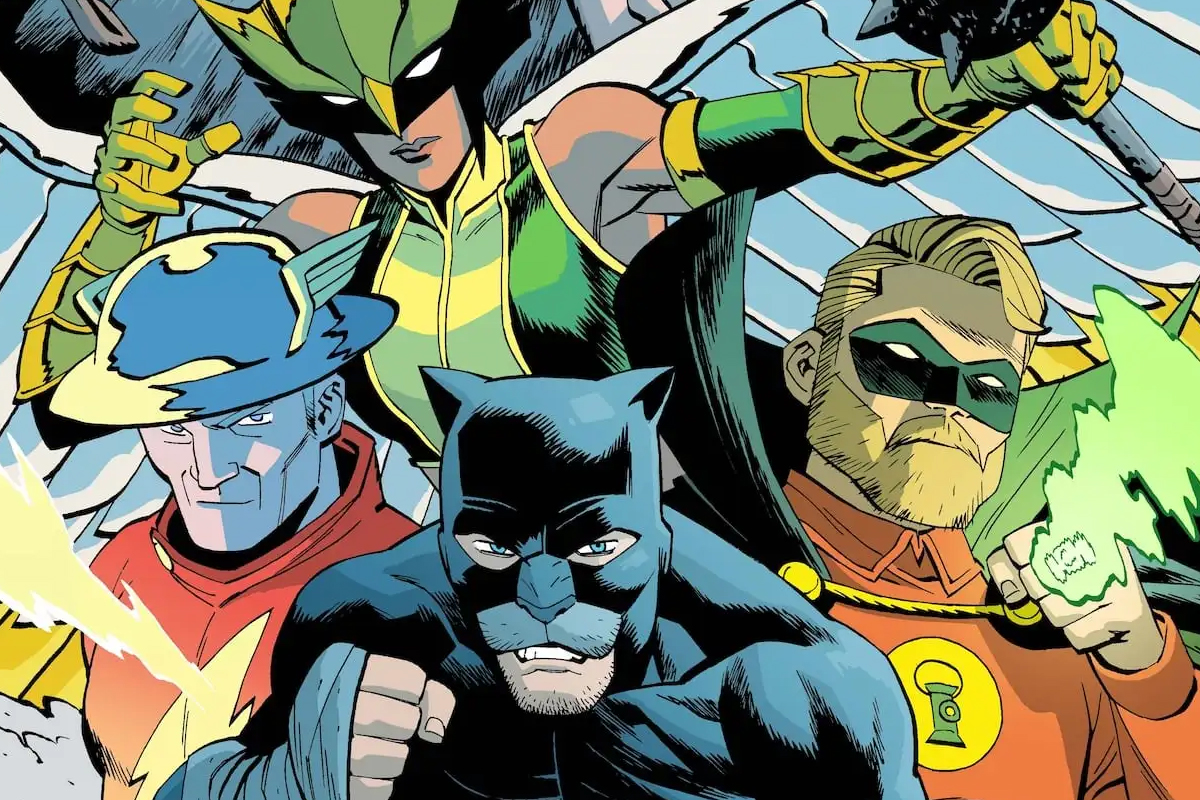
Though not a perfect story, one of the high points of Lemire’s first JSA arc has been his ability to immediately immerse readers into the action without going heavy on exposition. Coupled with Olortegui and Vazquez’s dynamic pencil work and Luis Guerrero’s vibrant colors, Lemire’s script allows the action to speak for itself. All six issues have been reasonably fast-paced, and for the concluding chapter, Olortegui’s layouts do the heavy lifting in conveying the gravity of the crises the two groups of heroes are experiencing.

Another thing that works remarkably well in JSA #6 is Lemire’s focus on individual characters and their personal struggles. Primarily, the characters he’s been focusing on throughout “Ragnarok” have been Khalid Nassour (Doctor Fate), Beth Chapel (Dr. Mid-Nite), Jade and Obsidian, as well as Jesse Quick and Rick Tyler (Hourman). Each of these characters has had their moments to shine throughout Lemire’s JSA run, but issue #6 is where they get to overcome their greatest shortcomings. It also proves to be the issue where Khalid and Jade experience significant moments of vulnerability, which is best captured by Olortegui’s highly expressive artwork.
Though Lemire excels at exploring the JSA’s character dynamics and relationships, one recurring trope that’s becoming a bit tiresome is the constant bickering among the Infinity, Inc. characters. While Lemire’s intent is to showcase the hotheadedness of youth, at the same time, it does give the impression that Infinity, Inc. hasn’t grown since the 1980s, when the team first came together. Considering they are the second generation of JSA heroes (right behind the original team from the 1940s), they should really be in a different place in their lives compared to the third generation of JSA heroes like Stargirl and Jakeem Thunder.
Another thing that doesn’t quite stick the landing in JSA 6’s finale is how the various subplots conclude. While Lemire has done an excellent job at balancing the various character arcs throughout “Ragnarok” (namely by focusing on one character at a time), when the moment arrived to conclude those arcs, the impact fell flat. This was mostly felt when the Injustice Society killed one of the veteran JSA heroes, largely because they were in a supporting role and weren’t given a strong focus. Lemire attempts to rectify this in JSA #6 with a flashback sequence that shows this character’s importance to Khalid’s character growth, but this mentorship should have been present since issue #1.

While generational legacy has been a major recurring theme throughout “Ragnarok,” the older JSA heroes haven’t actually mentored their younger counterparts for the full weight of the first hero’s death to be felt. More specifically, exploring Khalid’s deeper relationship with the deceased hero wasn’t a main feature throughout the story. Instead, Khalid’s character arc has mainly focused on his anxiety and his summoning the courage to wield the immense power he has. While he was in the company of the older JSA heroes, they were also primarily focused on getting themselves out of the crisis they were in. Since the setup didn’t really facilitate a mentorship storyline, the tragic death didn’t truly feel earned.
One final plot thread that’s left hanging is the one involving the Injustice Society and Kobra. Despite the Injustice Society being the villains who drive the conflict, their own storyline doesn’t actually progress by “Ragnarok’s” conclusion. At best, they finally acquire all the tools that they need to move forward with their plans, but those plans are now being saved for the next story arc to pick up. How Kobra ties into the larger narrative is also never clarified by the story’s finale. At best, they largely served as a distraction for the younger Infinity, Inc. heroes, but their overall role in the story feels like an afterthought.
All in all, JSA #6 is an enjoyable read, complete with mind-blowing artwork and highly engaging characters, but the various subplots don’t really come together into a highly impactful conclusion. While JSA’s first major death is meant to induce shock, the lack of build-up to this moment doesn’t allow this moment to pay off.




You must be logged in to post a comment.