

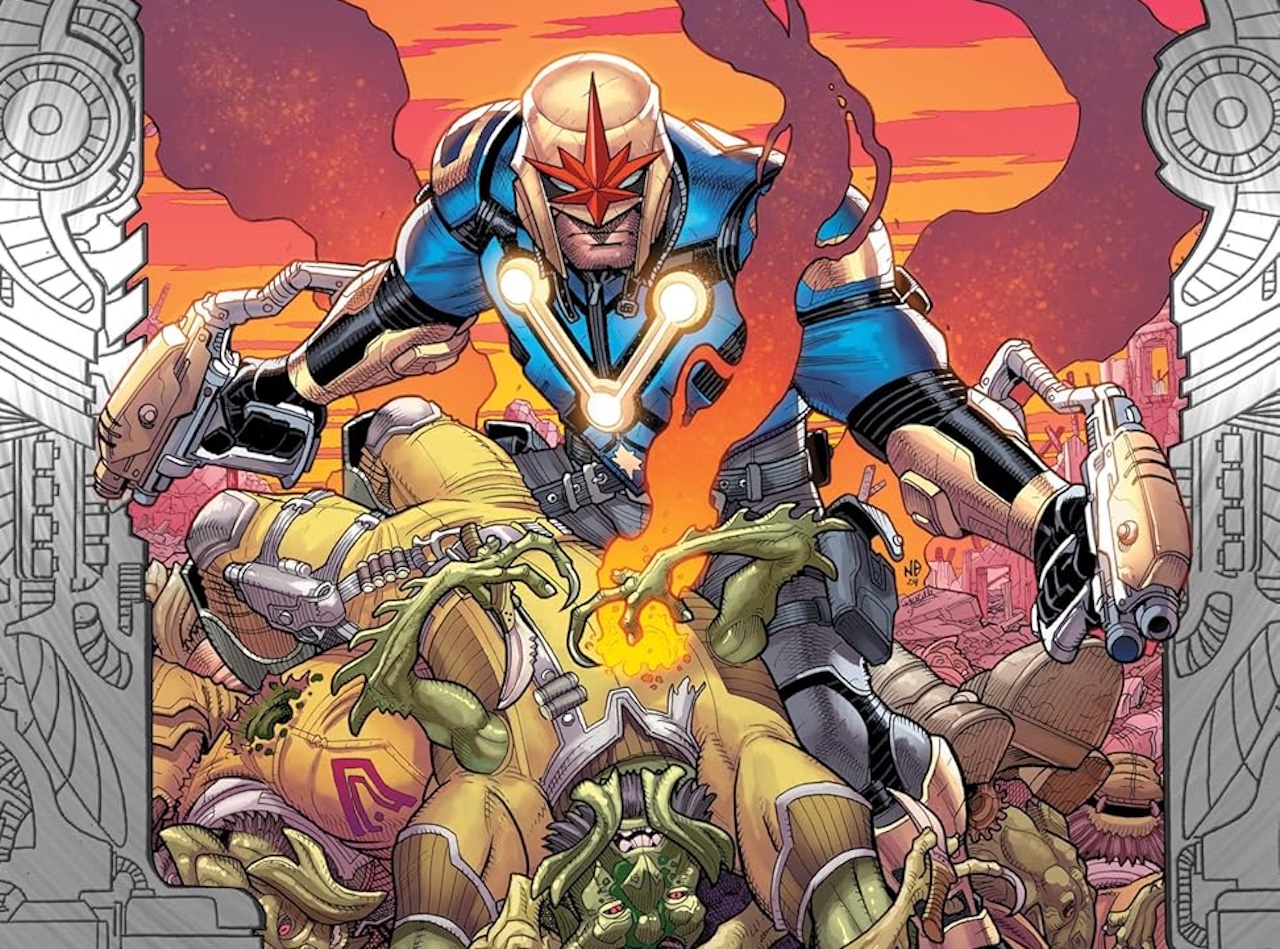

Even after 33 years of 2099 stories, there is plenty of (literal) space for exploration. While Marvel has explored the expansive cosmic universe of the future in other ways – notably with the original Guardians of the Galaxy – the intergalactic world of the cyberpunk 2099 universe has barely been scratched.

Marvel
The original Annihilation event utilized a collection of miniseries, each positioning a specific character in the wide Marvel cosmos. It was a smart structural gambit, a keen way to unfold a massive event from the perspective of those living through it. Though Annihilation 2099 doesn’t have that sort of narrative real estate, it uses introductory one-shots in much the same way: each issue introduces a new character, breaks down the basest details about them, and suggests (by way of a Dracula-led backup story) the larger conflict.
Here, writer Steve Orlando oversees the introductions of a new Nova (with artist Ibram Roberson), Hulk (Pete Woods), Starlord (Jose Luis Soares with inks by Oren Junior), and Silver Surfer (Ario Anindito); a backup story leads us to a final issue featuring the return of Dracula, with heavy suggestion that he will take the place of Annihilus as this Annihilation’s invading conqueror.

Marvel
Each one-shot is varied enough to make the universe feel wide and diverse. While some issues work better than others, each of the characters feels unique enough to support their own dense narratives. Every issue is—by necessity—a bit of an origin-dump of exposition, but Orlando weaves the introduction and in media res action deftly; the reader never feels snowed under by exposition.

Marvel
There are no duds here: each issue feels bombastic in its way, each new character just compelling enough to entice the reader. Some of the new heroes are more engaging than others – Nova, an exhausted far-flung Wolverine, has an instantaneous hook, while Starlord’s story relies more on her compelling villain, a sentient star.
This is all to be expected – not every piece of a puzzle can be as bright as any other. But even at its least shiny, Annihilation 2099 captivates; like its 2099 forebears, each character is just off enough, just new enough, to tempt further exploration of their concepts. Further, the series all but drives the reader back to previous entries in the franchise; this series connects directly to recent Spider-Man 2099 miniseries, which might bear further fruit. An even deeper reading of the barely-connected 1992 comics might also be in order, if not to get a wider scope understanding than to revel in that unique cyberpunk aesthetic.

Marvel
It’s interesting how much faith Marvel has put into vampires in the last few years – from the founding of Chernobyl as Earth-616’s undead capital to last year’s frantic Blood Hunt crossover. Here, Dracula’s oncoming reign of terror feels like it comes a bit late on the heels of all that other action. Dracula’s story itself, however, is bold and gruesome. Told in those backups and resolved in his issue of the miniseries, his story dips into horror by way of space-flight and ghoulish sci-fi laboratories. Found floating through space in a sarcophagus, Dracula then survives a spaceship crash that leaves him pinned, undead and skeletal, under the wreckage. It exhibits the burden of immortality in an infinite space, the tragic weight and ultimate brutality of Earth’s oldest surviving being.
A taste-test for a larger universe, Annihilation 2099 succeeds at cracking open a rich, promising new territory.




You must be logged in to post a comment.