

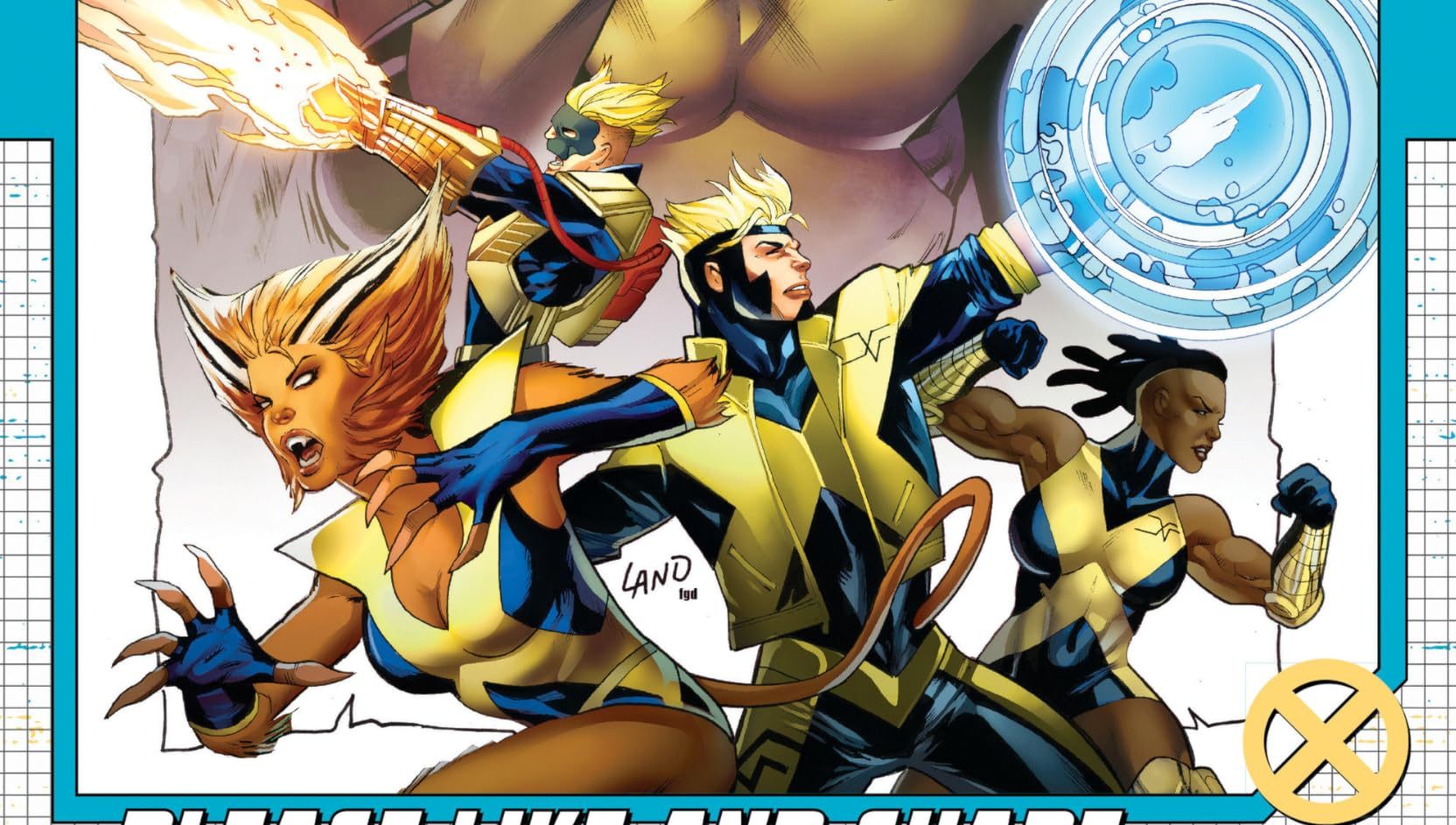

I remember collecting the original X-Factor books when I first got into comics in the 1980s. The back issues seemed to be abundant at comic shops, and since the team of original X-Men was absent from the main title at the time, it was interesting for a new reader like me to learn about the original team’s dynamics.
While there have been some incredible runs on X-Factor, the moniker has struggled to find a place in the X-line in recent memory. The Krakoan era version by Leah Williams was unceremoniously cancelled mid-stream, and with this new version by Mark Russell, we return to the team’s government-sponsored roots. At a time when Marvel is sifting through the fallout of Krakoa’s narrative arc and reshaping its various X-teams, this book takes some interesting swings and flirts with some interesting ideas, but it doesn’t quite stick the landing.
X-Factor by Mark Russell Vol. 1: Please Like and Share collects the first five issues of the new monthly written by Mark Russell and illustrated by Bob Quinn. The story opens with the U.S. forming its own mutant paramilitary strike team to compete in a global arms race now dominated by super-powered soldiers. X-Factor luminaries like Angel and Havok are joined by Pyro, Frenzy, and Feral under government sponsorship to represent mutant kind in a world with marketing deals and livestreams. Over the course of five issues, the team investigates threats ranging from rogue tech to actual mutant terrorism. Along the way, they tangle with corporate puppeteers, lunar A.I. conspiracies, and a smart fridge who might be the most effective new character introduced. Themes explored include corporate exploitation, public spectacle, and the weaponization of identity.

Marvel
I have lamented that the current X-books have been too safe by returning to tried-and-true X-Men tropes, so I appreciate that this series touches on intriguing real-world issues into its narrative. Unfortunately, these topics are often used as window dressing for the plot, and the book brushes past them in favor of broad satire or punchline-driven pacing.
Mark Russell brings his trademark wit and political satire to the table, and when it works, it works well. There’s clear commentary on tech-bro culture, virtue signaling, and the commercialization of resistance movements. Characters like Ethan Farthing are so on-the-nose they nearly collapse into caricature, but there’s no denying the fun Russell has writing these loathsome figures. That said, the script often moves too fast to land emotional beats or give the cast meaningful arcs. Havok’s grief over Polaris feels forced, while Angel remains oddly flat (this was a problem with the last Angel fronted book, X-Corps, as well). Much of the humor relies on snide remarks or meta-gags, some of which land, others that stall mid-panel. At its best, the writing is clever and pointed, but this approach could benefit from a slower book that doesn’t have the same number of plotlines to cram in.

Marvel
I love Bob Quinn’s art throughout the book – he offers clean, expressive line work that sells both action and comedy. His facial expressions bring levity to quieter scenes and kinetic force to the bigger moments. Whether depicting a chaotic fan convention or a lunar base under siege, Quinn keeps things visually engaging. His design work gives each character a clear visual identity, and the few splash pages included are well-earned and impactful. There’s a nice balance between grounded realism and heightened absurdity, which is essential for a book that veers between satire and super heroics. The colors by Jesus Aburtov complement Quinn’s lines well, especially in the high-energy fight sequences.
In the end, X-Factor by Mark Russell Vol. 1: Please Like and ShareX-Factor Vol. 1: Please Like and Share is a competent yet uneven entry in Marvel’s “From the Ashes” relaunch. Its ambitions are clear, and there’s potential in the premise of a government-run mutant strike team embroiled in performative heroism. But pacing issues, inconsistent tone, and underdeveloped characters keep it from reaching the heights of Russell’s more successful satirical work. It’s a mid-tier volume that might appeal to readers craving something new from the X-line, but for others, it may feel like a missed opportunity with a few good one-liners.




You must be logged in to post a comment.