


“I’d need evil in its prime. And that is the thought that brings two disparate ideas together…to form a plan.”
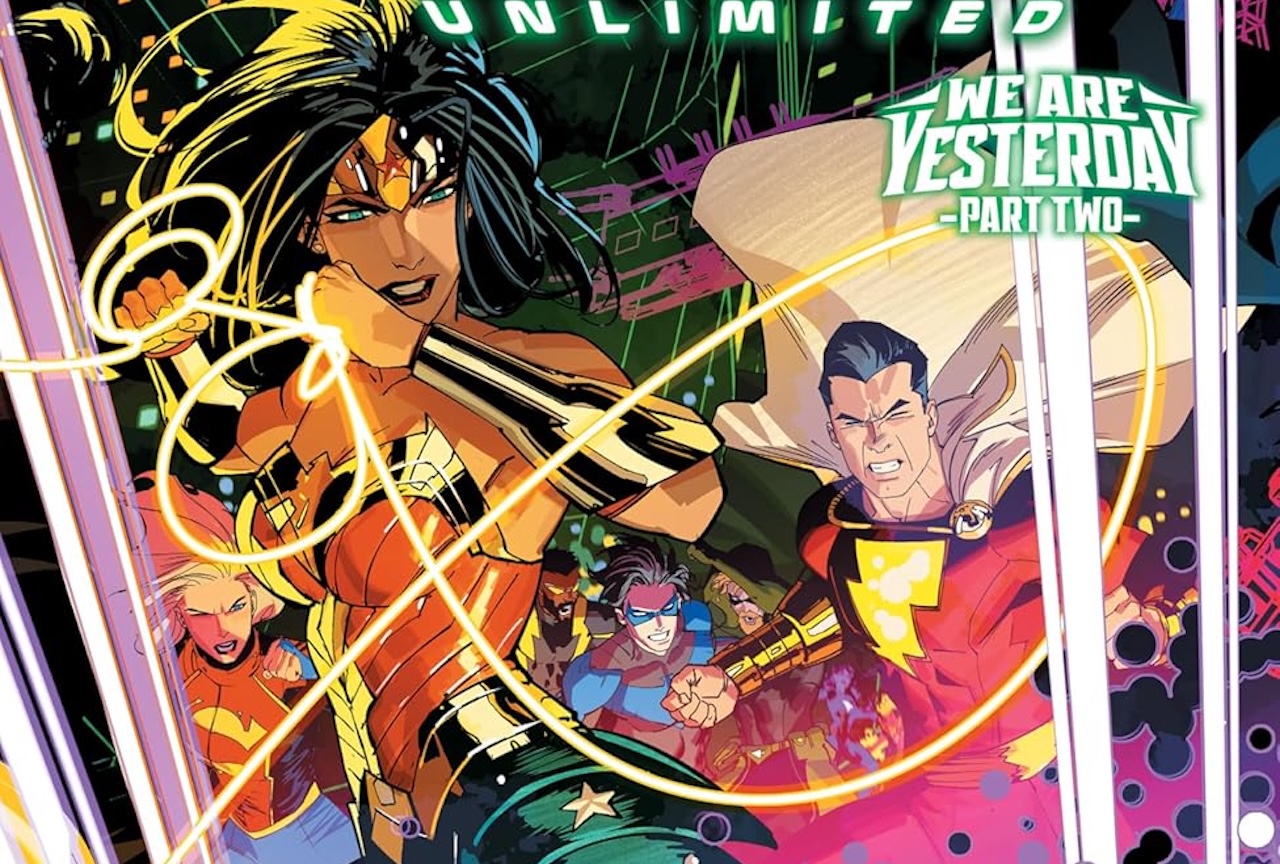
Despite how much crossovers make many of us groan and yawn, they are just as much the backbone of superhero comic books as the literal staples holding the pages together. Naturally, they were expected with the All In initiative, but so far “We Are Yesterday” has reflected the growing pains of the average early series crossover.
Naturally, it will never be as awkward as reading The Ultimates 2 (the Al Ewing one) and seeing the comic get blasted with a Secret Empire crossover seven issues in and cancelled two issues afterwards. Now, this isn’t a company-wide crossover, so the drawbacks aren’t too major. Justice League Unlimited is a major book – nothing could stop the book until it’s finished – but the narrative awkwardness is apparent.
As said by Grodd himself, the villain’s work is inspired by Amanda Waller’s plans in Absolute Power. With the missing powers of Martian Manhunter, he sought out to manipulate and indoctrinate Air Wave to infiltrate and offset the new Justice League by making him believe that his teammates are super-powered fascists. Grodd is a fascinating choice for this kind of narrative due to his explicit history as a cruel Gorilla City ruler lusting for power, now framing himself as a rebel in order to achieve plans that are not quite clear yet.

DC
The discussion of fascism in superheroes, and in general as of late, deserves nuance; to see it revisited in such a way (written by the guy who wrote Kingdom Come, no less) is a decent thematic swing with potential, though an odd one with Grodd as the issue’s main character. Air Wave also gets significantly more space to work finally, but his role in the future of the story becomes unclear once more. Admittedly, a deranged fascist preying on a young man’s loneliness and naivety of the world for the gain of power is a familiar narrative, and would be far more interesting if the ideas at play, such as the League’s allegations from Grodd, were to spark a deeper discussion as the arc continues. Regrettably, it seems like it’s a throwaway plot beat at the moment.

DC
Unfortunately, the art is not up to snuff for the first big crossover of the All In initiative. Travis Moore, another alumni from World’s Finest, draws this issue, yet it doesn’t quite fit with what we’ve seen of the book artistically so far. The issue is primarily focused on the relationship between Grodd and Air Wave, leaving little room for other characters, which in turn takes away from the “unlimited” feel Mora has portrayed up to now. Moore’s style worked incredibly well in his World’s Finest issues, a series that was more intimate in terms of character usage, but here it makes the story feel a bit narrow and lacking in scale, and not to mention the expression work is unusually stiff.
Another odd shift for the series with this issue is the pacing, which is weighed down very heavily by Grodd recapping the events that lead up to his reveal as the one behind Inferno last issue. So far, JLU has been balls-to-the-wall action with little breathing room, though it’s never skimped on smart or emotional story beats. Breathing room is most certainly welcome, but it jarringly stalls the pacing of the series for the sake of filling people in on the mystery almost immediately. And to boot, there is little to be said about the rest of the Legion of Doom beyond being Grodd’s lackeys and have done nothing as a unit two chapters into the crossover. There are definitely some interesting ideas at play, but so far this crossover has admittedly gotten off to a rocky start.
In conclusion, Justice League Unlimited #6 is a bit of a rough issue. Waid and Moore put interesting ideas in play, but the pacing and the change in tone is jarring to say the least. We’re sure “We Are Yesterday” can find a way to turn out strong, but at this present moment, the crossover doesn’t bring much to the table.




You must be logged in to post a comment.