

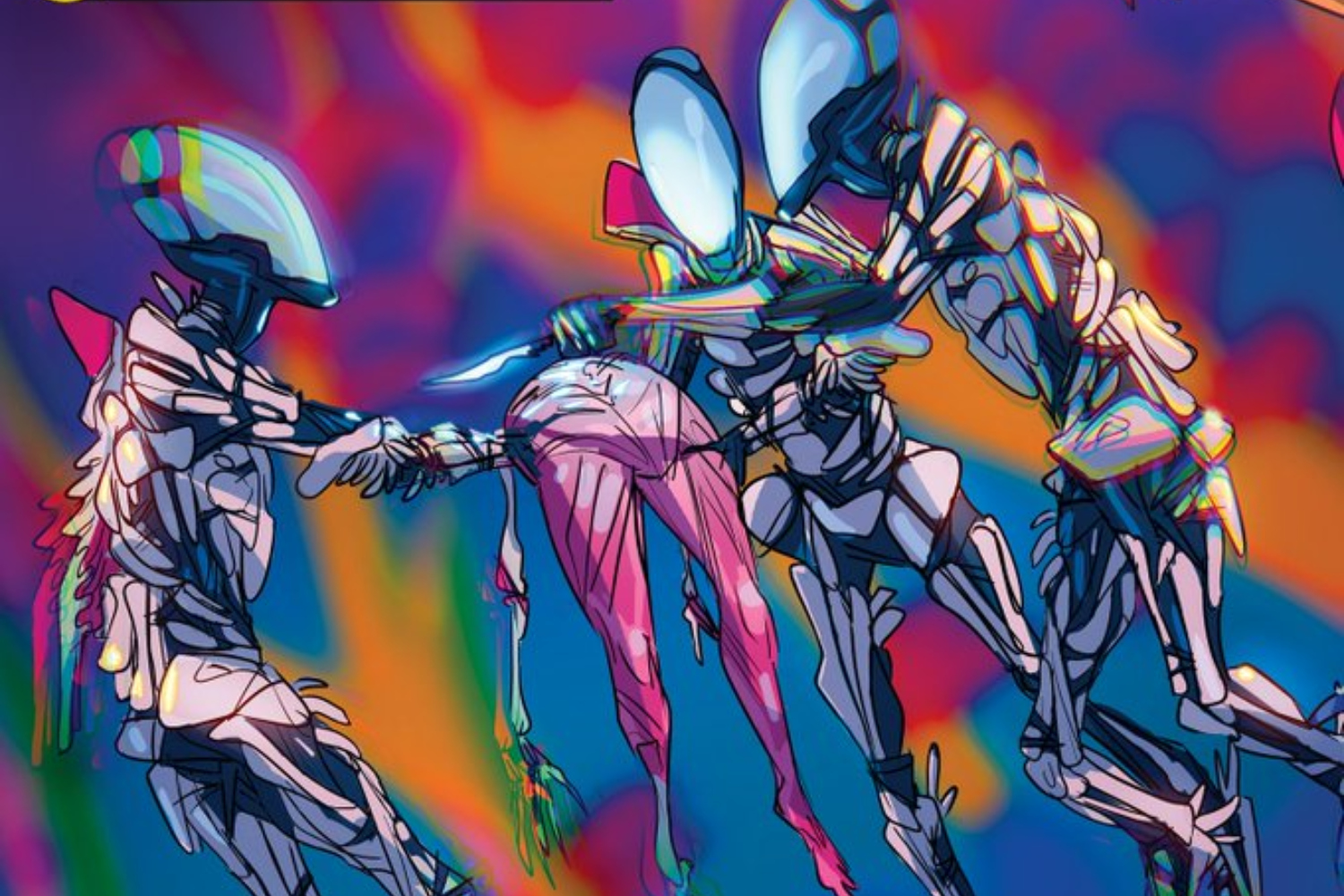

If you’ve read 2000 AD for long enough, you’ll know the future is bleak. But of the magazine’s many, many unsettling depictions of tomorrow, a new story from writer Guy Adams and artist Megan Huang is an extra interesting slice of speculation.
Debuting in last month’s issue #2,427, Ghosted is takes place in a “futuristic Africa,” where the citizens of Kinshasa are “holed up in a gigantic walled mega-city, with only themselves for entertainment.” (Sound familiar enough?!) The story specifically follows Benu, who spends her days partaking in “hedonistic drug-taking and partying” — until it’s revealed she has “secret abilities” that may complicate her mostly listless life (and perhaps the whole of Kinshasa).
Ghosted may have involve some familiar tropes, but between Huang’s vivid art and Adams’ thoughtful scripts, this world feels fresh and alive with new energies and ideas. Factor in its relevancy to our own moment in history, and Ghosted is a powerful snapshot of an all-too-familiar future as well as a deeply compelling story about communities, personal agency, and what happens to society when the party’s truly over.
Ghosted continues in 2000 AD #2,430, which is out this week. To get a better idea of what makes Ghosted so unique, we caught up recently with Adams and Huang via email. There, we discussed their collaborative process, the story’s themes and messages, the importance of 2000 AD, and the ins and outs of our lead, Benu, among other topics and tidbits.

Courtesy of 2000 AD.
AIPT: What’s the elevator pitch for Ghosted?
Guy Adams: What would you do if you found out your government had hidden the fact that you’re at war, and that millions have died without you knowing?
Megan Huang: I’ve been pitching it to curious folks as, “A woman in a futuristic city, is able to connect across the stars with a soldier fighting on another planet. Together they discover a grim conspiracy.” That, more or less.
AIPT: What’s it mean for Ghosted to be featured in 2000 AD? Does this uniquely wonderful book inspire/motivate you to tell stories differently somehow?
GA: I’m old-school, I subscribed to this damn thing when it was made of soft, matte paper. I grew up on Ron Smith’s Judge Dredd. Being a part of 2000 AD is always pulling a thread that runs through every year of living memory I possess. Was there ever a time without Nemesis the Warlock? Who’d want to live in such a time? I’m always aware that I want to tell the sort of stories I love within a long history of a very precious, subversive, sexy history.
I’m a structure junkie so I always enjoy shifting my brain to the rhythms of wherever I happen to be working on, prose, audio drama, film or six-page comic bursts, a mutated clenched fist (and you can feel the difference, rhythmically switching between five pages or six on the prog, the beats drop entirely differently).
MH: I think given the smaller page counts each week it gives me more time to breathe and think. I’m able to play with designs and atmosphere more than I would if things were moving at a faster pace. For that I’m grateful, and I think the story — or my art in the very least — has benefited from the calmer timeline.
AIPT: The story seems to include/tease people having skills-memories they never knew about. Can you talk a little more about this element that forms in part one?
GA: The skills Benu finds herself possessing at the opening of the story are not her own, they’re entirely borrowed from someone who understands the world – and the danger – they all live in. The title of the story is both literal – Benu is haunted by another person, albeit a living one – and thematic, touching on abusive relationships and also people living at an emotional distance from one another.

Courtesy of 2000 AD.
MH: Some aspects of the story are not clear yet (even to me!) but it seems that specific pairs can access each other’s skills. Felli, the soldier, is a gifted fighter and marksman, and willing or not, she lends those abilities to her counterpart.
AIPT: People’s personal finances seem to also be a central element of this world. Can you talk about that a bit more and what it does to structure/add to the story?
MH: Structure is a good word. The city, Leopoldville, is built based on wealth. It’s a very vertical city, and therefore elevators are used to reach each level. At the very top, where the sun shines are the mega-rich, at the bottom, in the gutters, living among rats and sewage, are the poor. And the levels in between… Benu is a rich girl and only takes an interest in what’s happening to the poor at the bottom after she has the worst luck in a later issue/ part.
GA: The populace of Kinshasa are rated and judged entirely by how much money they have. So, just like the world we currently live in.
AIPT: Our lead, Benu, is rather interesting to me even still so early on. What can you tell us about her so far, and is she someone you automatically admire or are we meant to feel a little more complicated about her?
MH: For me, it was neither. I think she’s outgoing and flamboyant but had never had to develop any skills since her money is/ was her personality. A party girl, a rich dumb-blonde – minus the blonde. And she really has this goofy comedic sense about her. I think she means well but has been drowned in wealth so heavily that she can be a bit silly when it comes to the struggles of people beyond herself.
GA: I’m not sure I admire her. I envy her, certainly, though less so once her existence is complicated by the pesky, grit-in-your-eye, business of knowing the truth. Like all lead characters I hope she’ll grow as the story rolls on, we all have to after all.
MH: To me she’s not complicated per se but does have a great story arc and a massive opportunity to grow from her limited mindset, which is very exciting!
AIPT: What was the collaborative process like between you two?
MH: Guy had scripts prepared in advance, before I was brought on board. I worked with those for a while.
GA: The one drawback to 2000 AD – shush, Tharg the Punitive, Editor and Majesty, has ears everywhere – is that there isn’t always a collaboration between writer and artist, at least not initially. I only found out Megan was working on it after I’d written episode seven (of twelve). Some people don’t mind that – prefer it in fact, I’ve worked with a couple of artists that I’ve never ended up having conversations with as they enjoy the isolation – but I like to know. I think you can make prettier, richer things if you work to each other’s strengths.

Courtesy of 2000 AD.
MH: As things went on and Guy and I got to speak more, I noticed that the new ones were personalized to my art style, designs, and myself. I was quite happy about it. It felt more official, I suppose. Guy didn’t have to do it either, but the fact that he did meant a lot.
GA: Now I’ve seen – and fallen in love with — Megan’s art I understand a little more of her style. I feel that vibrant, electric, day-glo punch and want to roll with it and work with it. Hopefully, if the series returns you’ll see me writing *for* her rather than despite of her.
AIPT: What were some of the core visual and thematic influences of Ghosted?
GA: I’m Autistic/ADHD, and part of that, for me, is that I have a weird relationship with language and rhythm. I’m playing with the words here, the dialogue in particular, trying to find a different beat, a more alien phrasing that helps to color the world of the story as much as the plot. This city sounds different to others.
Obviously, living in a time of bullshit and barbarism, I’m influenced to write about it. It’s all painfully on the nose but so is the world outside the door, I’ll applaud the return of subtlety with the rest of you.
MH: When I was a kid my dad watched The Fifth Element over and over and over, and thus I watched The Fifth Element over and over and over. I think the outlandish designs for the police, taxis, and some of the silly advertising, like McDonald’s incorporated into the movie, along with the odd fashion choices for Milla Jovovich (and everyone else, if I’m being honest), really helped. I’m not sure I was thinking about it consciously, but if you’re forced to watch something a billion times, I think it will come out in some way or another if you’re working on something creatively. I think that’s what happened here.
AIPT: What was the interest in narrowing down on a place like the Republic of Congo?
GA: It’s tricky this, and I thought about it a great deal. I really wanted to get away from the storytelling convention – in this part of the world – of the U.S. super-city. Lots of male white faces (just like mine) playing with their sci-fi toys (this could sound like I’m looking down on other work or casting shade on it, really not, promise, just the big gut instinct I came into this with).
Kinshasa is one of the biggest cities in the world and a place deeply divided by money. It also has an awful political history – like everywhere once you dig deep enough, I know – that’s lamp-shaded by the fact that in this future version of the city they’ve reclaimed the name Leopoldville which it was initially given in honor of the Belgian king who “owned” it!
I’m painfully aware that the result of this – I hope well-intentioned – desire to explore a more diverse world means we’re left with another annoying white boy talking about a world that’s not his. I hope the fictional divide afforded by a few hundred years and some nonsense about space aliens means I’m not treading too closely to things that I shouldn’t.
AIPT: The best sci-fi still feels connected to our own experiences/time. How close is the world of Ghosted to our own, and does the proximity matter?
MH: I think an obvious one is the rich vs. poor and how we victimize those without means. As the story progresses, we see in more detail how the government tends to the poor, and it’s only slightly darker than the times we live in now, which says a lot more about the present day and how we need to do better for humanity lest we really do become the citizens of Ghosted.
GA: Aside from the complicated issues about the world discussed above, the politics of this world are entirely recognizable. Brazenly so. And yes, I do think that can be important. Not that there’s not room for stories that simply thrill with the unknown, take our minds and eyes to somewhere entirely removed from our own experience, all stories are equal. I think great sci-fi can be utterly alien, it’s very hard to do richly and successfully though!

Courtesy of 2000 AD.
AIPT: What standout moments or other tidbits can we expect from the rest of this story?
GA: I make Megan draw things she had to research the insides of the human body for. Because I am evil.
MH: Some spoilery moments that I can’t talk about! But there is a cool sequence that leans into the “vision” Benu had in part one a bit more. That comes up relatively soon. We also introduce a very crazy fella — crazy in a bad way. Not fun for the characters, but I think he’ll be fun for the readers. And more spoilery moments, haha!
AIPT: Is there anything else you want to add about Ghosted, 2000 AD, stories, the future, etc.?
GA: Just that I hope Megan and I get to keep building this horrible world together.
MH: If you’re a reader looking for something a little weird and a lot of fun, I may be biased but check out Ghosted! Aside from it 2000 AD obviously has Judge Dredd, but also a whole slew of fresh mind-bending stories. Keep your eyes peeled!



You must be logged in to post a comment.