

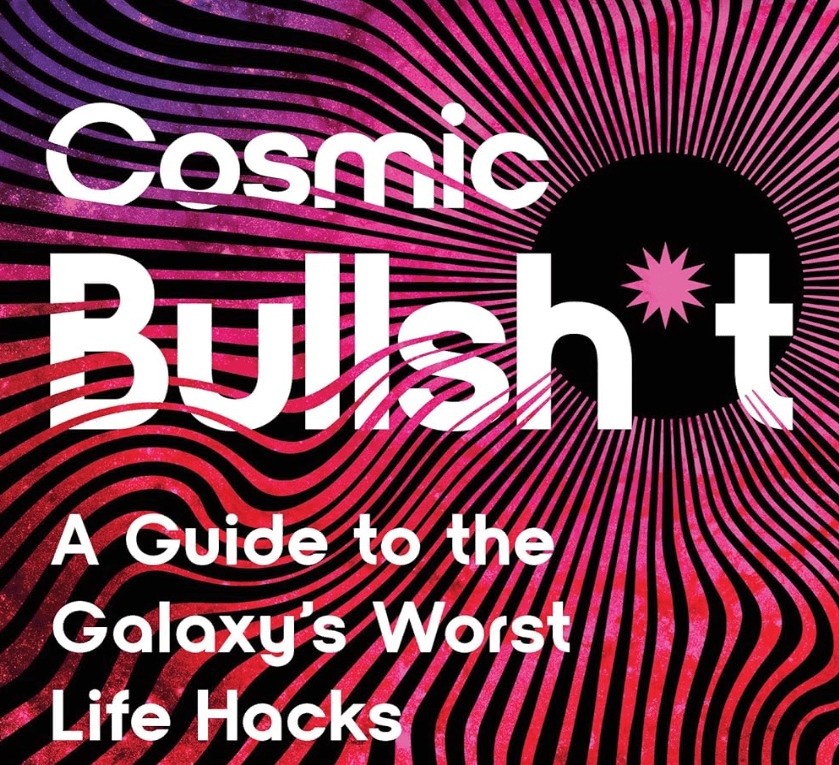

The author of books such as Quantum Bullsh*t, Where Did the Universe Come From? and 42 Reasons to Hate the Universe, Chris Ferrie has written a new book called Cosmic Bullsh*t: A Guide to the Galaxy’s Worst Life Hacks. Cosmic Bullsh*t is very much in the same vein as Quantum Bullsh*t, complete with copious bad language, sarcasm, and humorous asides. There’s not much jargon, nor is it expected that you know much science going into it. What is cosmic bullsh*t? Ferrie defines it with a single simple phrase, “deceptively profound nontruth.”
Ferrie starts Cosmic Bullsh*t by taking us on a tour of origin myths, and ends with the apocalypse. He considers many different myths, including indigenous ones. Ferrie claims that underlying all such myths is the human need for control and a desire to stave off existential dread. He pokes fun at these myths, because they’re so varied and incongruent with modern conceptions of reality, and includes some fun running gags. There were many moments I laughed out loud.
Ferrie makes his aims clear, “This isn’t about taking a sledgehammer to Aunt Edna’s cherished belief in a divine garden party starring Adam, Eve, and a conniving serpent. No, my task is to hype up scientific inquiry because, sadly, it needs it.” Surprisingly, he even calls out the “skeptics, new atheists, and techno-optimists” who engage in scientism, which he defines as the belief in science as the highest authority. Science can help to inform decisions, Ferrie says, but it can’t tell us which of a variety of choices we ought to take.

Cosmic Bullsh*t also takes aim at things like astrology and alien visitations. He wants to make the important point, “if the only options for debunking pseudoscience are expensive and time-consuming scientific studies or derisive public takedowns, we are essentially screwed.” This is a false dichotomy, of course, but it’s a fruitful area of discussion. Conducting scientific research is a time-consuming and expensive process. Why would scientists prioritize scarce resources studying astrology? Ferrie says we shouldn’t. Alternatively, does public ridicule and mockery actually change minds about astrology? Ferrie doesn’t think so.
Ferrie’s assertion that skeptics ridicule, mock, and attack, is something of a strawman. It’s certainly true that some skeptics do that, and there are plenty of non-skeptics who love to talk down to others. Maybe he’s thinking of internet trolls, which seem to be a problem in all online communities. Still, he’s not wrong that we should strive to avoid meanness and scientism.
After Ferrie’s discussion of skeptics, he then proceeds to do his own detailed and thorough debunking of astrology. I love that Cosmic Bullsh*t points out this debunking will make our ancestors seem foolish for believing certain things about reality, but we must remember that we haven’t evolved from them or are somehow better than them. We’re the same species of animal, homo sapiens, and that hasn’t changed for at least 200,000 years. What has changed is our collective knowledge. A couple of his joking one-liners could strike the reader as condescending, so I guess it just goes to show there’s a fine line between comedy and ridicule, too.
Cosmic Bullsh*t compares hypothetical technologies to warp drives and time machines. Hypothetical technologies have their doubters, but the doubts revolve around the practicality, not the basic physics. Quantum computers are a good example. The open question is whether or not a useful quantum computer can be built. Things like warp drives and time machines, on the other hand, require unobserved, new physics for which we don’t have any evidence. It’s not about whether imaginary mass or negative energy are practical to harness, but whether they even exist at all.
Cosmic Bullsh*t suggests this goes hand-in-hand with quantum weirdness. “All quantum mysteries are of this flavor — first, you assume there is a classical Newtonian reality living below the quantum equations, then you arrive at nonsensical conclusions,” Ferrie says. Those nonsensical conclusions are then used to justify time travel and other baloney. “While that sounds sarcastic, it’s a depressingly accurate summary of thousands of peer-reviewed academic journal articles,” he says.
When Ferrie switches gear to take on alien visitations, he quickly gets into the UFO disclosure campaign in the U.S. Many skeptics have dismissed the whole thing, but it actually has turned into a significant movement, complete with congressional hearings and the spending of not insignificant amounts of taxpayer money.
Another unexpected thing is that Ferrie refers to Carl Sagan and Christopher Hitchens as skeptical icons, and uses two famous quotes by them. Is the author a scientist or a skeptic? Or just a comedian who’s making fun of everyone? I think he’s all three. I’ll end this review with one of my favorite lines from Cosmic Bullsh*t, which you can brandish how you like: “When our imagination shrinks the universe to fit into our brains, it becomes distorted beyond usefulness as a map of reality.”
AIPT Science is co-presented by AIPT and the New York City Skeptics.



You must be logged in to post a comment.