

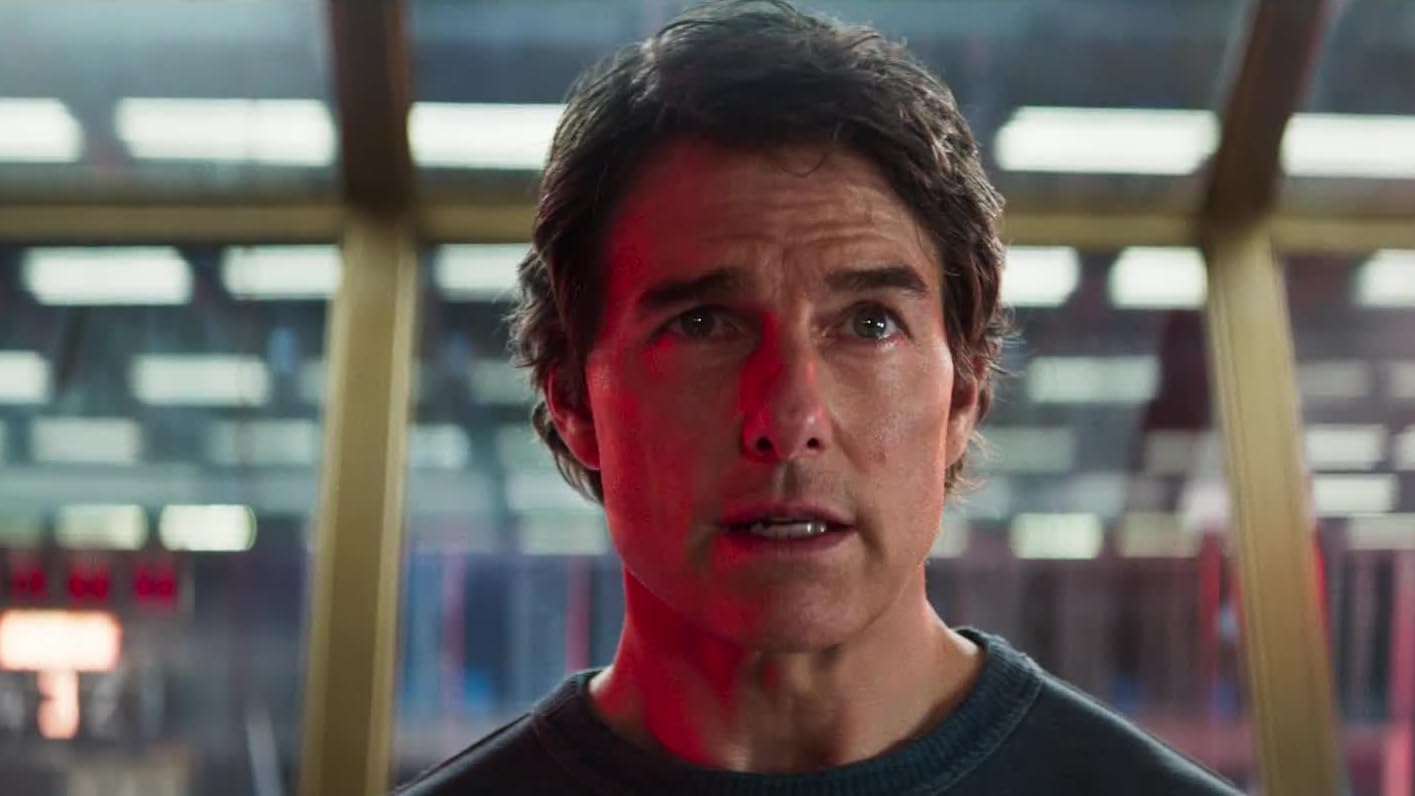

During the lengthy prologue before we even get to the opening credits of Mission: Impossible – The Final Reckoning, we get a montage showcasing the past adventures of Tom Cruise’s Ethan Hunt. Similar to what the promos have bene doing, the film not only serves as a conclusion to the narrative that began with 2023’s Dead Reckoning, but also as a celebration of a franchise that has been around for three decades, cementing Cruise as one of our last great movie stars. And yet, this constant looking back on the past is why this supposed finale is not entirely a home run.
Picking up where the last instalment left off, Ethan Hunt and his team continue their pursuit of Gabriel Martinelli (Esai Morales), an agent previously working for the artificial intelligence known as the Entity. As the world seems to be on the brink of war, due to the cyber manipulation of the Entity itself, all hope seems to lie on Ethan, despite the mistrust of the US government and whether his own actions are part of the Entity’s own plan.
By this point, the rogue artificial intelligence is a more compelling villain than Gabriel, who supposedly has a connection to Ethan’s past, but like in the previous film, it is rarely explored and thus Esai Morales’ villainous turn comes across as pantomime. By shifting the focus towards the Entity the main antagonist, it leads to Mission: Impossible – The Final Reckoning’s most disturbing sequence where Ethan chooses to use a device that communicates with the Entity, which shows Ethan a vision of a coming nuclear apocalypse.
With a running time that is close to three hours, the first hour leans too hard on a serious tone that may lend itself to a narrative where characters feeling like the end of the world is upon them, the film takes a long time to find that sense of fun that has defined the franchise. Throughout his time on Mission: Impossible, director/co-writer Christopher McQuarrie has always tried to bring more dramatic depth to Ethan Hunt’s journey, and while he laid out an engaging mystery in Dead Reckoning, how McQuarrie resolves it all is by looking at the past.
In a similar vein to what 2015’s Spectre did for the James Bond series, McQuarrie tries to bring this series full circle, even if the initial charm was that each instalment was helmed by a different director who was bringing their own sensibilities and didn’t have to worry about continuity. As much as McQuarrie attempted to make each of his own instalments different from one another, not only does Mission: Impossible – The Final Reckoning re-tread story elements from all the previous movies – leading to some major retconning – but McQuarrie ends up repeating himself, even including certain action sequences.
However, when the action finally kicks in and you are reminded that this is a Mission: Impossible movie, this is where the fun begins. It may have too many characters, resulting in not much of a dynamic towards the new team, comprising of Simon Pegg’s Benji, Hatley Atwell’s Grace and Pom Klementieff’s Paris, you are really watching this for Tom Cruise, who is his early sixties, is still willing to risk his own life for our entertainment.
While there is some CGI in places, there is still a practicality and an intensity to the action, especially during Hunt’s claustrophobic infiltration of a wrecked submarine will go down as an all-timer as part of the series’ tradition of a super complicated heist.




