

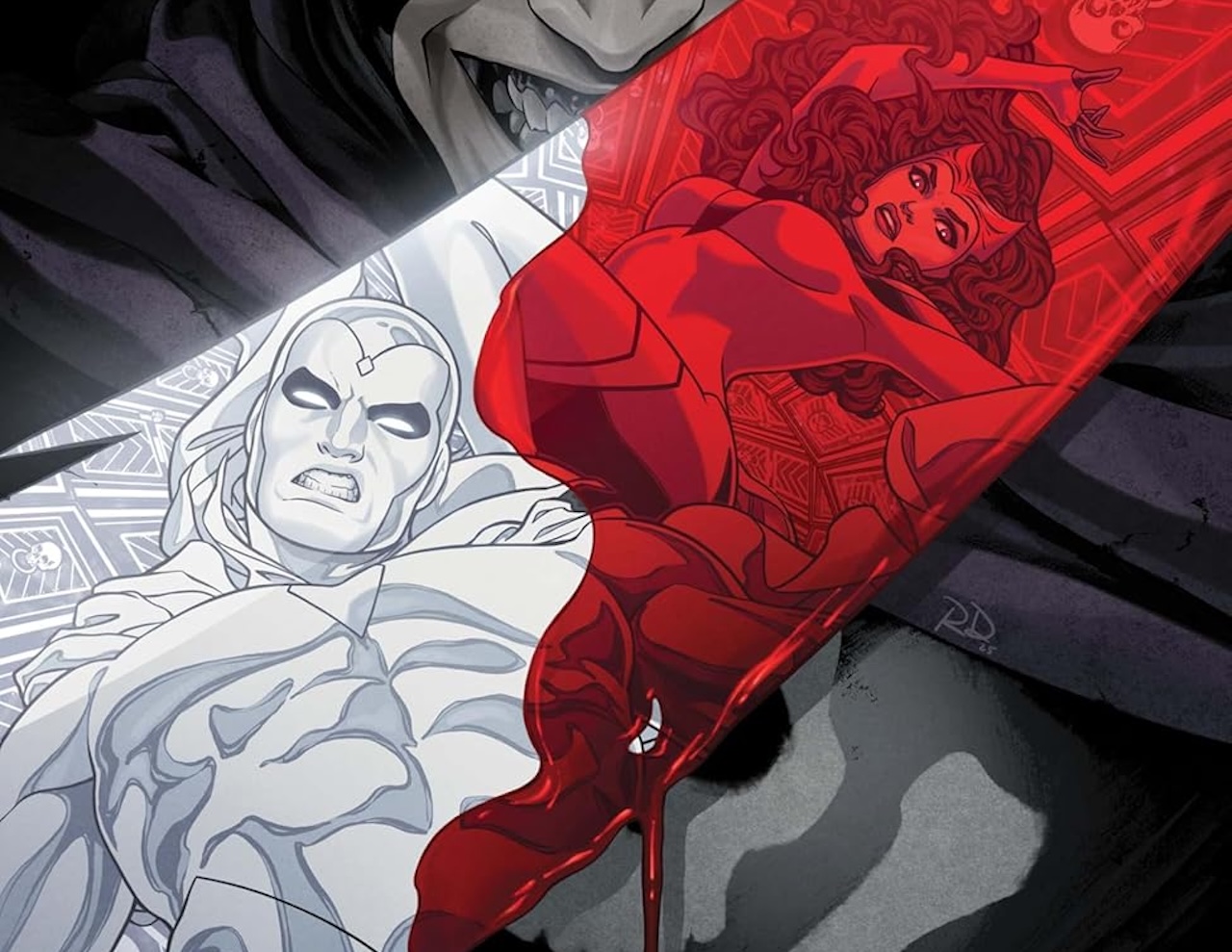

You all know the story: a machine, built to be the next stage of human evolution, slowly gains human feelings. The machine might even fall in love or start a family or experience heartbreak, all at once. From Data in Star Trek: The Next Generation to Steven Spielberg’s A.I.: Artificial Intelligence, it’s a story that’s inspired countless creators. With The Vision & the Scarlet Witch #2, Steve Orlando and Lorenzo Tammetta ask, “what happens when a machine has a near-death experience?”
That’s the case with the Vision, who almost died after an attack by the Grim Reapers. The Scarlet Witch is able to save him from the abyss, but at a major cost: he’s now essentially a ghost of his former self, and he’s not taking it well. Many readers will immediately think of the shift that happened in the original West Coast Avengers run, where the Vision was disassembled and reassembled into a more ghostly form, but that’s not the only nod to continuity Steve Orlando makes. There’s references to Tom King and Gabriel Hernandez Walta’s Vision maxiseries, the Valkyrie: Jane Foster mini by Jason Aaron and Al Ewing, and even the deeper cosmic entities that populate Marvel’s canon.
But Orlando doesn’t just use these past stories as building blocks for this one; he also takes the opportunity to zig where others would zag. The biggest example is with the Vision. While West Coast Avengers had him becoming an emotionless wraith, here he flips out, blaming Wanda for his current state and then breaking down when he returns to his old house. This makes for a truly interesting dynamic, since Wanda was usually the one who was losing a grip on her emotions while Vision comforts here. The reverese happening here isn’t just a great character dynamic, but another way for Orlando to show how the Scarlet Witch’s grown as a character.

Marvel
Tammetta also pushes his artwork to the limit in The Vision & The Scarlet Witch #2, showcasing the full extent of Wanda’s powers. In an effort to calm Vision down – and to mitigate the damage he might cause – she pulls him through a variety of different dimensions, each one rendered in pure visual splendor. One dimension is full of aquatic life, another is an Escherian staircase, and another is full of creatures that would give H.P. Lovecraft nightmares.
It wouldn’t work as well as it does without Ruth Redmond’s colors. Most of these dimensions stand out due to their unique colors; the one Wanda and Vision end up in is a bright, acidic green. But a constant that Redmond always returns to is red, especially when Wanda utilizes her chaos magic. Swirls of crimson, violet, and pink merge together into a stunning image, showcasing how powerful she really is. The Vision also stands out due to his ghostly white visage, and Orlando even comes up with a clever in-story reason for the change.
The Vision & The Scarlet Witch #2 utilizes its title characters’ history to shape its story, but it also puts new twists on what readers might come to expect. In a genre that often skirts the boundaries of mortality, having a comic that deals with death is a welcome change of pace.




You must be logged in to post a comment.