


Cullen Bunn is truly a prolific comics writer — even technology can’t keep up.
“I just started messing around with this new website platform that auto-generates all your books,” Bunn said during a recent Zoom call. “It goes out and aggregates your books into a store. And I was like, ‘Something’s wrong. This doesn’t have all my books.’ Tech support was trying to figure it out, and they finally, just this morning, said, ‘You have more books than we support currently.’”
Still, Bunn never intended to effectively become comics’ very own Stephen King.
“I’ve always been someone…I like working, I like doing it,” Bunn said. “I don’t recommend my work schedule to anyone else, but it’s what makes me happy. So, for me, it’s a combination of that I love telling these stories. I usually say I’ve got one speed, and it’s full speed ahead.”
The proof is in the industrial vat of pudding. From Big Two titles (Deadpool Kills the Marvel Universe, Lobo, etc.) and westerns (The Sixth Gun) to a veritable cornucopia of horror stories, Bunn has made an important career out of his genre exploration, endless creative intent, and general, sustained presence. He is, in short, an unstoppable dynamic of weird, engaging stories.
Yet even with that gargantuan list of credits, Bunn is aware that he can’t keep up this maddening pace forever.
“The output level has been dropping for a little while now. I think it’ll continue dropping,” Bunn said. “I think I could be doing one comic a year and I would still have someone say, ‘I don’t know how you’re doing so many books.’ No matter what I do, that mystique will follow me forever. I’ll always be the guy who…how do you do so many books? ‘Well, I just work nonsense hours and I work fast.’”
And this shift, as it were, has given the writer a chance for a brief pause regarding his career and accomplishments.
“If I hadn’t done as many books as I had done, would they be better? And then I think to myself, ‘No, they’d be exactly the same,'” Bunn said. “I would’ve had a lot more time if I were focused on a few projects instead of as many as I’ve done (at certain times).”

Courtesy of author.
If there’s anything coming close to regrets from Bunn, it’s that his prolific pace didn’t always leave room for other, equally important jobs as a beloved comic book scribe.
“I would have had a lot more time for the marketing of those projects and the promotion of those projects,” Bunn said. “And a lot of that stuff gets lost in the shuffle sometimes when you’re doing a ton of books. I was always running to meet those deadlines. It’s tough to support those books. I remember when I was doing Venom and Fearless Defenders at the same time. Venom fans said, ‘Well, Cullen really promotes Fearless Defenders and not Venom.’ I bristled at that because I was promoting both of them as much as I could.”
There’s also another vital function he may have missed out on: networking.
“In comics, everybody knows each other,” Bunn said. “All these creators are really good friends. I do think that sometimes I’m working so hard and so fast that I didn’t have time to make and forge some of these deep, meaningful friendships that a lot of creators have. That has, on a professional front, hurt because there are connections that I didn’t make because I was so busy working on things.”
Bunn added, “I’m not necessarily comfortable when it comes to meeting other people and interacting with people. I’ve had some interactions with comic creators that weren’t pleasant, especially early on. And I’d rather just work and avoid that.”
An Ocean of Stories
Yet even with that can-do attitude, Bunn recognizes that not every book has been his absolute best. Most of his “complaints” come from, say, wanting a 12-issue run instead of a seemingly industry standard of four or five issues. But there’s at least one book that he recognizes as not cutting the mustard whatsoever.
“The one that immediately jumps to mind is Aquaman,” Bunn said. “I probably shouldn’t have taken that. I remember I was in the emergency room for kidney stones or something. I got a call about Aquaman, and I was like, ‘Yeah, I’ll do that.’”
Bunn added, “It was at a time where I couldn’t fathom turning down a project working on some of my favorite superheroes. Aquaman came with so many rules and so many bizarre requests from publishing that…I wish I had pushed back. I was definitely in that mode of, ‘This is what you need. I’m going to deliver what you need.'”
Aquaman ultimately was a case of both sides having issues, and Bunn not doing enough to work in the name of the story. It’s a rare failing that speaks volumes about how Bunn approaches these tales and the seemingly sacred duty of being a storyteller.
“They wanted Mera hunting Aquaman,” Bunn said. “So I said, ‘What if Mera and Aquaman got this big, elaborate plot where they’re working together, but they have to look like they’re enemies? They’re really working on something bigger.’ They said, ‘No she wants to kill him, and she’ll kill innocent people to get him.’ And I should have really dug into what does that mean? And why do we want to do that?”
There’s other, semi-related concerns as well (outside Aquaman, naturally). Bunn readily acknowledges that because of his mega-output, “there have been times where publishers have seen me as a commodity instead of a creator. And that is something I’m very aware of.” But at the end of the day, Bunn wouldn’t change a darn thing for one very simple but important reason.

Courtesy of DC Comics.
“And so would I have changed things? Or would I have done things differently,” Bunn said. “Probably not, because I’ve got to eat.”
But this pace isn’t merely about putting food on the table. Bunn’s nigh-endless output is also an effective way to understand both the man and the writer.
“If you really think about it, and if you were to somehow go back and look at my bibliography, or what I was posting about online, you can see exactly where I was in my headspace,” Bunn said. “And then in some cases, in some of those books, you can also see where I’m trying something out, man. Just trying something different. It doesn’t always pay off, and I’m OK with it.”
And so, if you really want to comprehend where Bunn is at now (or in any moment, really), you can look at a few more recent works, including one newly-announced, extra mysterious horror title. Books that may be drops in the veritable water tower of Bunn’s career, but that are still deeply personal, massively resonant, and extra interesting.
Let The Horror Begin
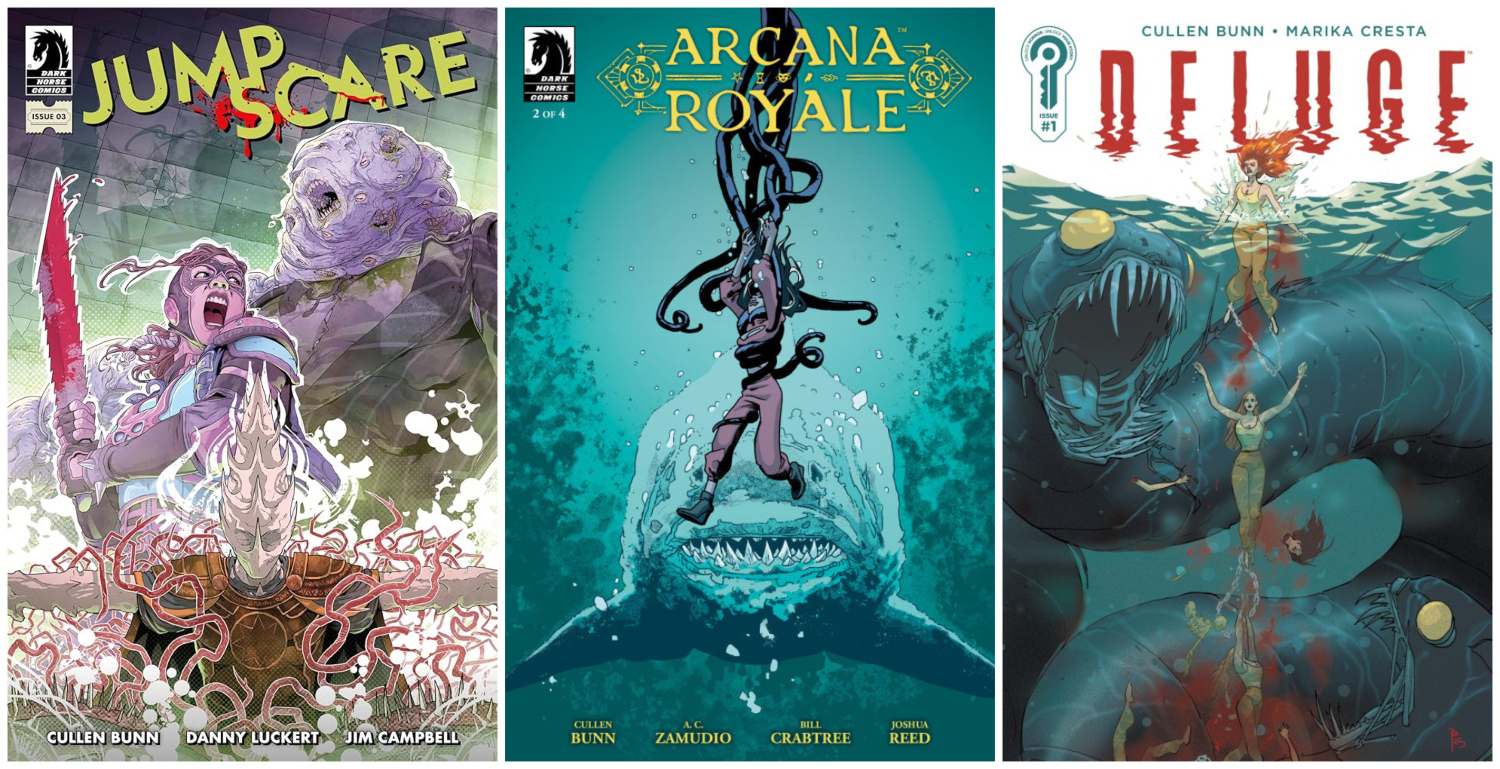
The first such title is the recently-released Jumpscare, in which Bunn and artist Danny Luckert joined forces for a story about a young horror movie fan who is infected by eldritch-ian monsters and becomes a superhero.
“I don’t know if it represents everything I am as a writer,” Bunn said. “I can tell you that it’s the most fun I’ve had writing a comic in a long, long time. I think Jumpscare is one of the most interesting characters I’ve created in a long time. I think she’s a character that, if people find the book, they’ll really get into it and like the character. My regret with Jumpscare is the four-issue model is…I get why publishers have to do it. I don’t love it.”
There’s lots of reasons why Jumpscare is so darn good. For one, horror is always going to be Bunn’s bread and butter; he knows how to scare and effect readers like few others. There’s also Luckert’s art, which is both massively stylized and endlessly unsettling. And, of course, you can’t go wrong with a hero who draws her powers from the weapons of fictionalized horror flicks.
“I have a big spreadsheet somewhere,” Bunn said of the book’s made-up movies. “My dream, obviously, is, ‘Let’s do adaptations of those movies that never existed.'”
But Jumpscare‘s appeal goes deeper still. Perhaps because it achieves that thing that marks all of Bunn’s truly great work: His fanboy-esque passion for making the project and keeping it going as long as humanly possible.
“Danny and I already have the next several Jumpscare stories in mind,” Bunn said. “I know what we’re doing. We have new characters. Jumpscare is going to have a sidekick. It’s such a creative outlet for me because I’ll just text Danny, ‘Hey, what about a character like this?’ And suddenly there’s art coming in over my phone.”

Courtesy of Dark Horse Comics.
That commitment goes even deeper still. In the hands of other writers, the sheer gimmickry of Jumpscare may have consumed everything. But in Bunn’s extra capable hands, the story’s more evocative than you’d ever previously believed.
“Jumpscare started when I had an idea for a gimmick, but a real story can’t rely on this,” Bunn said. “With Jumpscare, that human element is more obvious than others, but it just all worked out because I wanted it to feel like an old Marvel superhero type story. Peter Parker always had these very important family issues going on behind the scenes of his superhero action. So I wanted that.”
And as an extension of that humanity, it’s a rather involved book that doesn’t demand much studying beforehand. You can just leap in, figure out Jumpscare‘s rules and world-building, and enjoy some spooky nerd fun.
“What I don’t like is having pages and pages and pages of exposition to explain this is the world and this is what’s happening,” Bunn said. “I like to think of readers like myself, and I would prefer just to be thrown into it all. It’s more immersive that way. You just put the reader in on the joke with you.”
Before we get into another of Bunn’s recent books, though, let’s take a tiny, mostly related break. Because for a man with a million titles under his belt, you may or may not be surprised to know that Bunn actually has a system for dreaming up new stories. Sorta.
“It’s driving, or doing laundry,” Bunn said. “It can be random. Sometimes little ideas pop in my head, but I do have an idea process.”
When the fates aren’t being kind, then, Bunn employs an old-school trick for conjuring the spirits.
“I try to come up with one idea a day that I keep in a little index card file over here,” Bunn said. “And most of them, the vast majority, are just terrible. But I try to come up with one idea a day. Sometimes there are little details and sometimes it’s things like, ‘Washing machines come to life’ or something stupid. I try to put a little more to make sure they’re sellable ideas, and that they have legs to them.”
A Game of Chance
The washing machine idea needs workshopping for sure, but one recently successful idea to tumble from Bunn’s mind is Arcana Royale. Here, we follow Hudson Tremaine, a card player who enters the Arcanos Mysterinos (a peculiar card game) in the hopes of altering her own sordid personal life. But the stakes are so much bigger than Hudson had ever intended, and the story follows her as she wanders down a metaphysical rabbit hole that questions the very nature of community, suffering, and reality itself.
“I’m slowing down a little,” Bunn said. “I’m doing other things. I’m still trying to tell stories.”
I pointed out that Arcana has some spiritual connections to Jumpscare in that both feel massively oriented around their respective gimmicks, and yet both maintain this lively humanity above all else. Bunn agreed to an extent, but noted that the books were written years apart.
“At the time, it just so happened that A.C. Zamudio couldn’t do it at that time,” Bunn said. “I always knew I wanted A.C. to do the book, and so I knew we’d wait.”
Bunn’s commitment to his collaborators is also worth noting. For a man who has had heaps of dance partners over the years, that dedication to people and the shared vision is both uplifting and something that filters into actual stories. Because Bunn’s not exactly committed to everything in his projects, alright?
“I’ve got some friends who are really deep in the gaming world and they’re like, ‘So what’s the rules of the game? Let’s hear about. And I’m like, ‘I don’t know. It’s a magic card game,'” Bunn said of the card game within Arcana. “The truth of it is the rules of the game don’t matter in the context of the story. They have to be there because there’s a game they’re playing and there’s things that are happening. But I didn’t develop a card game. I think that would be fun, but it’s for someone else and not me.”

Courtesy of Dark Horse Comics.
Bunn added, “I did talk to a game designer and he said, ‘Well, tell me about the game.’ I go, ‘Well, it influences reality.’ He’s like, ‘Well, that’s going to be hard for me to design.’ It is the way it is.”
It’s not that Bunn is lazy; Arcana is still a massively exciting book even if you’re aware of his “resentment” toward rule-making.
“I map things out enough to make me dangerous,” Bunn said. “I don’t try to overthink these things. I know people who are writing a fantasy book, and they’ve got thousands of pages of notes about their world, but not one page of story. So all of that can be a trap. I don’t want to be bored while I’m writing something. I want to leave some room to be surprised, and to surprise myself. In the past, it’s given me headaches…where I’ve written myself into a terrible corner and now I’ve got to figure a way out of it.”
Luckily, I was able to offer one suggestion to help Bunn in the future with any of those pesky corners he’s inadvertently made for himself.
“That’s the way I’m going to define every time I get into a writing problem,” Bunn said. “I’m just going to put up that little clip from The Dukes of Hazzard. Like, ‘They sure have gotten themselves in a pickle this time.'”
Opening The Flood Doors
But if there’s one book that seemingly won’t offer Bunn any such pickles/similar issues, it’s the forthcoming Deluge. Co-created with artist Marika Cresta (Doctor Aphra), Deluge is something Bunn has been mulling over for years.
“I used to drive by this old building set off the road,” Bunn said. “It’s outside Jefferson City, Missouri. It is a crumbling giant structure covered in weeds that are just wrapping around it. And I was always really curious what that building was…it was a woman’s correctional facility. It’s built right on a floodplain and it flooded in a major way. They had to ferry the inmates across the water on boats and then put them on buses or in tractor trailers and drive them off to be put somewhere else.”
From that was born a story about inmates of the fictional Sieverville Correctional Prison for Women dealing with rise floods and an unknown evil carried in by the raging waters. In short, classic Bunn fiction.
“I don’t know if this is the kind of story that you would never expect from me,” Bunn said. “I do think that people probably aren’t expecting this story in this book. I play it pretty close throughout the first couple of issues anyway.”
Still, Deluge is novel in all the right ways. For one, the focus on a woman’s correctional center was essential for Bunn.
“I always wanted it to be a women’s facility,” Bunn said. “It’s apparent who our main character is right from the jump in issue #1,” Bunn said. “But I also wanted this character to spark some debate with readers. Are they making the right calls? Have they done the right things? Are the a hero? Are they a villain? So the main character is pretty great. There’s also a character called Mama Bear that I’m very excited for people to meet.”
It also shares some threads/energies with other Bunn titles. Most specifically, Death Follows (also with Zamudio), which is similarly a “very contained, very dark story that had some moments that I don’t think people would expect.” But Deluge is horror done the way that matters most: It’s really about the doorways we encounter in life, and what happens on the other side of these existential portals.
“It is absolutely a horror story,” Bunn said. “I don’t want to reveal the horror of it too soon, so that’s why I have to look at how we’ve announced it at this point. I could have probably just done a story about a prison that was flooding and it would have been terrifying. But there’s a little more to it than that. There are moments in this story where I’m like, ‘OK, now I’m writing this page and we don’t go back. After this page, everything is different than what everyone has thought the story they’ve been reading up until now.’ That’s the fun stuff I wanted to do.”

Courtesy of Ignition Press.
And even as Bunn establishes a solid cast of convicts for us to follow, Deluge does more to get us to consider these people and our corresponding relationships and interests. It’s never about pointing fingers but bringing in readers ever deeper.
“I felt like the stories I wanted to tell about the individual inmates were about them and do they deserve it,” Bunn said. “I don’t ever write down, ‘And this person didn’t deserve it.’ Because I felt like that’s something that the reader needs to figure out. Let the reader judge if they think that person deserves it or not. I have my own opinions on each of those characters, but I think the reader should also do it.”
That sense of humanity isn’t just vital to the narrative itself, but is perhaps best reflected in Cresta’s artwork.
“I’m not an artist, but I feel like this book is a hard book to draw because if you think about it as a prison, everybody’s in the same kind of clothes,” Bunn said. “Making sure that the characters look different, that the characters have personality, and you can see on their faces what’s going through their minds. I don’t think a flood is easy to draw either.”
Bunn added, “I think that can be a challenge to draw because there’s a lot of rising waters, everything’s changing and there’s a lot of movement. You’ve got a prison, which is pretty bleak and uniform. You’ve got people in uniforms. You’ve got half the buildings covered in water. It’s a challenge in a setting where individuality is eliminated to some degree. So it’s making sure these characters are individuals. [Cresta] really has had no hesitation in it.”
To check out the audio version of the Deluge conversation, checkout the AIPT Podcast.
All of that life and intent makes sense given how decidedly personal Deluge is in Bunn’s rather robust CV. I mean, the man has practically made a life out of writing about floods.
“The Sixth Gun had big sections of flooding going on,” Bunn said. “The Midnite Show had floods happening in the middle of it. Obviously Dark Ark has aspects of the biblical flood. I think visually, for a comic, it’s an interesting look.”
Yet again, though, it’s not just about fostering cool visuals. Floods may also speak to something essential about how Bunn views the world, and like all of his best works, he’s happy to share that however he can.
“I remember in fourth grade, someone read a story about a hurricane and a flood that came with a hurricane,” Bunn said. “And it was washing snakes into a building and nests of copperheads were being washed into this building. That terrified me. Years later…My car flooded out in the middle of the creek because the waters were higher than I expected. I looked to the right and I just saw a wall of water just running to me. I scrambled to get out of the car. It didn’t wash [the car] down river, but it definitely did move it.”
Bunn added, “I’m terrified by flood waters. They’re slow to a point and maybe that’s it. It’s like life: You’re taking steps, you’re going somewhere, and something’s happening here. And, if we don’t fix it, something bad is going to happen. And then, boom, it happens.”
What’s to Come
In a way, Bunn’s overarching life and career is a response to those kinds of fears/uncertainty. Life is never assured, and you’ve got to make a move before it’s too late. That probably explains why a veteran like Bunn got involved with upstarts Ignition Press for Deluge (and perhaps other titles down the road).
“They are a new publisher, but the team isn’t green at all,” Bunn said. “Everyone they’re bringing in, and everyone who’s been involved, is damn good at their job. I know all the people who are involved; I’ve known them for a long time. I do feel like I have a lot of freedom, and in some cases, I’ve worked with publishers in the past, you have a lot of freedom but no support. But in this case, I feel like I’m both supported and I have a lot of freedom.”

Courtesy of Oni Press.
To some extent, freedom means having options. But it also means having someone to occasionally say no.
“They’re really letting me do some different things,” Bunn said. “They’re also very clear on, ‘Let’s look at the books that are going to best represent you.’ I’ve pitched them some things that are like, ‘That doesn’t feel right. This doesn’t feel right for you.’ They’re interested in supporting that and helping to build that voice.”
And after a long and productive career (that’s still ongoing, obviously), maybe that’s what Bunn needs more of than anything else. Because if life in recent years has taught all of us absolutely anything, it’s that change is constant and all we can do is try and handle it the best we can.
“I get in my own head and I really get mixed up and I’ll get that ‘analysis paralysis,'” Bunn said. “I’ve got a big decision to make, but this is the bad thing that could happen if I make this decision, and I’ll get frozen. So that’s always bugged me. And I think a lot in the quiet hours about those moments. There’s been so many of those for me in recent years – something has happened and my life’s different. That can be scary or exciting depending on the moment, right?”
So, more often than not, Bunn decides to focus on the work. And aside from Deluge, he’s got a lot of things he’d still like to get done.
“I’d love to finish The Damned,” Bunn said. “Brian Hurtt and I have got big plans for The Damned and we’d love to get to that. Jumpscare is connected to a book I did called Beyond Mortal, which is a superhero horror universe. I want to create that universe. Think multiple books and crossover events.”
It’s here that we arrive at the true lesson of all of this comics madness. That for all of his insane work so far (the man also writes novels!), and the many weird and wild stories still to come, Bunn has one clear path he follows. Maybe it’s not always so easy to see said path, but it means you just move forward however you can. Jot that idea down, write that silly story, shed blood on the page itself, and maybe just maybe, you’ll have changed the world (or at least one other person’s life).
“Every choice we make, if you really think about it, that could be a game-changer,” Bunn said. “You don’t know it at the time.”
Arcana Royale #4 hits shelves August 6. Deluge #1 debuts October 8.



You must be logged in to post a comment.