

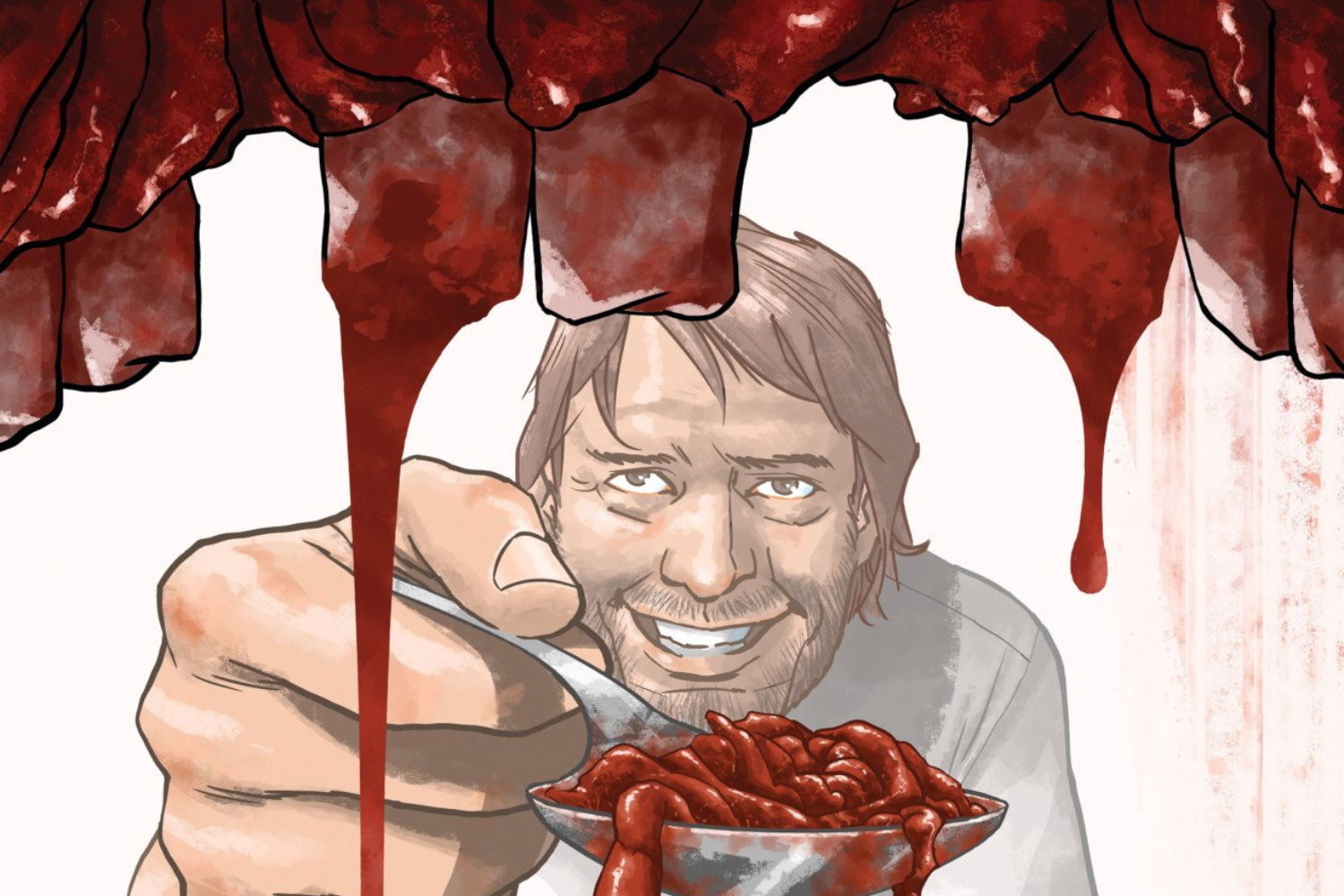

At this point, there’s more zombie stories than their are actual earthly corpses for reanimating. But we keep on skimming the graveyard regardless for new offerings, and while some of them are derivative excuses for undead cannibalism, there are still gems rising up from the ground all the time. Those are often the books, films, comics, etc. that respect the sheer humanity of a world where our very life and dignity can be so readily taken from us via mashing teeth.
One such title that’s already shuffled into our hearts is Everything Dead & Dying, from writer Tate Brombal (Batgirl) and artist Jacob Phillips (Newburn). Here, we follow Jack Chandler, who after a zombie uprising, as opted to live with the undead on his rural farm. But when outsiders threaten to kill Jack’s zombified husband and adopted daughter, he must stand stand up for what he loves or watch it die for a second time. Described as “The Walking Dead meets Essex County,” Everything Dead & Dying is truly among those most potent zombie stories of recent years, one where the undead are used to explore our own fears and shortcomings with ruthless, brutal efficiency and endless heart.
Everything Dead & Dying #1 is due out September 3. (The FOC is Monday, August 11.) In the lead up, we caught up with both Brombal and Phillips recently via email. There, the pair discussed their friendship and collaboration, how to make a zombie story feel novel, their interest in westerns, and some favorite scenes/panels, among other topics and tidbits.

Main cover by Jacob Phillips. Courtesy of Image Comics.
AIPT: How familiar were you two before starting Everything Dead & Dying? Does that connection (or maybe the lack thereof?) help with a project like this one?
Tate Brombal: Yeah, we met a few years back in Toronto, and we’ve been friends ever since! I do think that connection matters, especially in creator-owned comics. So much of it is about trust, and telling a story together is like a giant trust fall. This particular story means so much to me, that for a while. I couldn’t figure out who to share it with. It’s funny, though. I’ve always been a huge fan of Jake’s work, but it wasn’t until another friend suggested him for this book that I realized how perfect he’d be. It made so much sense, and he was right there the entire time!! I think I just figured Chris Condon had him locked to a drawing desk in some dark basement. Luckily, I have freed him at last!
Jacob Phillips: We met a few years ago when I was over in Toronto for TCAF, and Tate looked after me and [the] gang of other out-of-towners for the weekend. And we’ve been pals ever since! We live on opposite sides of the Atlantic so it’s not like we were hanging out all the time but I think as soon as I heard the pitch for the story I was instantly like, “I get it, let’s go.”
AIPT: Tate, you’d mentioned in some press that the story of Everything Dead & Dying been percolating for you since summer 2020. Is this a COVID story in that it deals with some of these issues/anxieties?
TB: It definitely deals with some of those anxieties. A lot of those worries and fears existed before 2020, but I think for a lot of us that was truly the first time we were facing them head-on in reality. The loss of life, the horror stories coming out of major cities, the isolation of quarantine…all those things and more have left a lasting mark on us. A lot of this book is dealing with that grief and the weight of a dying world. Just with zombies!!

Courtesy of Image Comics.
AIPT: Zombies have been popular for years. Do you have to reconcile at all with that genre’s over-saturation? How do you make a truly novel zombie story in 2025?
TB: I never thought I’d write a zombie story until this one came along. It’s not that I dislike zombie stories, or think there are too many of them…I just truly never imagined myself doing so. And I love zombie stories!! I grew up loving zombie films and reading World War Z and The Walking Dead throughout high school, but I’m not one to jump on a fad simply because it’s hot. This is a story that I needed to tell, and, when I first came up with it, publishers told me that zombies were old news and the fad was over. That didn’t bother me. I knew this story would be told some day.
It just so happens that zombies are back in the cultural zeitgeist, which we also hadn’t predicted when starting this project!! Basically, I’m just saying that I don’t pay much attention to what’s over-saturated or not. I knew this story was special and meaningful to me, and that’s what mattered. I also had never read or seen a zombie story like this one, which I think is the only way I could ever write one. It’s very me. Since it didn’t exist, we needed to make it ourselves.
JP: Tate can probably speak more to this but what struck me about this story was that I had never read a zombie like it before. It’s a fresh take on both character and zombie lore which I think people will be excited about. It’s all about using these horror tropes to tell an original story, I think.
AIPT: Similarly, westerns have also had a heyday as of late. For at least this project specifically, why is that genre still so interesting/compelling?
TB: The western is about the rise and fall of civilization. It’s the last “creation myth” where America trail-blazed west and formed a nation over the bones of other nations. The West was uncharted territory, at least to those early settlers, and it became the frontier of uncharted possibility. It’s the struggle between upholding civilization against the unruly wilderness. The cowboy, meanwhile, is as American a hero can be. Cowboys uphold core American values of heroism, morality, and a willingness to sacrifice one’s life for the community, for the family unit.
The film Shane is a perfect example of this. Westerns also make incredible morality plays because meaning is distilled so purely into iconic symbols. White hat = Good. Black hat = Bad. Etc. Where westerns really reach new heights is when you play with these core ideas and challenge them, too. In many ways, a zombie western is the most natural fit in the world. It’s the end of the world, and it’s gonna kill us, but we’re all still clinging to old ways…which is just Butch Cassidy and the Sundance Kid.

Courtesy of Image Comics.
JP: Well, if people are familiar with my previous works, they will know I’m a fan of the western genre. But again I think it’s just a framework that can be used over and over again to tell different interesting stories. Plus, the visual tropes never get old.
AIPT: Everything Dead & Dying is being released via Image, which in Tate’s own words has “revitalized zombie stories for an entire generation.” What’s your fave or most inspiring zombie book from Image and why? Or maybe just a zombie story that filtered into this book?
TB: I mean, like most comics fans my age, I grew up reading The Walking Dead, so I have to say that. It was around the same time that I first read World War Z, and that also blew my mind. This book definitely rests on the shoulders of so many incredible stories before it. I mean, [George] Romero goes without saying, but the zombie metaphor is a powerful one when wielded tactfully.
JP: Interestingly (to me at least), I have actually been looking a lot at another of Robert Kirkman’s Image books, Outcast. I love that book anyway but there’s something about the way Paul Azaceta draws it that I have found to be something I have kept going back to throughout this project. But generally I try not to pull too much from books in the same space. I’ve been looking a lot at Tommy Lee Edwards work on Grendel, Kentucky and Mazzucchelli’s work on Daredevil. Although having said that I’ve also been poring over Phantom Road, the Image book by Jeff Lemire and Gabriel E. Walta.
AIPT: Jacob, Everything Dead & Dying is something of an outlier in your more grounded bibliography. (Even if you’re no slouch when it comes to depicting violence.) How did you take to do something that’s more straight up fantasy/horror?
JP: It’s definitely stretching slightly different muscles for me but my approach is broadly the same. My main focus is character and acting. It doesn’t really matter to me the situation as long as I can clearly show how they are reacting to it, that’s the fun part for me. The horror elements are just an added bonus!

Courtesy of Image Comics.
AIPT: Building off that last question, I’d also like to touch on how you both approach depicting gore/blood. Do you have to almost go overboard to get the message across, or is there a balance of sorts you have to achieve with these kinds of stories?
TB: It all depends on the story you’re trying to tell and the effect you want. In this case, we did want the big moments of gore to be abrupt and shocking. This is because we have undead corpses wandering around already, which means if we want the gore to have an impact, it needs to stand apart from those rotting faces. Jake does a fantastic job of balancing it all, especially in bringing humanity to our zombie characters.
JP: I think there’s definitely a balance to be had. It’s obviously an important element to a story like this but I wouldn’t say it ever strays into gratuitous. I want to create a cool image but I don’t want that image to pull you out of the story. Again, it’s more about the emotional weight surrounding the gore.
AIPT: Our “hero” is Jack Chandler, who remains with his undead family and must eventually defend them. Do you feel pity, admiration, or some odd combination for Mr. Chandler?
TB: It’s all of that and more. Jack is a complicated, stubborn man, but he’s had a difficult life and he’s fought tooth and nail for every inch of it. How could he give all of that up so easily, especially when it’s still staring him in the face and walking around the house?
AIPT: Do you have a favorite page/panel/moment during the series that you can tease/spoil? Something that speaks to the heart of this tale?
TB: Anytime our dear zombie cow shows up. That is my favorite piece of iconography from this book.

Courtesy of Image Comics.
JP: I love this panel of Jack and his family cowering away as Jack tries to shield them from what is coming. [Editor: See above.]
AIPT: The book’s set to run as a five-issue miniseries. Is it easier/more fulfilling to have that “limitation” versus plotting out or managing an ongoing series? Could there be a future for this book depending on the reception?
TB: Never say never, but this was definitely conceived and written as a story with a clear beginning and end. I wouldn’t say either one is more fulfilling. What’s fulfilling is telling a meaningful story and pulling it off, whether it’s three issues or 100. It all depends on what that story requires. In this case, we knew it was a miniseries from the start.
AIPT: Is there anything else we should know about this book, zombies, horror, comics, etc.?
TB: Bring the tissues. These zombies are going to make you cry!


You must be logged in to post a comment.