

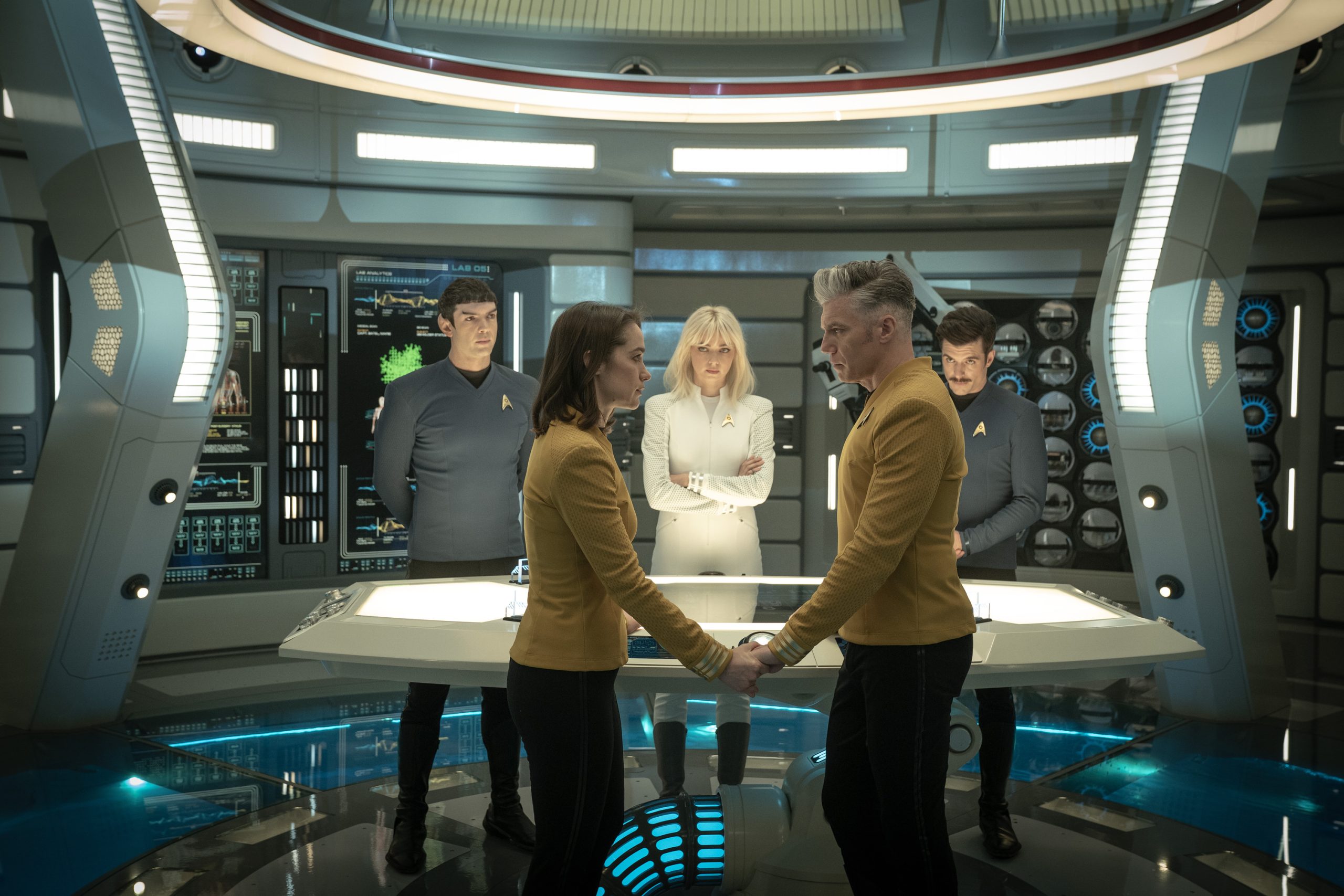

Season three of Star Trek: Strange New Worlds comes to a close with Enterprise facing off against the embodiment of evil…or some such eldritch horror. Fortunately, Captain Pike’s girlfriend is Space Jesus, so we’re all spared from the greatest of all cosmic dreads, a season ending on a cliffhanger.
Most of “New Life and New Civilizations” is a slow-motion car wreck. It’s a direct sequel to “Through The Lens Of Time” — tied for my worst-reviewed episode of this disappointing mess of a season that leaned far too obnoxiously in the direction of unchallenging, schlocky goofiness. Each minute of the runtime, I became more and more convinced I would rank this episode with an abysmal 1 out of 10 and wondered if I could go lower than that.
Then unexpectedly, the episode took a lengthy break from its dumb, absurd, incoherent plot for a lengthy, well-executed sequence imbued with actual humanity that I found genuinely moving. And even though I knew where it was ultimately going — a seemingly inevitable and ill-conceived character exit — and even though it was too late to save the episode as a whole, Pike and Batel experiencing a whole lifetime of growing old together punctuated by interrupting door knocks is some of the best storytelling Strange New Worlds has ever achieved.
The somber epilogue also nicely maintained the affecting tone of Pike’s grief, though what a bummer that these sections were serving a story this utterly lousy and at odds with the spirit and philosophy of Star Trek. In my review of “Through The Lens Of Time,” I took issue with Pelia’s essentializing evil, suggesting this ancient entity was simply intrinsically evil. I was relieved when the very next episode made a point of teaching James Kirk the lesson of recognizing the shared humanity of our enemies.
This theme — a trope spanning the entire history of the Star Trek franchise — was repeated in last week’s “Terrarium” when Erica Ortegas develops newfound understanding of and kinship with a Gorn, a fearsome species she’d only previously known to be monsters. To wrap up the season with this ancient evil entity that simply must be defeated with no ethical consideration is a betrayal of the Star Trek ethos. And the fact that Kirk shows up with the USS Farragut to help destroy the evil being completely undermines the lesson he supposedly just learned a few episodes ago that we’re to believe will guide his decisions for the rest of his life.
And while this is not the first time Trek has dipped its toes into prophecy and destiny, it’s a lazy writing choice here that removes agency from the characters. If we accept the premise that M’Benga will carry out the destiny assigned to him just because prophecy demands it, M’Benga has no true free will and he’s reduced from a human subject to just an object, a plot device, or a robot algorithmically performing a pre-written program.
Worse still is Marie Batel. Actress Melanie Scrofano is saddled with some of the clunkiest, nonsensical, jump-to-conclusions technobabble dialogue in the franchise’s history as the rest of the cast is written to accept the craziest, most unfounded and off-the-wall theories that spew out of her mouth as she determines she’s Space Jesus because of a few unorthodox, experimental medical treatments from earlier in the season. The flimsiness of this flawed, Joseph Campbell monomyth reasoning of a universal, cross-cultural, galaxy-spanning belief in good and evil being itself evidence living paragons of these concepts must necessarily exist in reality is, as the Vulcans would say, illogical.

Photo: Marni Grossman/Paramount+
Even some of the comedy moments were problematic. It’s one thing for Scotty to foolishly assume his first invite to the captain’s dinner table meant he should show up in full, traditional Scottish garb, but the manner in which everyone teases him about it feels a bit too mean-spirited for the more inclusive, “come as you are” culture of Starfleet and The Federation. This is why characters like Worf, Quark, and Garek were such comedic assets to The Next Generation and Deep Space Nine; there was no expectation their perspectives aligned with the utopian multiculturalism of the enlightened human society of the 23rd and 24th Centuries.
Conversely, I appreciated some of the design work this week. Though the landscape of the planet Skygowen lacked verisimilitude, showing the tactility of a videogame cut screen, the overall look was interesting and distinct from any other world we’d seen.
“New Life and New Civilizations” runs the gamut from Strange New Worlds‘ worst storytelling to its best…albeit very briefly in the latter’s case. Too much of its runtime feels as though written in crayon by second-graders for the extended, bravura sequence of Pike and Batel sharing a lifetime together to salvage this dismal episode or the disappointing season three. And the early behind-the-scenes hyping of a season four episode involving puppet versions of our crew elevates my fears the writers may not have time to course correct from these Buffy/Angel-inspired gimmicky premises that have reduced Strange New Worlds to safe, unchallenging dreck.
Watch Star Trek: Strange New Worlds on Paramount+.




You must be logged in to post a comment.