

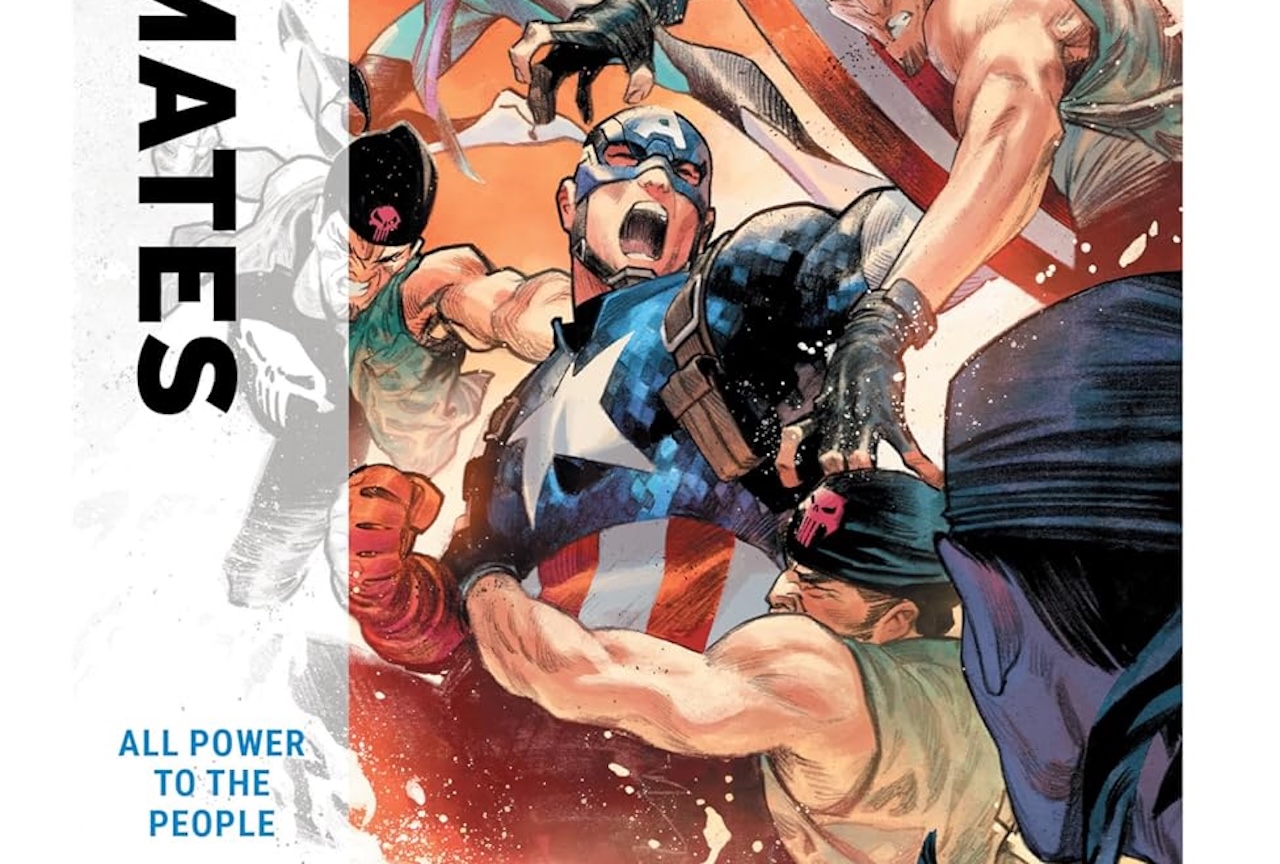

In my opinion, The Ultimates by Deniz Camp has been the best ongoing superhero comic since its debut in 2024. Camp’s work on this series has further cemented his status as one of the best – if not the very best – comic book writers working right now. It’s no wonder Marvel and Jonathan Hickman basically put the current Ultimate Universe in his hands. Combined with Juan Frigeri – one of the best artists working right now – The Ultimates by Deniz Camp Vol. 2: All Power to the People continues an epic series that displays the variety of what can be done with superhero comics.
This collection includes the one-shot Ultimate Universe: One Year In as well as issues #7-12 of the main series. Camp purposely made each issue a standalone story. Additionally, almost every issue is told in a different narrative style – often homages to great comic creators or classic series – obviously Camp’s creative influences. Amazingly, Camp excels in every style he takes on.

Courtesy of Marvel
Although the collection starts with Ultimate Universe: One Year In, I actually see The Ultimates #7 and #12 as the bookends to this arc. They most explicitly advance the main story involving the Ultimates’ campaign against the Maker and his evil Council. Issues #8-11 and Ultimate Universe: One Year In each introduce us to this universe’s versions of some well-known Marvel characters. But Camp also uses this ‘What if…?’ conceit to place poignant metaphors of important social topics into the story.
So, let’s see what we get.
Ultimate Universe: One Year In‘s art is provided by Jonas Scharf with colors by Mattia Iacono. It introduces us to this universe’s Nick Fury, the director of H.A.N.D. – this universe’s S.H.I.E.L.D. – the secret intelligence agency that enforces the Maker’s tyrannical rule. Camp very explicitly shows how such dictatorial regimes surveil their own citizens in order to seek out and eliminate those who could potentially pose a threat to their power. The comic is designed to summarize the state of the Ultimate Universe for anyone attempting to jump on. The main story follows Fury’s plan to betray and assassinate the Maker’s Council. Camp and Scharf throw in a lot of fun Easter eggs about the canon of this alternate universe. And the twist ending is both ominous and appropriate.
We then get into the main series with issue #7 – a quieter issue after the Ultimates team was so thoroughly defeated by the Hulk in the previous issue. Everyone’s trying to figure out where to go from here, which Camp uses to explore the characters more deeply and sow seeds of future plots. He also continues the theme of the oppressed rising up against oppressive regimes – America Chavez helps young protestors in a Latin American country and Hawkeye destroys a shipment of weapons headed for the war going on in the Ultimate Black Panther series.

Courtesy of Marvel
Issue #8 is by far my favorite of the collection, because Camp successfully channels the spirit of one of my favorite creators, Grant Morrison. The issue introduces the Guardians of the Galaxy of the far future in a crazy, almost irrationally creative, Morrison-esque cosmic epic. It’s so much fun to read – with so many wild ideas on each page, while also being deeply emotional and in-touch with the human experience. And it’s actually the origin story of the Ultimate America Chavez.
Moving on, guest artist Chris Allen draws issue #9 – all about this universe’s Luke Cage. Camp updates Cage’s origin story – which has always been about the wrongful imprisonment of minorities – to include all forms of systemic injustice in the prison system. Cage overthrows one prison after another, but not as a brutish, one-man army. Instead, Luke Cage is a caring intellectual able to organize his fellow prisoners through camaraderie and a shared philosophy.
Series artist, Juan Frigeri, returns in issue #10 – my second favorite of this collection – for a story reminiscent of Ed Brubaker’s Captain America run. In it, Captain America and the original Human Torch take a few other Ultimates to retrieve Namor’s body from the current Red Skull – who is the leader of a far-right, neo-Nazi cult. Camp expertly narrates the issue through the thoughts of the android Human Torch. In the best social commentary of the collection, Camp satirizes the real-world appropriation of the Punisher logo by far-right, white-supremacist groups. The sad but meaningful reveal at the end feels very appropriate both in context of the social metaphor as well as in the twisted world created by the Maker.

Courtesy of Marvel
Then, in a complete surprise, Camp and Frigeri tell the story of issue #11 completely in splash pages in the style of an ancient Norse myth – including rhyming, innuendo-filled, epic poetry as narration. We follow Thor and Sif as they travel through the Nine Realms that have been ruined by the evil and inept rule of Loki – whom the Maker helped gain power. Camp once again returns to the theme of the oppressed rising up to revolt against the tyrannical rule of an autocrat – but also manages to sneak in some commentary on propaganda and content-farming. I can’t help but again see the influence of Grant Morrison – this time from their work with Dan Mora, Klaus: The Life and Times of Joe Christmas – which was also told completely in splash pages.
If there is any downside to these wonderfully written, standalone issues, it’s that they tend to get away from the main story of the series. Camp tries to remedy this by throwing a page or two into each issue about the recovery of Tony Stark. But there isn’t really any progression to Iron Lad’s main plot. Still, with standalone issues as excellent as this collection, there really isn’t anything to complain about.
Camp does finally return to Iron Lad’s and the Ultimates’ plan to beat the Maker and his Council in issue #12. But it’s more of a summary issue, showing us how the past five issues led to where we are now, while talking about where it should go from here. There’s a bit too much exposition as everyone kind of just stands around the HQ, talking about what hasn’t been working and how they need to change things. But, Camp writes good exposition. Each character is distinct and complex, especially Doom. Issue #12 doesn’t have much action, but it wraps up this volume well while providing a definite direction for the next arc. The surprise last-page reveal also gets us anxious about what comes next.
If you haven’t been reading anything by Deniz Camp or Juan Frigeri, you should remedy that immediately. And if you enjoy an interesting alternate universe take on common Marvel superheroics filled with thought-provoking social metaphors, The Ultimates is a great place to do that. Obviously, you should start with volume 1. But even if you haven’t read that, Camp provides enough background for anyone to enjoy the mostly standalone stories collected in volume 2. Combined with Frigeri’s amazing art, The Ultimates by Deniz Camp Vol. 2: All Power to the People is a tour-de-force of the variety that a superhero comic can achieve.



You must be logged in to post a comment.