


“Comics are a visual narrative medium. The story only works if both sides are unified.”
That very philosophy guides Ariela Kristantina across her latest project, The Girl Who Draws on Whales. Serving as both writer and artist, Kristantina enthusiastically invites readers into a world inspired by her Indonesian heritage.
With colors by Sarah Stern, letters by Bernardo Brice, and edits by Will Dennis, the book is a lush, atmospheric YA adventure about a girl growing up “several centuries after ‘The Great Flood'” and her unique connection to whales. From there, Kristantina and company expertly blend Southeast Asian folklore with post-apocalyptic myth-making to tell a story that’s as intimate as it is expansive, and one rooted in sibling bonds, colonization, and the enduring power of storytelling.
AIPT spoke with Kristantina recently to delve deeper into the rich literary waters of this massively personal tale.
Some Lofty Aspirations
In some ways, The Girl Who Draws on Whales is a new challenge from the rather seasoned artist.
“It’s not actually the first comic I’ve both written and drawn, but it is the longest — and the first of this scale published in the States,” Kristantina said.
Despite that, its a book very much at the heart of her artistic philosophy, where writing and art are utterly inseparable. That unity sometimes meant tossing out entire sequences.
Kristantina admitted that she cut about five pages once she realize that, after drawing them, that they weren’t helping the story. Compared to her earlier collaborative work, including Adora and the Distance, this book felt more like “building a house alone — you can only curse at yourself when things don’t work out. But the flip side is that every part of it is exactly the story I wanted to tell.”

Courtesy of ComiXology.
A Story Rooted in Home
As mentioned, Kristantina’s approach to The Girl Who Draws on Whales stems from her roots. More specifically, it was about using key elements to achieve a novel outlook.
“As an Indonesian, it felt natural to pull from what I’ve grown up with and what’s around me,” she said. Folklore and wayang comics from her childhood became the backbone of a narrative she wanted to feel distinctly Southeast Asian rather than another Western-style dystopia.
Colonization, too, found its way into the story — not as a direct lesson, but as an unavoidable undercurrent.
“It’s not front and center, but if readers want to look deeper, it’s there — in the conflict, in the metaphors,” Kristantina said. “I aim to entertain, not making any kind of statement and (hopefully) the rest follows.”

Courtesy of ComiXology.
Whales as Guardians and Friends
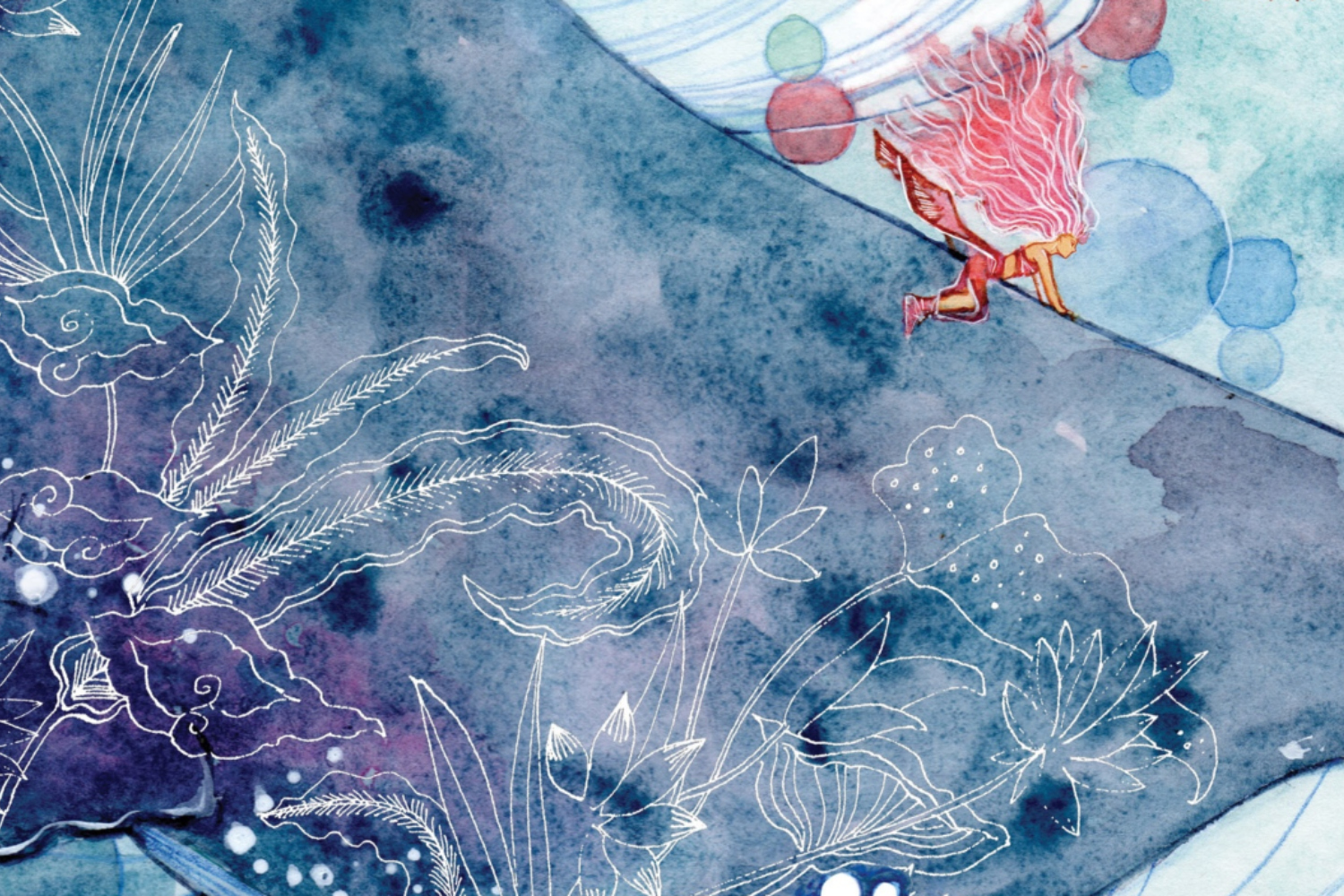
One of the book’s most striking images is the connection between the protagonist Wangi and her whales. The idea grew from a simple sketch Kristantina once made of a little girl and a whale floating together.
“What if the whale wasn’t just transportation, but also a friend? A guardian? A co-storyteller?” Kristantina said.
That sense of awe and intimacy became a guiding force.
“Nature is huge and overwhelming, but still deeply personal,” Kristantina said.
Siblinghood at the Core
The book also avoids the familiar “chosen one” arc by focusing on the messy, complicated bond between siblings Wangi and Banyu. Kristantina, who has a sister herself, drew directly from that experience.
“You fight, roll your eyes, don’t always ‘get’ each other… but when things fall apart, they’re the ones who show up,” Kristantina said.
For her, the heart of the story is survival through solidarity, not isolation.
“Wangi and Banyu survive because they lean on each other, not in spite of each other,” Kristantina said.
Citra, another key character, complicates that dynamic and reflects the idea that family extends beyond blood.
“It’s also the people you choose and who choose you back,” Kristantina said.


Stories Old and New
Though Kristantina didn’t do exhaustive academic research, she was fascinated by how flood myths surface across cultures — from Mesopotamia to Mesoamerica to Indonesia.
“They all talk about this giant flood, usually as divine punishment or part of some bigger cosmic reset,” Kristantina said. The universality of these myths felt strikingly relevant in today’s era of climate change and rising seas, grounding her fantastical setting in eerie plausibility.
Resistance and Storytelling
For all its mythic imagery and lush backdrops, Kristantina describes The Girl Who Draws on Whales as a story about trust, resistance, and believing in yourself.
“Sometimes, resistance isn’t about fighting the biggest battles,” Kristantina said. “Sometimes, it’s about holding onto what truly matters—whether that’s your beliefs or your family, whether they are the ones you’re born into or the ones you choose to find.”
In other words, the story balances scale with intimacy: huge whales and sweeping floods, but also deeply personal bonds.


And if She Could Draw on Anything…
Asked which creature she’d draw on if given the chance, Kristantina didn’t hesitate whatsoever: “Easy. A manta ray. They’re already like giant canvases. I’d probably doodle some abstract creature.”
Seems like an apt choice for The Girl Who Draws on Whales. It’s a book clearly about family, cultural legacy, and great change (among other things), but also very much about celebrating life with true joy and sense of unwavering intent.
You can purchase The Girl Who Draws on Whales starting September 23. Dark Horse Books will release a physical copy on March 31, 2026.



You must be logged in to post a comment.